
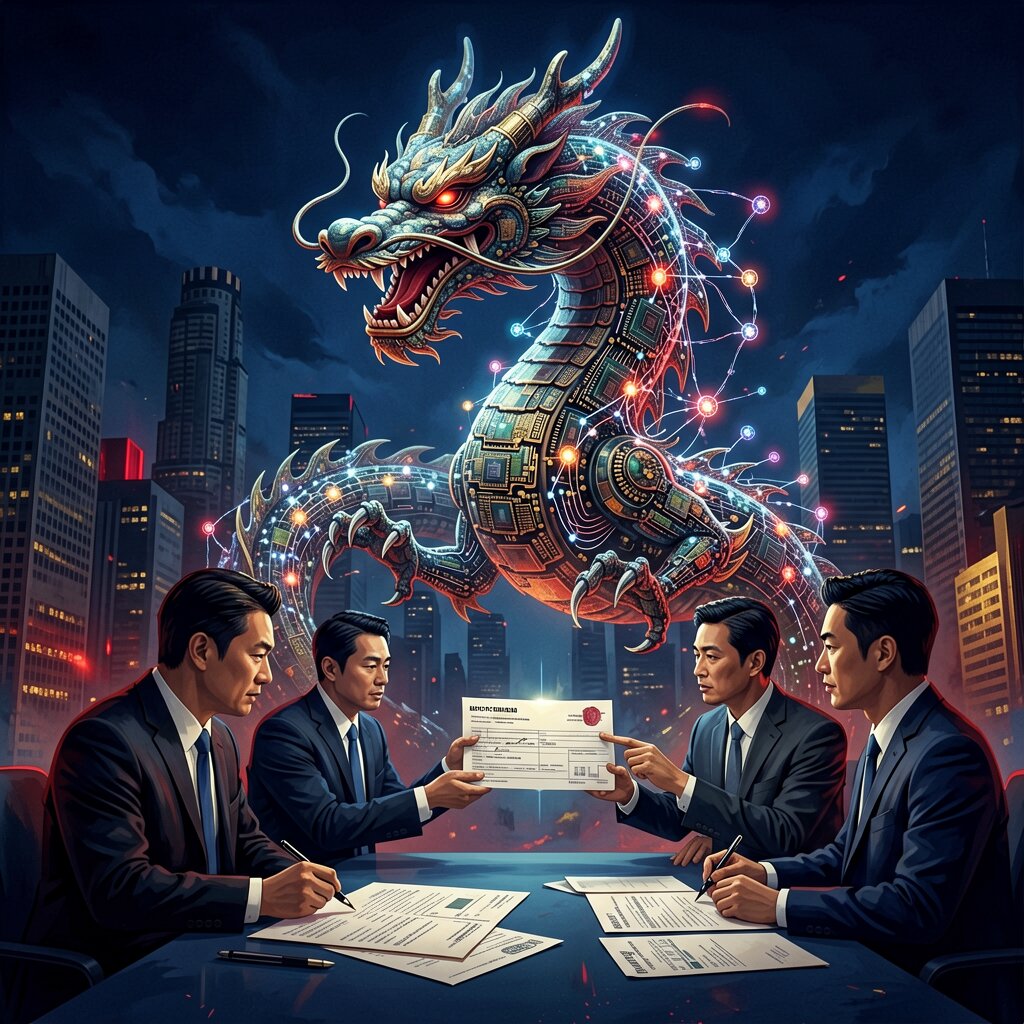
In June 2026, a Chinese AI company did something that would have been unthinkable just two years ago. DeepSeek — the Hangzhou-based startup that shocked the world in January 2025 by releasing a model that rivaled GPT-4 at a fraction of the cost — claimed the top spot on a major US business spending index. Not OpenAI. Not Anthropic. Not Google. DeepSeek.
According to data from Ramp Economics Lab, which tracks corporate software spending across thousands of American firms, DeepSeek overtook every Silicon Valley AI provider in June 2026 to become the most-purchased AI service by US businesses. The significance cannot be overstated. This is not about hobbyists downloading open-source weights. This is not about researchers running experiments on local GPUs. Ramp Economics Lab's analysis found that "US firms appeared to be making direct payments to DeepSeek, rather than only running DeepSeek's open-source models on their own infrastructure." American companies are wiring money to a Chinese AI lab. The geopolitical implications are seismic.
The Background: From Open-Source Sensation to Enterprise Vendor
DeepSeek's journey from academic curiosity to enterprise juggernaut has been remarkably fast. When the company released DeepSeek-V3 in late 2024 and R1 in January 2025, the initial reaction was shock at the technical achievement. The models matched or exceeded the performance of GPT-4 and Claude 3.5 on standard benchmarks, yet DeepSeek claimed to have trained them for roughly $6 million — a figure that OpenAI insiders privately dismissed as impossible until independent verification confirmed the architecture's efficiency.
The secret sauce was DeepSeek's radical approach to model architecture. The company employed a Mixture-of-Experts (MoE) design with 671 billion total parameters but only 37 billion active per token, dramatically reducing inference costs. Combined with FP8 training precision and a custom-built training framework optimized for Nvidia's H800 chips (the export-controlled variant available to Chinese firms), DeepSeek achieved what industry analysts now estimate as roughly 10x cost reduction compared to American models of equivalent capability.
At first, US enterprise adoption was cautious and indirect. Companies downloaded the open-source weights, ran them on their own infrastructure, and enjoyed the cost savings without the geopolitical baggage of sending money to China. That phase is ending. Ramp Economics Lab's data shows a clear inflection point in early 2026, when US firms began making direct API payments to DeepSeek for hosted inference services. The convenience of managed APIs, combined with pricing so aggressive that it makes American competitors look predatory, has overcome the political hesitation.
The Numbers: A Cost Gap That Defies Competition
The pricing differential is genuinely staggering. DeepSeek's API pricing for its R1 reasoning model is approximately $0.14 per million input tokens and $0.28 per million output tokens. For comparison, OpenAI's o1 reasoning model costs roughly $15 per million input tokens and $60 per million output tokens. Anthropic's Claude 3.5 Sonnet runs around $3 per million input tokens and $15 per million output tokens. Even Google's Gemini 1.5 Pro, positioned as the budget option among American providers, costs roughly $3.50 per million input tokens.
These are not minor differences. They are order-of-magnitude gaps. For a mid-sized software company processing 100 million tokens per day, the annual cost difference between DeepSeek and OpenAI exceeds $2 million. For a financial services firm running complex document analysis across millions of PDFs, the savings can reach eight figures annually. In an era where every CFO is scrutinizing AI budgets and demanding ROI proof, these numbers are politically irresistible.
The enterprise adoption is not limited to a single sector. Ramp Economics Lab's data shows DeepSeek penetration across software development, financial services, healthcare, and manufacturing. Software companies use DeepSeek for code generation and review. Financial firms deploy it for document analysis and risk modeling. Healthcare organizations leverage it for medical literature synthesis and clinical note processing. Manufacturers apply it for supply chain optimization and predictive maintenance. The pattern is consistent: wherever a company was paying premium prices for American AI inference, DeepSeek is now undercutting by 80-95%.
The Funding Frenzy: DeepSeek's $7 Billion Moment
The market is validating this enterprise momentum with capital. DeepSeek is reportedly nearing a $7 billion funding round that would value the company among the most valuable AI startups globally. The investor roster reads like a who's-who of Chinese tech and global capital: Tencent, CATL, IDG Capital, and Monolith are among the named participants, with sovereign wealth funds from the Middle East also reportedly circling.
This funding round matters beyond the headline valuation. It signals that DeepSeek is transitioning from a research lab to a full-stack enterprise vendor. The capital will fund expanded inference infrastructure, global data center expansion, enterprise sales teams, and compliance certifications that American procurement departments require. DeepSeek is no longer just a model provider. It is building the enterprise machine to compete directly with OpenAI's and Anthropic's go-to-market operations.
The timing is not accidental. DeepSeek's funding push coincides with its peak enterprise adoption moment. The company is capitalizing on its cost advantage while it lasts, knowing that American competitors will eventually respond with price cuts or efficiency improvements. The $7 billion round is a land-grab investment — capture as much enterprise market share as possible before the gap narrows.
What It Means: The End of the AI Premium
The DeepSeek phenomenon represents something larger than a single company's success. It marks the end of the AI premium era — the period when American AI labs could charge monopoly prices for frontier models because no viable alternatives existed. That period is over. DeepSeek proved that comparable intelligence can be produced at commodity prices, and the market is responding accordingly.
For Silicon Valley, this is an existential challenge. OpenAI, Anthropic, and Google have built their business models on the assumption that frontier AI would remain scarce and expensive for years. Their pricing, their burn rates, their $100 billion data center plans, and their $200 billion valuations all depend on maintaining that scarcity. DeepSeek is destroying the scarcity narrative with every API call.
The response from American AI labs has been predictable but insufficient. OpenAI has accelerated its "o-series" reasoning models and hinted at price reductions, but its cost structure — built on massive training clusters and premium Nvidia chips — limits how far it can cut. Anthropic has emphasized safety and reliability as differentiators, but enterprise buyers increasingly view these as table stakes rather than premium features. Google has the most room to compete on price given its vertical integration, but its enterprise AI sales motion remains sluggish compared to the startup disruptors.
The geopolitical dimension adds complexity that pure market analysis cannot capture. The US government has spent years building a narrative of American AI supremacy, using export controls on advanced chips to slow Chinese AI development. DeepSeek's success — achieved with restricted hardware and under sanctions pressure — directly undermines that narrative. If Chinese AI is not just competitive but dramatically cheaper, the strategic logic of containment becomes harder to sell to American businesses who see their AI budgets bleeding.
This tension is already generating policy responses. Congressional voices are calling for expanded AI subsidies for American labs to help them compete on price, effectively acknowledging that market forces alone cannot preserve US leadership. More aggressively, some lawmakers are proposing tariffs on Chinese AI services — a digital equivalent of the trade war tactics applied to physical goods. The irony is palpable: the country that invented the internet and championed free trade in digital services is now contemplating protectionism for its own AI industry.
🔥 Hot Takes
1. The "US AI superiority" narrative is dead, and DeepSeek killed it with a spreadsheet. For years, Washington and Silicon Valley sold the story that American AI was categorically superior — safer, smarter, more advanced. That story worked until CFOs started comparing API bills. DeepSeek didn't win on ideology. It won on unit economics. When a Chinese model delivers equivalent performance at 5% of the cost, the superiority narrative collapses under the weight of procurement data. The new reality: American AI is premium-priced mediocrity, and enterprise buyers are done paying the brand tax.
2. OpenAI's $200 billion valuation is built on a pricing fantasy that DeepSeek just vaporized. Sam Altman convinced investors that frontier AI would be a scarce, high-margin resource for a decade. The entire OpenAI investment thesis depends on maintaining pricing power that DeepSeek is systematically destroying. If US enterprise customers continue migrating to Chinese alternatives at current rates, OpenAI will face a choice between slashing prices (and destroying margins) or losing market share (and destroying growth). Neither path supports the current valuation. The correction is coming, and it will be brutal.
3. Tariffs on AI services will backfire catastrophically and accelerate the very dependence they seek to prevent. The protectionist playbook — subsidize domestic, tax foreign — works for physical goods where domestic alternatives exist. AI is different. American labs cannot meet current enterprise demand at competitive prices, and tariffs will not change that overnight. What tariffs will do is force US companies to build more sophisticated workarounds: routing through third-country subsidiaries, licensing open-source weights through shell entities, or simply accelerating their migration to fully on-premise Chinese models. The result is not less Chinese AI dependence. It is more expensive, more complicated, and more politically embarrassing dependence.
4. DeepSeek's $7 billion funding round is the beginning of a Chinese AI colonialism that the West is unprepared to resist. With Tencent, CATL, and sovereign capital backing its expansion, DeepSeek is not merely a model provider. It is becoming an AI infrastructure layer that American enterprises will build upon. Every API call, every fine-tuned deployment, every integration into business workflows deepens the dependency. The West spent decades decrying Chinese state capitalism while building its own digital infrastructure on American platforms. Now the reverse is happening in AI, and there is no regulatory framework or industrial policy ready to address it.
The Bottom Line
DeepSeek's ascension to the top of US business spending indexes is not a fluke. It is the market speaking clearly: when comparable intelligence is available at a fraction of the cost, geopolitical concerns are secondary to economic survival. American companies are not betraying their country. They are responding to the same cost pressures that have driven outsourcing, offshoring, and supply chain globalization for decades.
The question is not whether DeepSeek will continue to gain enterprise share. It will. The question is whether American AI labs can adapt their cost structures fast enough to remain competitive, and whether Washington can craft a policy response that helps rather than hinders. Subsidies may help. Tariffs will not. The only sustainable answer is building American AI that matches DeepSeek's efficiency — and doing it before the dependency becomes irreversible.
For now, the checks are clearing, the API calls are routing to Hangzhou, and Silicon Valley is learning a hard lesson about pricing power in the age of open intelligence. DeepSeek did not just build a better model. It built a better business model. And American enterprises are voting with their wallets.