
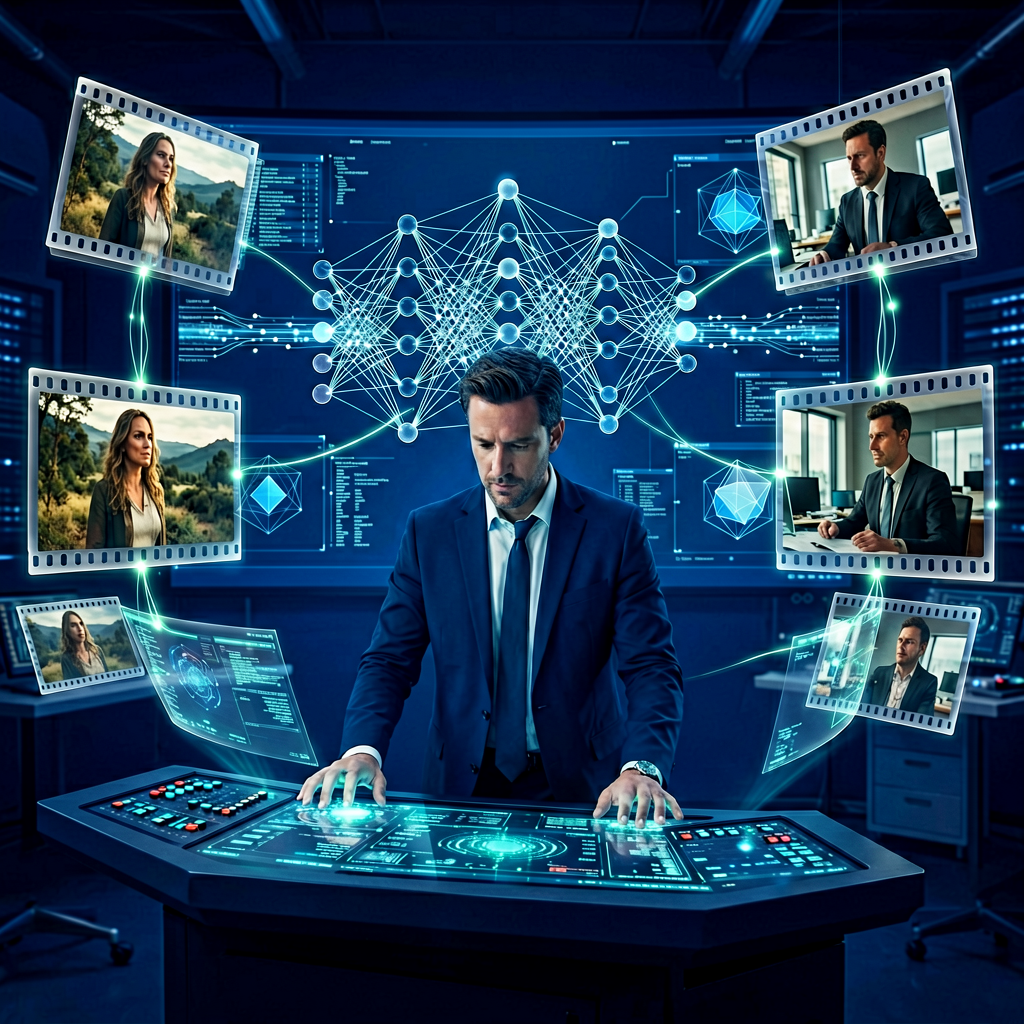
Netflix is done pretending. On its latest earnings call, Co-CEO Ted Sarandos said the company is now using AI in about 300 productions, mostly in post-production. That is not a pilot program. That is not a research lab. That is the world’s largest streaming studio baking generative tools into its assembly line — from concept development and previsualization to final delivery. The AI entertainment era is not coming. It is already here, and Netflix is the first major player willing to say it out loud.
The headline number is striking enough, but the specific example is more revealing. Netflix’s docuseries The American Experiment includes 17 minutes of AI-assisted footage that was produced, according to Sarandos, twice as fast and at half the cost of conventional methods. The technology was used to expand crowd scenes and historical battle sequences that, without it, would probably have been trimmed or cut entirely for budget reasons. In other words, AI did not replace the artists; it rescued shots that finance would have killed.
Sarandos was careful to frame the shift as additive. Netflix’s $20 billion content budget is not shrinking, he said, and any savings will likely be reinvested into more programming. “It takes great artists to make something great, and AI is not changing that,” he told investors. “AI will give creatives better tools to bring their visions to life.” That is the official line. It is also exactly the kind of line that makes Hollywood unions nervous, because the last time studios promised new technology would “empower” workers, the workers ended up editing reality shows for half the pay.
From Post-Production to Pipeline
Netflix’s AI footprint is broader than a few generative flourishes. The company is building a stack. Its Interpositive unit is developing AI tools for post-production and visual effects. Its Eyeline platform is merging VFX and virtual production. It runs an in-house animation lab. The goal is not to buy AI tools from OpenAI or Adobe and hope for the best; it is to own the workflow itself. That is the difference between dabbling and industrializing.
And the industrialization is moving fast. AI is already used for localization, dubbing, trailer generation, thumbnail optimization, and recommendation algorithms. The 300-production figure simply pulls the curtain back on the creative side. For a studio that releases hundreds of films and series a year, 300 is not a toe in the water; it is a decisive step into the deep end. Competitors are either following or pretending not to notice.
Hollywood’s “Don’t Ask, Don’t Tell” Policy
The creative backlash has been loud and predictable. Writers and actors spent months on strike over AI language. Studios signed agreements promising guardrails. Since then, the public conversation has been dominated by a kind of ritualized denial: AI is a tool, not a replacement; humans remain in the loop; the soul of storytelling is safe. Behind the scenes, the story is different.
Joel Kuwahara, a producer on The Simpsons, described the industry’s current attitude as “don’t ask, don’t tell.” Many studios are quietly using Chinese video models like ByteDance’s Seedance and other generative tools on projects while publicly decrying the same technology. The contradiction is not hypocrisy exactly; it is panic. No one wants to be the first major studio to admit they are using AI, but no one wants to be the last to reap the cost savings either.
Netflix has now removed that option. By putting a number on the board, it has made silence look like dishonesty. Every other studio will have to decide whether to match the disclosure or keep pretending their production pipeline is somehow AI-free while their competitors cut costs.
The Global Angle: China Wants the Crown
There is a geopolitical dimension that American coverage often misses. While Hollywood is still debating whether AI should be allowed in the writers’ room, Chinese companies are racing to own the underlying video models. ByteDance’s Seedance has become so good at mimicking Disney-style characters that the company itself has called it a “virtual smash-and-grab.” Hollywood wants it banned. Hollywood also wants to keep using it. That is not a policy position; it is a hostage situation.
Kling AI, backed by Tencent, recently raised $3 billion at an $18 billion valuation to build world-class AI video generation. Chinese regulators have forced consumer AI agent features offline, but they are clearly betting on generative video as a strategic industry. The implication is obvious: if the next generation of filmmaking tools is built in Shenzhen and Hangzhou, the next generation of films will be shaped by those tools, even when the studios are in Los Angeles.
This is AI nationalism in its entertainment form. The United States and China are not just racing for chips and large language models; they are racing for the visual grammar of global culture. Netflix has scale and distribution, but it does not control the foundational models. That matters, because the company that controls the model can eventually dictate the workflow, the pricing, and the standards.
What It Means for the Rest of the World
Outside the Hollywood bubble, the implications are more practical and potentially more radical. For producers in Nigeria, India, Brazil, and Southeast Asia, cheaper AI production tools lower the cost of making content that looks expensive. That could accelerate the long-predicted shift away from American cultural dominance. A streaming service in Jakarta or Lagos can now produce genre content with crowd scenes and VFX that would previously have required a Hollywood budget.
At the same time, the risk of homogenization is real. If everyone is using the same small set of generative models, films everywhere may start to look and feel similar. The “Netflix look” has already been criticized for flattening cinematography. A generative pipeline could make that flattening faster and cheaper. The danger is not that AI will destroy creativity; it is that it will standardize it.
Europe’s role is likely to be regulatory and artistic. The EU AI Act is already probing copyright, transparency, and training data for generative models. European public broadcasters and indie producers may position themselves as the “human-made” alternative to AI-heavy American and Chinese content. Whether that becomes a premium niche or a death sentence depends on whether audiences can actually tell the difference — or care.
🔥 Hot Takes
1. The WGA strike bought creatives a few clauses, not a future. The 2023 strikes forced studios to acknowledge AI on paper, but they did not stop the technology. Netflix’s 300-production rollout proves that the floor of the industry is already being automated. The next fight will not be about whether AI is allowed; it will be about who gets paid when a background extra is replaced by a prompt.
2. China’s video models are the real monopoly threat, not Netflix’s in-house tools. American politicians love to attack Hollywood for “going woke” or “cutting costs.” They should be more worried about Chinese models eating the production stack from below. If Seedance and Kling become the default tools for cheap, high-quality video, Hollywood will find itself dependent on the same Chinese technology it is trying to ban.
3. The “savings will fund more content” promise is mostly PR. Netflix says its $20 billion budget is safe, and the savings from AI will go toward more programming. Maybe. But the more realistic scenario is that some of those savings flow to margins and shareholders, while the rest fund a faster content treadmill. The real test is not what Sarandos says on an earnings call; it is what the budget looks like in three years.
The Bottom Line
Netflix has turned the entertainment industry’s AI conversation from a whisper into a spreadsheet. Three hundred productions is a number that cannot be un-said. It forces every rival studio to either disclose their own AI use or look like they are hiding something. It forces unions to move beyond moral objections and toward concrete bargaining over AI-generated work. And it forces governments to decide whether AI-generated content is a trade, a technology, or a cultural product.
The most important lesson is not that AI is replacing artists. It is that AI is becoming the infrastructure of the entire industry, from the cheapest unscripted show to the biggest spectacle. The companies that control that infrastructure — whether they are in Los Gatos, Shenzhen, or Brussels — will shape what the world watches next. Everyone else is just performing in their studio.