
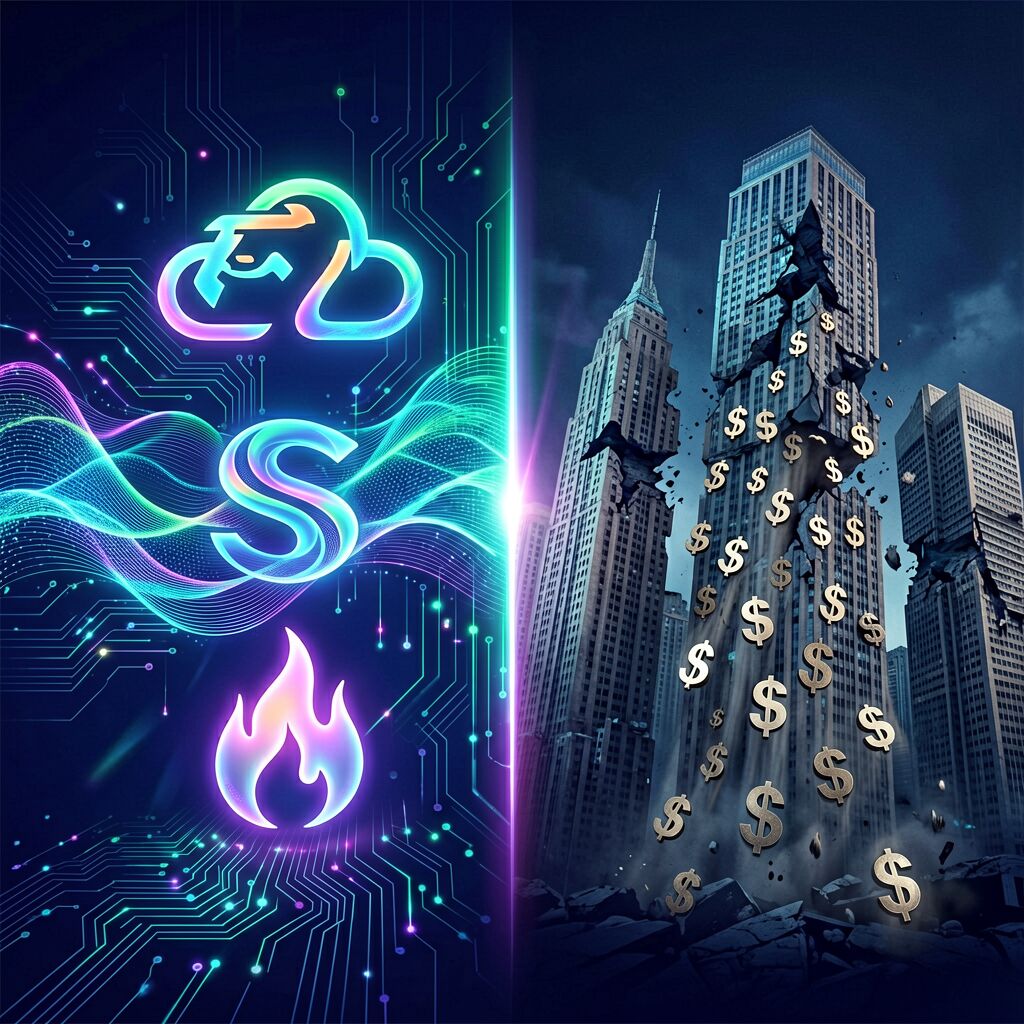
The AI arms race reached a new fever pitch this week as Chinese model developers launched a coordinated pincer movement on American dominance, combining cutting-edge open-weight releases with pricing that makes Anthropic and OpenAI look like luxury brands.
On Monday, Alibaba unveiled Qwen 3.8-Max, a 2.4 trillion-parameter multi-modal mixture-of-experts model that benchmarks within striking distance of Anthropic's Claude Sonnet 5 and OpenAI's GPT-5.6 Luna. Just days earlier, DeepSeek dropped V4 Flash — a 284 billion-parameter model that outperforms its own 1.6 trillion-parameter V4 Pro variant while costing 40% less per task than GPT-5.6 Luna.
The message is clear: Chinese open-weight models are no longer inferior copies. They are competitive, sometimes superior, and always cheaper.
The Numbers Don't Lie
Let's look at what's actually being sold here. Qwen 3.8-Max is priced at $2 per million input tokens and $6 per million output tokens on Alibaba's QwenCloud API. Compare that to Claude Sonnet 5 at $2/M input and $10/M output — with prices set to jump 50% on September 1st. GPT-5.6 Luna undercuts on input at $0.20/M but charges $1.20/M output for short contexts, doubling for longer ones.
But pricing alone doesn't tell the full story. DeepSeek V4 Flash is where the real disruption lives. At $0.14/M input, $0.0028/M cached, and $0.28/M output, it's not just cheaper per token — it's 40% less expensive to solve tasks than GPT-5.6 Luna. Three cents versus five cents per task may sound trivial, but for developers running millions of tokens daily through agentic workflows, that difference compounds fast.
DeepSeek achieved this efficiency through DSpark speculative decoding baked directly into the model weights. A smaller draft model predicts the outputs of the larger one, and when it guesses wrong, the base model corrects it. The result is lossless speed: DeepSeek claims 57–85% more tokens per second on identical hardware. Independent testing on a $4,699 NVIDIA DGX Spark confirmed the model runs at 128,000-token context windows with acceptable quality loss.
Anthropic's Safety Theater
Of course, the American incumbents are not taking this lying down. Anthropic CEO Dario Amodei recently published a blog post insisting he's not opposed to open models — just ones made in China, ones distilled from proprietary models, and ones that don't meet his company's self-defined safety metrics. In plain English: any open model that actually competes with Anthropic's offerings.
This is fearmongering dressed as responsible governance. Proprietary models can be walled off, rate-limited, and monitored. Open weights, once released, cannot be recalled. The very thing that makes open models dangerous to incumbent business models — their unrestricted availability — is the same thing that makes them powerful for the rest of the world.
Amodei's posture has clearly reached Washington. He has been active in stoking governmental fears about Chinese AI, pushing for restrictions that would effectively ban the only credible open-weight alternatives to US proprietary models. The irony is palpable: Anthropic is simultaneously calling for open model restrictions while preparing to launch proprietary models at prices that make them inaccessible to most enterprises outside Silicon Valley.
The Hugging Face CEO's Honest Assessment
Not everyone is buying the fear narrative. Clément Delangue, CEO of Hugging Face, was blunt in a CNBC interview this week. "They're clearly dominating on open models right now, and I wouldn't be surprised if they start dominating at the frontier either by the end of this year or next year at the rate of progress," he said.
The data supports him. America's most capable open-weight model, Inkling from former OpenAI CTO, sits at under a billion parameters — a fraction of DeepSeek's 284 billion and nowhere near matching its performance. Meanwhile, Moonshot's Kimi K3 and Z.ai's GLM 5.2 operate in a completely different performance tier than anything American open-weight models have produced.
The trend line is unmistakable. Chinese labs are publishing frontier-class models on open weights at a pace that American labs simply cannot match. Moonshot, Alibaba, DeepSeek, MiniMax, and Z.ai are all racing simultaneously, each bringing a different specialization to the table. When they share benchmarks and iterate openly, the entire ecosystem accelerates.
What This Means for Enterprises
For companies that have been forced to choose between proprietary US models with questionable data policies and inferior open alternatives, the calculus has shifted dramatically. Chinese open-weight models now offer a credible path to deploying frontier-class AI without surrendering data to American cloud providers or accepting unpredictable price hikes.
Qwen 3.8-Max's 1 million token context window and MoE architecture mean it can handle complex, long-horizon tasks that previously required expensive proprietary APIs. The 27 billion parameter variant ensures smaller organizations aren't left behind. And with weights landing on Hugging Face next week, the entire open-source community gets to fine-tune, customize, and improve upon them.
The enterprise imperative is straightforward: if your security policy requires you to send data through an American API, you're accepting that your data is being processed, potentially logged, and used to train competing models. Chinese open weights eliminate that dependency entirely.
🔥 Hot Takes
1. The open-weight arms race is already won by China. While American labs debate whether to release weights at all, Chinese labs are releasing frontier models weekly. By the time American open-weight models reach parity, Chinese models will have moved on to the next breakthrough. The gap isn't closing — it's widening.
2. Anthropic's safety arguments are a pricing strategy in disguise. When your model costs 5x more than a competitor's and you start lobbying governments to restrict the cheaper alternative, something other than safety is driving your posture. Call it what it is: industrial policy wearing a compliance costume.
3. The "sovereign AI" narrative is being written in Beijing, not Brussels or Washington. Every country wants AI autonomy, but China is the only one building it at scale and distributing it openly. Open weights are the ultimate soft power tool — they make Chinese AI infrastructure the default choice for the Global South, Europe, and eventually American enterprises looking for alternatives.
The Bottom Line
The AI open-weight revolution is no longer a promise. It's happening right now, and China is leading it. Alibaba's Qwen 3.8-Max and DeepSeek's V4 Flash represent a coordinated assault on American proprietary dominance that combines superior efficiency, lower costs, and unrestricted availability. American labs can complain about safety all they want, but the market is voting with its tokens.
For developers, enterprises, and governments seeking true AI sovereignty, the choice is becoming clearer by the day: accept the rising costs and data risks of American proprietary models, or embrace the open-weight frontier that China is building at scale.