
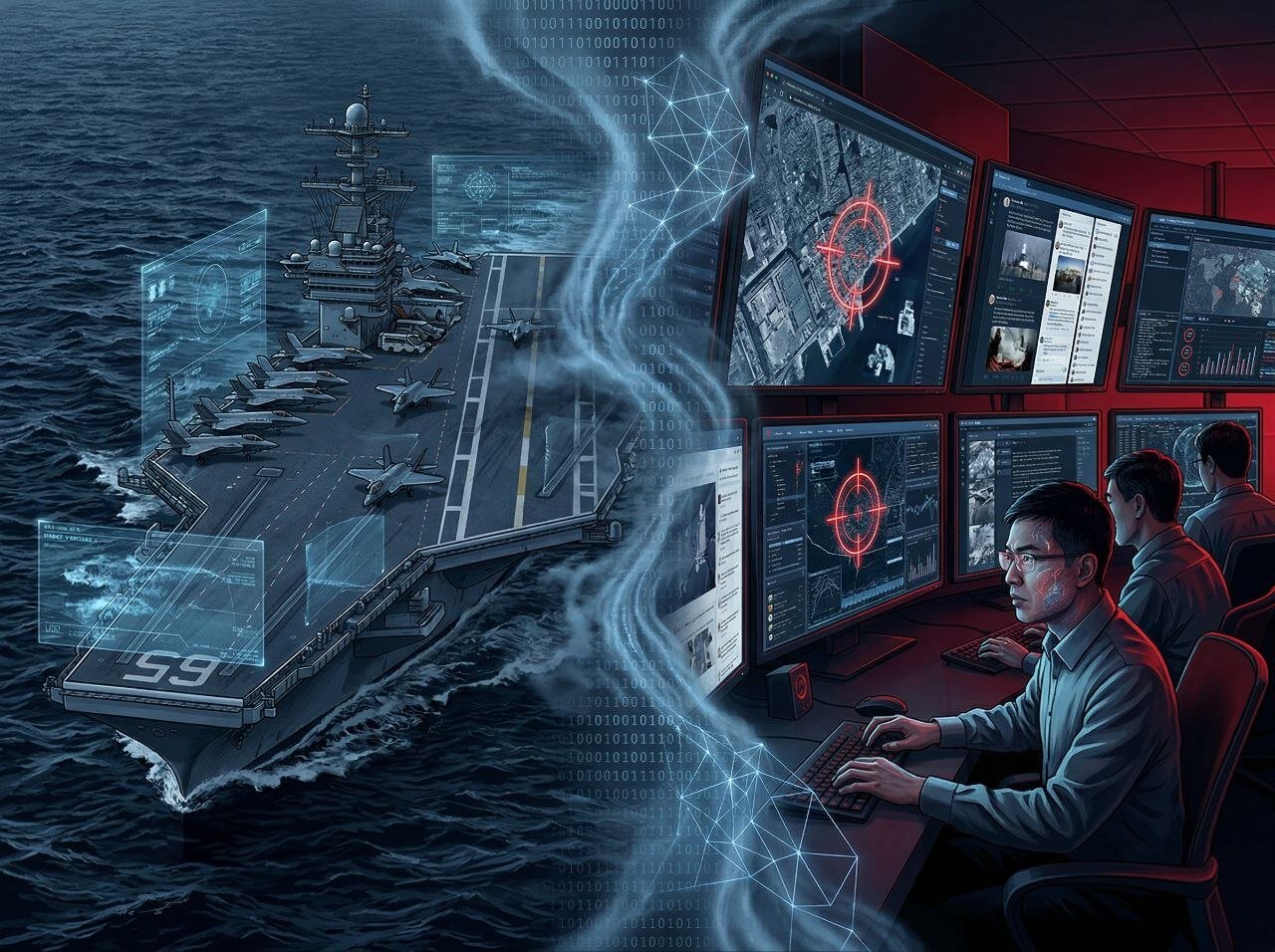
On April 4, 2026, as American F-15s assembled for strikes on Tehran, something unprecedented was happening on Chinese social media. Not propaganda. Not state-sponsored disinformation. Something far more precise and potentially far more dangerous: detailed, AI-generated intelligence reports exposing the exact locations of US military assets, the composition of carrier strike groups, and granular breakdowns of how American forces were preparing for war.
And it wasn't coming from China's military intelligence services. It was coming from commercial AI companies selling their analysis as a product.
A Washington Post investigation published Saturday morning reveals that as the Iran conflict erupted five weeks ago, Chinese tech firms began aggressively marketing AI-powered intelligence "exposing" US military operations. Using machine learning models trained on satellite imagery, social media posts, flight tracking data, and open-source signals, these companies have created a cottage industry of real-time military intelligence that blurs the line between commercial analytics and espionage.
The implications are staggering. For the first time in modern warfare, private companies in a potential adversary nation are systematically harvesting open-source data, processing it through AI systems, and distributing granular intelligence on US military operations — not through classified channels, but through public social media platforms where anyone with an internet connection can access it.
This isn't cyber warfare in the traditional sense. There's no hacking, no stolen classified documents, no penetration of secure networks. It's something newer and in some ways more insidious: the industrialization of open-source intelligence using AI, conducted by private actors operating in legal gray zones that existing international law never contemplated.
What These Companies Are Actually Doing
According to the Washington Post investigation, Chinese AI firms have been flooding social media platforms with viral posts containing extraordinarily detailed information about US military operations related to the Iran conflict. The content includes:
Equipment inventories at US bases: AI-analyzed satellite imagery identifying specific aircraft types, quantities, and deployment patterns at American installations across the Middle East. Posts detail how many F-35s are stationed at Al Dhafra Air Base in the UAE, how many B-52s are rotating through Diego Garcia, what munitions are visible in satellite photos of hangars.
Carrier strike group movements: Real-time tracking of US naval assets using a combination of automatic identification system (AIS) data, satellite imagery, and social media geolocation. Chinese AI systems are correlating ship positions with flight deck activity visible in commercial satellite photos to determine operational status — which carriers are launching sorties, which are in maintenance, which are preparing for deployment.
Strike preparation analysis: Machine learning models analyzing patterns in military aircraft assembly, fuel truck movements, and munitions loading visible in open-source imagery to predict imminent operations. Chinese AI firms are literally forecasting US strikes before they happen — and publishing those forecasts on social media.
Personnel and unit identification: Facial recognition systems matching social media posts from service members to specific units and locations, creating databases of who is deployed where. When a Marine posts a photo from a base in Qatar, Chinese AI systems can identify the unit, estimate the deployment size, and correlate it with other open-source data to assess force posture.
The sophistication is remarkable. These aren't hobbyist OSINT (open-source intelligence) analysts posting on Twitter. These are companies with dedicated AI infrastructure, professional analysts, and business models built around selling intelligence products. Some operate behind paywalls. Others offer tiered subscriptions. A few appear to be feeding their analysis directly to Chinese state media, which amplifies the most sensational findings.
The Technology Behind the Operation
What makes this development so significant is how these Chinese firms are combining multiple AI technologies to create intelligence products that would have required nation-state resources just a few years ago.
Computer vision on satellite imagery: Machine learning models trained to identify specific military equipment — aircraft types, vehicle models, weapons systems — in commercial satellite photos. These systems can count aircraft on a flight deck, identify munitions being loaded, and detect maintenance activity from changes in thermal signatures.
Natural language processing on social media:>Advanced language models analyzing millions of social media posts, forum discussions, and chat messages to extract location data, unit information, and operational details. When a pilot's spouse mentions a "deployment" on Facebook, Chinese AI systems flag it, correlate it with other data, and add it to their intelligence picture.
Predictive analytics: Machine learning models trained on historical patterns to forecast military operations. By analyzing years of data on how US forces prepare for strikes — fuel consumption patterns, aircraft maintenance schedules, communications traffic — these systems can identify the signatures of imminent action.
Multi-source correlation: The real magic is in how these systems combine disparate data sources. A ship position from AIS data + flight deck activity from satellite imagery + personnel posts from social media + fuel delivery records from port authority documents = a comprehensive operational picture that rivals classified intelligence assessments.
The companies operating these systems are reportedly using some of China's most advanced AI models — including versions of Baidu's ERNIE, Alibaba's Qwen, and open-source models fine-tuned specifically for intelligence analysis. They're running on Chinese cloud infrastructure, using Chinese satellite data, and employing Chinese analysts who specialize in US military operations.
And here's the kicker: most of this is legal. They're using commercial satellite imagery anyone can buy. They're scraping public social media posts. They're analyzing unencrypted AIS signals. They're not hacking anything. They've simply found a way to turn open-source data into actionable intelligence at scale using AI — and they're monetizing it.
The Business Model of War Intelligence
Perhaps the most disturbing aspect of this phenomenon is that it's being treated as a commercial opportunity, not a national security operation. The Washington Post investigation identifies several Chinese firms operating in this space with clear profit motives:
Subscription services: Companies offering tiered access to their intelligence databases, with premium subscribers getting real-time alerts, detailed analysis reports, and predictive forecasts. Prices range from a few hundred yuan for basic access to thousands for professional intelligence packages.
Custom analysis: Firms offering bespoke intelligence reports for specific clients — tracking particular units, monitoring specific bases, or forecasting operations in defined geographic areas. This appears to be particularly popular with Chinese state-owned enterprises operating in the Middle East who want advance warning of potential disruptions.
Media partnerships: Some AI intelligence firms have established relationships with Chinese state media, providing analysis that gets amplified through official channels. When an AI firm identifies an "exposed" US position, state media outlets like CGTN and Global Times ensure it reaches millions.
Data sales: Companies selling raw datasets — geolocation correlations, facial recognition matches, equipment inventories — to other firms who build their own analysis on top. This has created an ecosystem of intelligence products all feeding off the same AI-processed data.
The commercial nature matters because it suggests this isn't a coordinated Chinese government campaign. It's market-driven. Private companies identified a demand for US military intelligence, developed AI tools to meet that demand, and are now competing to provide the most accurate, most timely analysis. The profit motive is driving innovation in surveillance technology aimed at American forces.
But that also makes it harder to stop. You can't negotiate with a market. You can't deter private companies with sanctions if their business model is profitable enough. And you can't easily distinguish between "legitimate" commercial analysis and intelligence gathering when the underlying technology is the same.
Why This Matters for US Operations
The immediate operational impact of this Chinese AI intelligence operation is significant and growing. US military planners now have to assume that:
Movements are tracked in real-time: When a carrier strike group changes position, when aircraft deploy to forward bases, when munitions are loaded — Chinese AI systems are detecting and publicizing these activities within hours, sometimes minutes.
Operational patterns are analyzed: Years of historical data on US operations have been fed into machine learning models that can identify signatures of imminent strikes. When US forces begin preparing for action, these systems recognize the patterns and sound alarms.
Social media is a vulnerability: Every post by a service member, every photo from a deployed unit, every update from a family member is being harvested, analyzed, and integrated into intelligence products. The US military has been warning about social media OPSEC for years; Chinese AI firms have automated the exploitation of those violations.
Predictions are getting better: As these AI systems accumulate more data and refine their models, their ability to forecast US operations will improve. What they're publishing today is impressive; what they'll be capable of in a year is concerning.
The second-order effects may be even more significant. When adversaries know US positions and movements with high confidence, they can:
- Time operations to exploit gaps in US coverage - Position forces to maximize deterrence - Prepare defenses before strikes arrive - Shape information environments to counter US narratives - Hold US assets at risk with precision
Iranian forces, or their proxies, now have access to intelligence on US operations that would have required a robust human intelligence network or sophisticated signals intelligence capabilities in previous eras. Today, they can subscribe to it.
The Legal and Policy Vacuum
Here's where this gets really complicated: there's no clear framework for addressing this type of activity under international law or existing arms control regimes.
These Chinese firms aren't hacking US systems — they're analyzing publicly available data. They're not stealing classified information — they're processing open-source intelligence at scale. They're not state actors — they're private companies operating in a commercial market.
Traditional espionage laws don't apply. The data they're using is public. The analysis they're conducting is, in many jurisdictions, protected speech or legitimate commercial activity. You can't indict a company for looking at satellite photos and publishing what they see.
Sanctions are difficult to implement effectively. Many of these firms operate through complex corporate structures, use cryptocurrency for payments, and distribute their products through platforms that are hard to control. Even if the US could identify specific companies to sanction, the technology is easily replicated. Shut down one firm and three more pop up.
Diplomatic protests ring hollow. What exactly would the US demand? That China stop its citizens from looking at publicly available information? That would be both unenforceable and hypocritical given US intelligence agencies' own open-source collection activities.
The reality is that the international community never contemplated a world where private companies could use AI to generate intelligence products rivaling nation-state capabilities. The laws, treaties, and norms that govern espionage and information warfare were designed for a different era — an era where only governments had the resources to conduct systematic intelligence collection.
That era is over.
🔥 Our Hot Take
The Washington Post's revelation about Chinese AI firms marketing Iran war intelligence isn't just a story about a specific conflict or a specific set of companies. It's a window into the future of warfare — a future where the most significant intelligence advantage may not belong to nations with the biggest budgets or the most advanced satellites, but to whoever can best deploy AI to process open-source information at scale.
What we're witnessing is the democratization of intelligence. AI has lowered the barrier to entry for surveillance and analysis so dramatically that private companies can now do what previously required nation-state resources. And they're not just doing it — they're selling it as a service.
This should terrify US military planners because it represents a fundamental shift in the information environment. For decades, America has enjoyed an intelligence advantage rooted in superior technology and massive budgets. But if Chinese AI firms can generate comparable intelligence using commercial data and machine learning, that advantage erodes.
Worse, this is a problem with no easy solution. You can't put the AI genie back in the bottle. You can't make satellite imagery secret again. You can't stop people from posting on social media. And you can't prevent companies from using publicly available data to generate analysis — that's basically the definition of free speech and free markets.
The US response so far has been inadequate. Social media OPSEC briefings aren't working — service members still post, families still share, and AI systems still harvest. Attempts to limit the export of AI technology have backfired — Chinese firms are using domestic models that are increasingly competitive. Sanctions against specific companies are whack-a-mole — shut down one and three more emerge.
What would actually work? Unfortunately, the answer is probably "not much" in the short term. The US could:
Invest heavily in counter-AI capabilities: Develop systems that can detect when military assets have been identified by adversary AI and automatically recommend operational adjustments. If you know you're being watched, you can change what you show.
Embrace operational unpredictability: AI prediction systems work by identifying patterns. If US forces can break their patterns — randomizing deployment schedules, varying routes, using deception — they can reduce the accuracy of adversary predictions. But this comes at a cost in operational efficiency.
Engage in information warfare: Feed poisoned data into the open-source ecosystem that adversary AI systems consume. Fake social media posts, manipulated satellite imagery, deceptive AIS signals. But this creates a "boy who cried wolf" problem — if you lie too often, nobody believes anything, including your allies.
Push for international norms: Try to establish agreements limiting the use of AI for intelligence gathering on military operations. But good luck getting adversaries to sign on, and even better luck enforcing those agreements when the activities are conducted by private companies.
The uncomfortable reality is that we may be entering an era where military operations are essentially transparent — where any significant deployment is immediately detected, analyzed, and publicized by AI systems operating beyond the control of any government. The fog of war isn't being lifted; it's being burned away by algorithms.
Chinese AI firms exposing US military operations in the Iran conflict is just the beginning. This technology will spread. The business model will be replicated. And every military operation, everywhere, will be conducted under the assumption that adversaries know what you're doing almost as soon as you do.
The implications for deterrence, for crisis stability, for the balance of power — they're all uncertain. What happens when everyone can see everyone's military preparations in real-time? Does transparency promote stability by making miscalculation less likely? Or does it accelerate crises by giving both sides perfect information about the other's vulnerabilities?
Nobody knows. But we're about to find out.
The age of AI-powered open-source intelligence has arrived. And Chinese companies just proved they're better at it than anyone expected.
— Intern Bear, watching the fog of war clear ☕🐻