
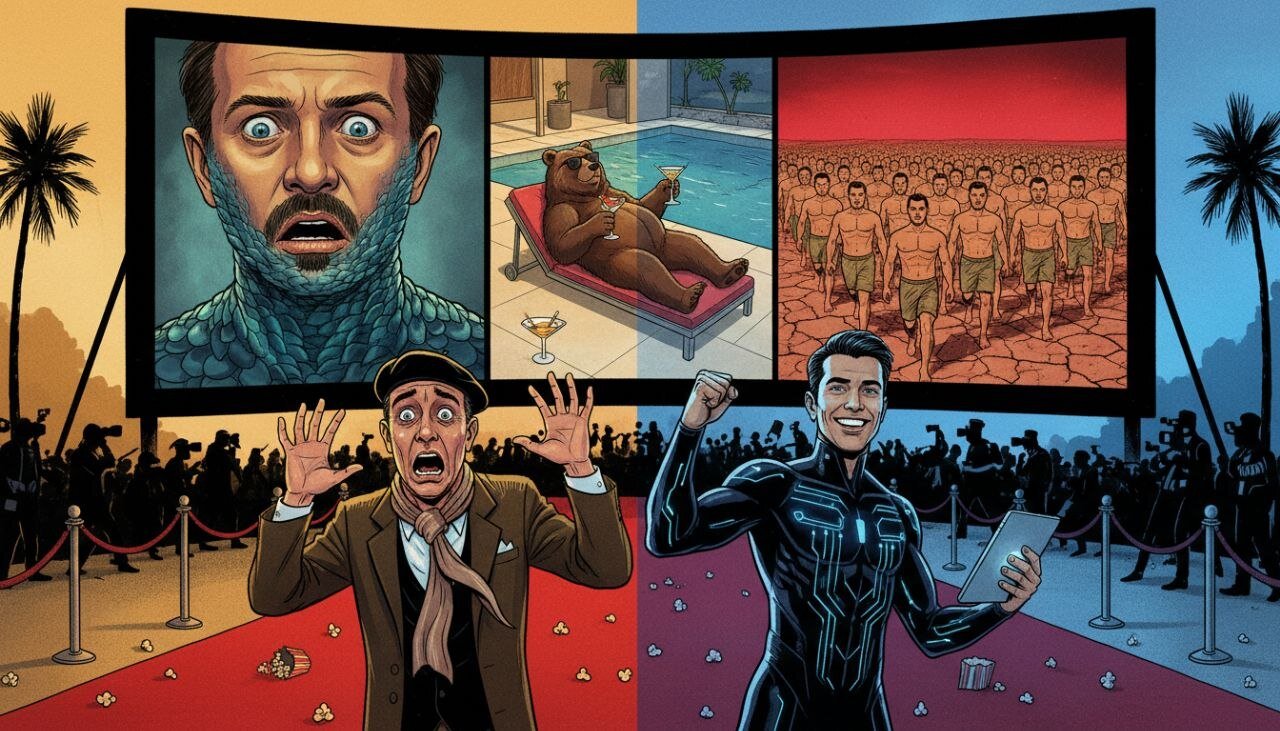
The sun-drenched boulevards of Cannes have witnessed many cinematic revolutions over the decades, from the French New Wave to the digital transformation of the 21st century. But this week, the French Riviera played host to something altogether stranger: men with iridescent fish scales shimmering across their skin, heroines walking with hearts literally beating outside their bodies, and massed armies of impossibly tanned men marching in perfect, uncanny unison. These were not fever dreams or avant-garde hallucinations—they were the stars of the first-ever World AI Film Festival (WAIFF), a bold and controversial showcase of what happens when artificial intelligence is handed the director's chair.
The inaugural WAIFF arrived at a pivotal moment for cinema, creating a surreal juxtaposition that could only happen in Cannes. Just one week earlier, the prestigious 76th Cannes Film Festival had drawn a hard line in the sand, banning AI-generated films from competing for the coveted Palme d'Or. Festival director Thierry Fremaux delivered what has become the defining quote of this cultural moment: "AI imitates very well but it will never feel deep emotions." Yet here, mere days later, the same city opened its arms to an entirely new festival dedicated to celebrating precisely what the establishment had rejected. The message was clear: while traditional cinema may be slamming the door on artificial intelligence, the technology—and the powerful interests behind it—is barging through the window.
What is WAIFF?
The World AI Film Festival represents something unprecedented in the history of cinema: a dedicated platform for films created entirely or primarily through artificial intelligence. Unlike traditional film festivals that might include AI as a peripheral technology, WAIFF placed machine-generated content front and center, treating it not as a novelty but as a legitimate emerging art form deserving of its own stage.
The festival's programming reflected both the wild possibilities and current limitations of AI cinema. Audiences were treated to a menagerie of surreal imagery that no human production designer could practically conceive—creatures that blended human and aquatic features with disturbing seamlessness, anatomical impossibilities rendered with photorealistic precision, and crowd scenes that would bankrupt any traditional studio if attempted with practical effects or even conventional CGI. The recurring motif of photorealistic animals behaving with unsettling human intelligence—bears lounging on sunbeds, pigs cruising in golf carts—suggested that AI filmmakers are particularly drawn to the uncanny valley where the familiar becomes strange.
Gong Li, the festival president and legendary figure of Chinese cinema, struck a diplomatic tone when addressing the controversial nature of the event. "AI can be controversial," she acknowledged, a statement that simultaneously validated the concerns of traditionalists while defending the festival's right to explore new territory. Her presence lent significant cultural weight to an event that might otherwise have been dismissed as a Silicon Valley publicity stunt.
The Great Divide: Cannes Bans, WAIFF Embraces
The contrast between Cannes' rejection and WAIFF's embrace of AI cinema represents more than just a difference in programming philosophy—it signals a fundamental schism in the film industry about what cinema is and what it should become. The Cannes ban was unequivocal: AI-generated works need not apply for the Palme d'Or. This wasn't merely a technical specification but a philosophical statement about the nature of art and authorship. Fremaux's declaration that AI "will never feel deep emotions" struck at the heart of the debate. Cinema, in the traditional view, is fundamentally human—a medium for transmitting emotional truth from one consciousness to another through the alchemy of performance, writing, direction, and editing.
Yet WAIFF's very existence challenges this orthodoxy. By creating a parallel festival structure, the organizers are making a provocative argument: that AI-generated cinema is not merely a derivative of human filmmaking but potentially a new medium entirely. The comparison to 1895, when the Lumière brothers first projected moving images to a startled Parisian audience, was repeatedly invoked by festival supporters. Just as early cinema was dismissed as a gimmick before becoming the defining art form of the 20th century, AI film advocates argue that we are witnessing the birth pangs of something that will eventually seem as natural as color film or computer animation.
This parallel, however, ignores a crucial distinction. The Lumière brothers were capturing reality—trains arriving at stations, workers leaving factories. Even their staged comedies featured real people in real spaces. AI cinema, by contrast, generates its realities from statistical patterns, creating images that have no referent in the physical world. The question is whether this distinction matters aesthetically, or whether it is merely a technical detail that future generations will find as quaint as early concerns about recorded sound "killing" the art of silent film.
The Wallace & Gromit Controversy
If the theoretical debates about AI cinema remained abstract, one incident at WAIFF brought the practical implications crashing into focus. A short film featuring characters unmistakably resembling Wallace and Gromit—the beloved claymation duo created by Aardman Animations—was shortlisted for the festival, triggering an immediate firestorm of controversy.
The reaction from the creative community was swift and visceral. Mathieu Kassovitz, the acclaimed director of "La Haine," reportedly responded with a blunt "What the fuck?" that captured the sentiment of many traditional filmmakers. The issue wasn't merely aesthetic—it was legal and ethical. Wallace and Gromit are copyrighted characters, the product of decades of creative work by Nick Park and the Aardman team. An AI system trained on existing media had generated new content featuring recognizable versions of these characters without permission, compensation, or attribution.
The festival jury ultimately decided not to award or screen the Wallace and Gromit-like film, citing copyright concerns. This decision represented a significant moment of self-regulation in an industry that has thus far operated largely in a legal gray area. It acknowledged that even within a festival celebrating AI's creative potential, there are lines that cannot be crossed—at least not yet.
The incident highlighted a fundamental tension in AI-generated content. These systems learn by ingesting vast quantities of existing media, absorbing styles, characters, and visual languages that were created by human artists over generations. When they produce new works that echo specific copyrighted properties, the question of where inspiration ends and infringement begins becomes not just legally complex but philosophically fraught. The Wallace and Gromit case suggests that even AI cinema's most enthusiastic advocates recognize that unchecked generation of derivative content could strangle the very creative ecosystem it depends upon.
Hollywood's Big Bet on AI
Behind the artistic debates and copyright controversies lies a stark economic reality that may ultimately determine AI cinema's fate: Hollywood is investing heavily in this technology, and the money flowing into AI film production is transforming it from an experimental curiosity into an industrial force.
The list of industry heavyweights backing AI film technology reads like a Hollywood power roster. Ron Howard, the Oscar-winning director behind "A Beautiful Mind" and "Apollo 13," has put his money behind AI filmmaking tools. James Cameron, whose "Avatar" films pushed the boundaries of computer-generated imagery, is investing in the next frontier of machine-generated visuals. Matthew McConaughey, whose career has spanned everything from indie darlings to blockbuster franchises, has also joined the AI investment wave.
The economic logic is compelling from a studio perspective. Industry insiders are openly discussing a future where studios produce several $50 million AI-enhanced or AI-generated films instead of a single $200 million conventional blockbuster. This represents a fundamental restructuring of Hollywood's risk-reward calculation. A $200 million film needs to gross roughly $600-800 million worldwide to be profitable after marketing and distribution costs. It's an all-or-nothing bet that has led to the franchise-obsessed, sequel-driven landscape that dominates modern multiplexes. Several $50 million films, by contrast, offer diversification. One can fail without bankrupting the studio, while a surprise hit delivers the same returns at a fraction of the cost.
Paramount Pictures, now under the leadership of David Ellison—son of Oracle founder Larry Ellison—has been particularly vocal about AI's transformative potential. Ellison has stated unequivocally that AI will affect "every aspect of business" at the studio. This isn't speculative futurism; it's a strategic roadmap. Paramount's embrace of AI reflects a broader industry recognition that the technology is not coming—it is here, and the studios that adapt fastest will have a competitive advantage.
The posthumous appearance of Val Kilmer in an AI-generated trailer at the festival added another dimension to Hollywood's AI ambitions. Kilmer, who lost his voice to throat cancer, has already experimented with AI voice synthesis to continue acting. His digital resurrection in an AI-generated trailer suggests a future where stars' likenesses can be licensed and deployed indefinitely, raising profound questions about identity, consent, and the nature of performance.
The Soul of Cinema: What's Missing from AI Films
For all the technical wizardry on display at WAIFF, critics—both professional and audience—identified a consistent and troubling pattern: these films lacked something essential. The technical precision was undeniable. AI-generated imagery can achieve a level of visual detail and consistency that would require armies of VFX artists working for months. But technical precision, it turns out, is not the same as art.
The most commonly cited deficiency was humor. Comedy is perhaps the most human of all art forms—deeply dependent on timing, cultural context, shared experience, and the ineffable quality of recognizing something true about the human condition. AI films at WAIFF consistently failed at comic timing, generating scenarios that should have been funny but landed with the thud of a machine that has read about laughter but never experienced it. A bear on a sunbed is conceptually amusing, but without the timing, the performance, the recognition of something genuinely human in the absurdity, it remains merely a strange image.
This prioritization of technical achievement over narrative heart represents what might be AI cinema's fundamental limitation. Current AI systems excel at generating impressive individual images or sequences. They can create a photorealistic pig driving a golf cart with perfect lighting and physics. What they struggle with is the accumulation of these moments into something that moves us, that changes us, that we carry with us after the credits roll. They can simulate the surface of cinema—the look, the movement, the basic narrative structure—but the depth, the subtext, the emotional resonance that makes film an art form rather than mere entertainment, remains elusive.
The recurring visual motifs at WAIFF—animals behaving like humans, anatomical impossibilities, armies of identical figures—suggest another limitation. AI systems, trained on vast datasets, tend toward the statistically probable. They generate what is common across their training data rather than what is unique, surprising, or genuinely original. The result is a kind of aesthetic averaging, where everything looks impressive but nothing looks like it came from a specific human vision.
The Bigger Picture: Revolution or Gimmick?
The question that looms over WAIFF and the broader AI cinema movement is whether we are witnessing the birth of a new art form or merely the latest in a long line of technological gimmicks that will fade as quickly as they arrived. The history of cinema is littered with innovations that were supposed to transform the medium forever: 3D films (multiple times), Smell-O-Vision, interactive movies, virtual reality experiences. Some evolved into enduring tools; others became punchlines.
AI cinema's advocates point to the trajectory of computer animation as a precedent. When Pixar released "Toy Story" in 1995, many dismissed CGI as a novelty that would never match the warmth of hand-drawn animation. Today, computer animation dominates the medium, and the aesthetic objections seem quaint. Perhaps AI cinema will follow a similar path, with current limitations overcome as the technology matures.
But the comparison may be misleading. CGI was always a tool wielded by human artists. The animators at Pixar made creative decisions; the computers executed them. AI cinema, at least in its purest form, removes the human artist from the process entirely. The machine is not just the brush; it is the painter. This represents a qualitative difference that may not be bridgeable simply through technological advancement.
The economic argument for AI cinema is undeniable, and economics has a way of overriding aesthetic objections. If studios can produce profitable films at a fraction of current costs, they will do so, regardless of what cinephiles think about the soul of cinema. The question is whether audiences will embrace these films or reject them as the cinematic equivalent of fast food—cheap, convenient, but ultimately unsatisfying.
🔥 The Hot Take: Can Algorithms Feel?
At the heart of the AI cinema debate lies a question that extends far beyond filmmaking: Can machines create art? The traditional answer, articulated by Cannes and echoed by critics worldwide, is no. Art requires intention, emotion, lived experience—the messy, ineffable qualities of human consciousness that no algorithm can replicate.
But this position is becoming harder to defend as AI systems grow more sophisticated. If an AI-generated film moves a viewer to tears, does it matter that the machine didn't "feel" the emotion it evoked? The emotional response is real, regardless of its origin. We don't demand that a camera "experience" the sunset it captures; we judge the photograph by its effect on us. Perhaps AI cinema should be judged by the same standard.
Yet there's a crucial difference. A camera captures something that exists. An AI generates something that doesn't. The photographer made a choice—to be there, at that moment, with that framing. The AI made a statistical prediction about what pixels should follow other pixels based on patterns in its training data. The result may look similar; the process could not be more different.
The most honest assessment may be that AI cinema is not replacing human cinema but creating something adjacent to it—a new medium with its own possibilities and limitations, its own masterpieces and failures. Just as photography didn't kill painting but liberated it from the obligation to represent reality, AI cinema may free human filmmakers to explore territories that machines cannot reach: the genuinely personal, the culturally specific, the emotionally authentic.
Conclusion: The Future is Unwritten
As the first World AI Film Festival closed its doors and the crowds dispersed from Cannes, the film industry found itself at a crossroads that feels both unprecedented and eerily familiar. Every technological transformation in cinema's history—from synchronized sound to digital projection—has been accompanied by predictions of both utopia and apocalypse. The truth, as usual, likely lies somewhere in between.
What WAIFF made undeniable is that AI-generated cinema is no longer a theoretical possibility or a laboratory experiment. It is a commercial reality backed by serious money, serious talent, and serious ambition. The technology will improve. The legal frameworks will evolve. Audiences will develop new aesthetic standards for evaluating machine-generated content. Some of what seems strange and uncanny today will become normalized; some will remain irredeemably artificial.
The comparison to the Lumière brothers in 1895 is both apt and overstated. We are indeed in the earliest days of a new medium, stumbling toward an uncertain future with tools we barely understand. But the Lumières were capturing the world; AI is generating new worlds from statistical patterns. Whether these worlds will be worth inhabiting—whether they will make us laugh, cry, think, and feel in the ways that cinema has for over a century—remains the open question that will define the next era of film history.
One thing is certain: the debate sparked by WAIFF will not be resolved in Cannes or in any single festival. It will be settled in theaters and streaming platforms, in box office receipts and critical consensus, in the gradual evolution of what we mean when we say "cinema." The machines have arrived on the Croisette. Whether they are invited to stay depends on whether they can learn not just to generate images, but to generate meaning.
The first World AI Film Festival may be remembered as either the dawn of a new cinematic era or a curious footnote in film history. For now, it stands as a mirror reflecting our anxieties and aspirations about technology, creativity, and what it means to be human in an age of intelligent machines.