
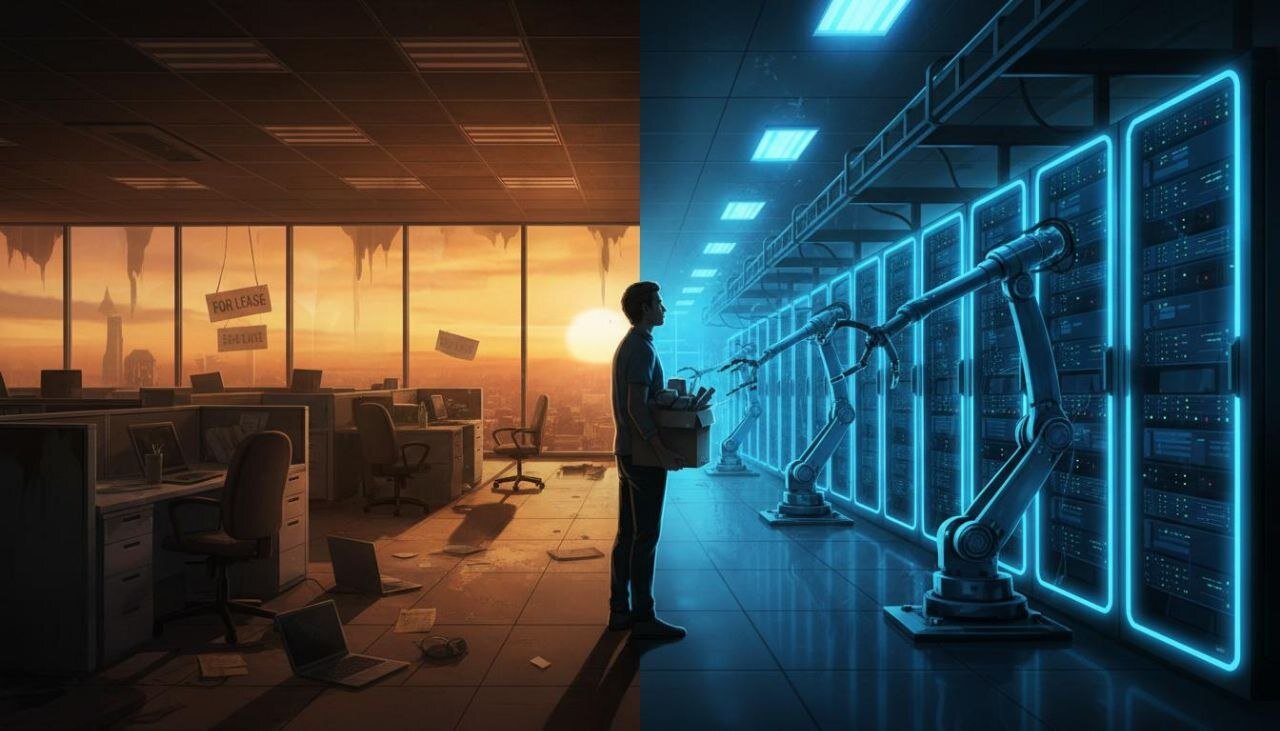
Sarah Chen spent twelve years building her career as a senior software engineer at one of Silicon Valley's most prestigious tech companies. Last Tuesday, she packed her belongings into a cardboard box while an AI system—trained partly on code she had written—quietly took over her team's responsibilities. She wasn't alone. By the time you finish reading this article, another dozen tech workers will have received the same devastating email.
Welcome to 2026: the year artificial intelligence stopped being a tool for workers and became their replacement.
The Numbers Are Staggering
According to Layoffs.fyi, the tech industry's premier tracking database for workforce reductions, more than 92,000 tech workers have been laid off in 2026 alone. Let that sink in. Ninety-two thousand. That's not a statistic—that's a small city of skilled professionals suddenly finding themselves redundant in an economy they helped build.
But the true scale of this crisis only becomes apparent when you pull back the lens. Since the beginning of the AI boom—roughly tracing back to late 2022 when ChatGPT first captured global imagination—nearly 900,000 tech workers have lost their jobs. Nearly a million people. If Silicon Valley were a country, that would represent a significant portion of its working population.
The acceleration is terrifying. By the end of March 2026, companies had announced 52,050 job cuts—a jaw-dropping 40% increase compared to the same period in 2025. What was already a crisis has become an avalanche.
The Tech Giants Lead the Charge
Meta: The $65 Billion Paradox
Mark Zuckerberg's Meta Platforms has become the poster child for this new era of corporate contradiction. In January 2026, the company announced it would cut 10% of its workforce—approximately 8,000 employees—while simultaneously closing 6,000 open roles that will never be filled by humans.
The kicker? Meta is spending $65 billion on AI infrastructure this year alone. That's billion with a 'B'—enough money to pay those 8,000 workers for decades. But Zuckerberg isn't interested in paying workers anymore. He's interested in building the machines that replace them.
"We're entering a new phase where AI can handle an increasing portion of our engineering and operational work," Zuckerberg told investors in a recent earnings call. The translation? Thanks for building the platform, but we don't need you anymore.
Microsoft: The $80 Billion Goodbye
If Meta's numbers are staggering, Microsoft's are downright dystopian. The Redmond giant is investing $80 billion in AI data centers while simultaneously offering voluntary retirement packages to approximately 7% of its workforce—roughly 12,000 employees.
Let that math sink in. Eighty billion dollars to build AI infrastructure. Twelve thousand workers shown the door. The company that built its empire on software is now dismantling its human workforce to make room for the artificial kind.
Microsoft CEO Satya Nadella has been characteristically diplomatic, framing the transitions as "restructuring for the AI era." But workers on the ground tell a different story. Internal Slack channels have become support groups. LinkedIn feeds are flooded with Microsoft alumni posting their "open to work" badges. The company that once prided itself on being a place where people built lifelong careers has become a case study in algorithmic displacement.
Wall Street: The New Efficiency
The bleeding isn't limited to tech companies. Wall Street—always eager to cut costs—has embraced AI-driven downsizing with characteristic ruthlessness. Major banks have shed more than 1,000 jobs through AI automation, with the cuts concentrated in back-office operations, compliance, and analysis roles.
One bank CEO, speaking on condition of anonymity, put it with refreshing candor: "AI isn't just augmenting work anymore. It's eliminating work and applying technology."
There's no sugarcoating it. The finance industry, which has always viewed labor as a cost to be minimized, has found its ultimate cost-cutting tool. Why pay analysts six-figure salaries when an AI can process market data, generate reports, and identify trends in milliseconds?
The White-Collar Bloodbath
Historically, automation targeted blue-collar jobs. Factory workers. Assembly line operators. Warehouse staff. The narrative was always that knowledge workers—coders, analysts, professionals—were safe behind their degrees and specialized skills.
That narrative is dead.
The jobs most at risk in 2026 are precisely the ones that required years of education and training:
- Software Engineering: AI coding assistants like GitHub Copilot and Cursor have evolved from helpful tools to genuine replacements. Companies are discovering that a single senior engineer overseeing AI-generated code can replace entire teams.
- Data Analysis: Why hire a team of analysts when AI can process datasets, identify patterns, and generate insights in real-time? The "data-driven decision making" era has become the "AI-driven decision making" era.
- Customer Service: Advanced language models have made human customer service representatives largely obsolete. AI agents can handle complex inquiries, process returns, and resolve complaints—often more patiently than burned-out human workers.
- Content Creation: Marketing copy, technical documentation, even journalism—AI is eating the creative class from the bottom up.
- Legal and Compliance: Document review, contract analysis, and regulatory compliance—previously labor-intensive processes—are increasingly handled by specialized AI systems.
The cruel irony? These were supposed to be the "safe" careers. The ones parents encouraged their children to pursue. The ones that justified six-figure student loans.
The Great Contradiction
Perhaps the most maddening aspect of this crisis is the sheer contradiction at its heart. The very companies laying off thousands of workers are spending unprecedented sums on AI infrastructure.
Meta: $65 billion on AI, 8,000 workers fired.
Microsoft: $80 billion on data centers, 12,000 workers encouraged to leave.
The message couldn't be clearer: humans are a cost. AI is an investment.
This isn't capitalism as we understood it. This is something new—a world where the means of production aren't just automated; they're intelligent. Where the machines don't just work for us; they work instead of us.
And here's the truly disturbing part: AI companies need fewer people as AI gets better. Every improvement in AI capability directly translates to reduced human labor requirements. It's a feedback loop where progress for the technology means regression for the workforce.
Expert Warnings: This Is Just the Beginning
Economists and labor market experts are sounding alarms that would have seemed hysterical just three years ago. Today, they sound prophetic.
"We're looking at the largest structural transformation of the labor market since the Industrial Revolution," says Dr. Elena Vasquez, labor economist at MIT. "But unlike the Industrial Revolution, which created more jobs than it destroyed over the long term, AI has the potential to be genuinely labor-replacing across virtually every sector."
The numbers support her concern. While new job categories are emerging—AI trainers, prompt engineers, robotics maintenance technicians—the creation rate isn't remotely close to offsetting the destruction. For every "AI whisperer" job created, hundreds of traditional roles evaporate.
"We're in the early innings," warns Dr. Vasquez. "What we're seeing in 2026—92,000 layoffs, nearly 900,000 since the boom began—is just the beginning. As AI capabilities expand, the displacement will accelerate."
Other experts are even more blunt. "The middle class is being automated out of existence," says former Treasury Secretary Lawrence Summers. "We're creating a world where there are AI owners and everyone else."
Historical Context: We've Been Here Before (Sort Of)
It's tempting to dismiss these concerns as modern hysteria. After all, every technological revolution has sparked fears of mass unemployment. The Luddites smashed looms. Farmers protested tractors. Factory workers feared robots.
And historically, those fears proved overblown. The Industrial Revolution destroyed agricultural jobs but created manufacturing ones. The computer revolution eliminated clerical work but spawned the information economy. Each wave of disruption ultimately created more prosperity and employment than it destroyed.
But AI is different. Fundamentally, structurally different.
Previous technologies replaced human muscle. AI replaces human minds. When a tractor replaced a farmhand, the farmhand could move to a factory. When AI replaces a software engineer, where does the engineer go? The factory is automated too.
The historical pattern of technological disruption creating new opportunities relied on humans still being necessary for something. AI challenges that assumption. If machines can think, learn, and create, what exactly are humans for?
This isn't Luddite paranoia. This is a genuine structural shift without obvious precedent. The cotton gin didn't design better cotton gins. AI is literally being used to build better AI.
The Human Cost
Behind every statistic is a human story. The 92,000 tech workers laid off in 2026 aren't numbers—they're people with mortgages, families, and dreams that didn't include being replaced by algorithms.
They're the mid-career professional who spent twenty years mastering skills that became obsolete overnight. The recent graduate who chose computer science because it was "safe" and now faces a job market where entry-level coding positions have virtually disappeared. The single parent who worked remotely for a tech company because it offered flexibility—flexibility that AI doesn't need.
LinkedIn has become a graveyard of dashed careers. "Open to work" badges proliferate. Former Googlers, Metamates, and Microsofties network desperately, discovering that the skills that made them valuable yesterday make them expensive today.
Mental health crises are spiking in tech hubs. Therapists in San Francisco and Seattle report unprecedented demand from recently laid-off tech workers struggling with identity, purpose, and financial panic. The industry that promised golden handcuffs has delivered pink slips.
🔥 The Hot Take: What This Means for Workers
Let's be brutally honest about where this is heading.
The era of "learn to code" as career advice is over. Coding is being automated by the very people who used to write code. The advice that defined a generation—"get a STEM degree, work in tech, secure your future"—has become a cruel joke.
If you're currently working in a role that involves sitting at a computer, processing information, and producing outputs, you should be worried. Not panicked—there's still time—but worried. The AI that can do your job is being trained right now, probably using data from people currently doing your job.
The new career advice? Be irreplaceably human. Roles requiring genuine creativity, emotional intelligence, physical dexterity, and complex interpersonal dynamics remain relatively safe—for now. Nurses, therapists, skilled tradespeople, and entrepreneurs who can navigate ambiguity may find themselves more secure than software engineers with six-figure salaries.
But even "safe" jobs aren't truly safe. AI is advancing faster than most predictions. Today's "irreplaceable" skill might be tomorrow's automation target.
The uncomfortable truth: we're entering an era where traditional employment may not be viable for millions of people. Universal Basic Income, once dismissed as utopian fantasy, is being seriously discussed by mainstream economists. Not because it's ideal, but because the alternative—mass unemployment and social instability—might be worse.
The Future of Work: Adapt or Perish
So where do we go from here?
The optimistic scenario: AI creates entirely new categories of work we can't yet imagine, just as the internet created jobs that would have seemed absurd in 1995 (social media manager, UX designer, data scientist). Humans adapt, as we always have, and find new ways to be valuable.
The pessimistic scenario: AI capabilities advance faster than human adaptability, creating a permanent underclass of economically displaced workers while wealth concentrates among AI owners and the ultra-skilled elite.
The realistic scenario: probably somewhere in between, but with significant pain along the way. Transitions of this magnitude don't happen smoothly. There will be years of disruption, political upheaval, and social recalibration before we find a new equilibrium.
What's clear is that the old rules no longer apply. The career ladder your parents climbed has been pulled up behind them. The skills that guaranteed prosperity are being commoditized by algorithms. The companies that promised loyalty are investing billions in your replacement.
Conclusion: The Reckoning
2026 will be remembered as the year the AI job crisis stopped being theoretical and became viscerally real. Ninety-two thousand layoffs. Nearly 900,000 since the boom began. Meta spending $65 billion on AI while firing 8,000 people. Microsoft investing $80 billion in data centers while pushing out 12,000 workers.
These aren't just business decisions. They're signals about the future of human economic value in an age of artificial intelligence.
The Industrial Revolution asked humans to be more like machines. The AI Revolution is making machines more like humans. And in that equation, humans are increasingly the variable being solved for elimination.
For workers, the message is clear: adapt, reskill, and find ways to be irreplaceably human—or risk becoming another statistic in next year's layoff reports. The AI revolution won't wait for you to catch up.
As for Sarah Chen—the software engineer packing her box while AI absorbed her team's work—she's considering becoming an electrician. "At least," she says with a bitter laugh, "robots can't crawl through attics yet."
She's probably right. For now.