
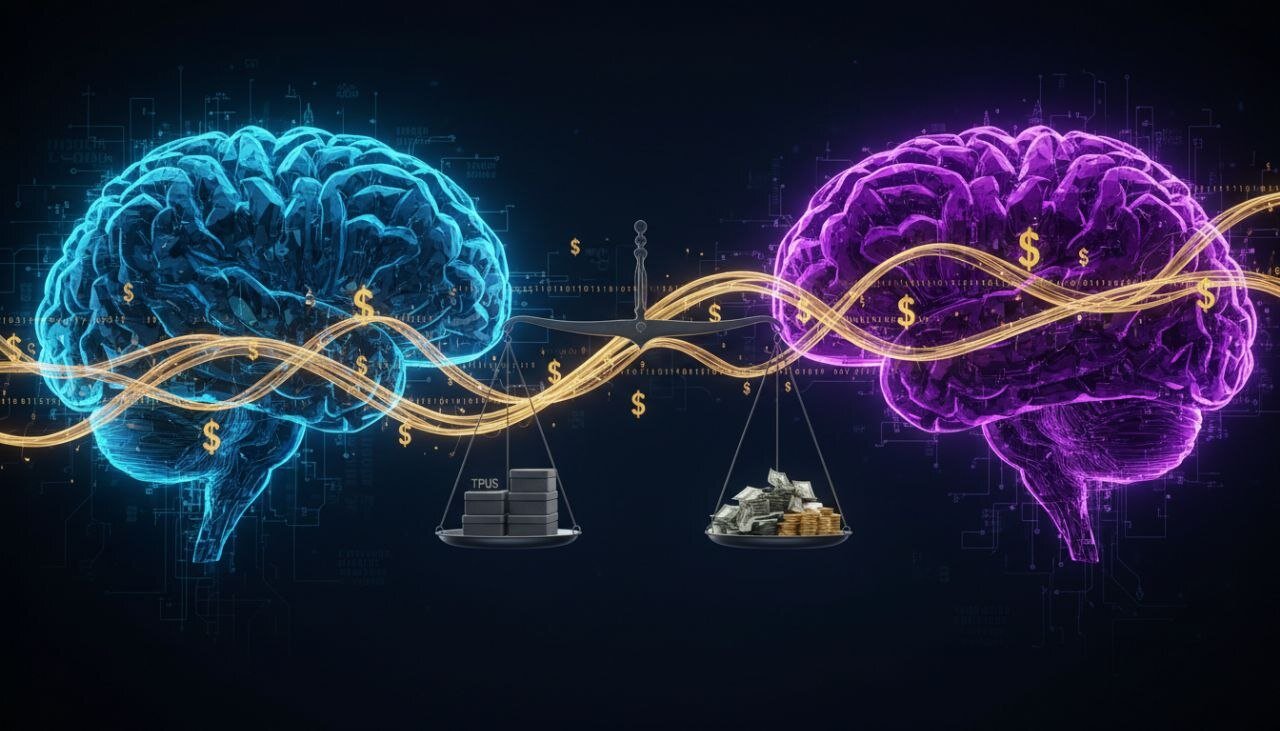
April 25, 2026 — In a move that reshapes the artificial intelligence landscape and raises serious questions about competition, concentration of power, and the future of the technology itself, Google parent Alphabet has committed to invest up to $40 billion in Anthropic, the San Francisco-based AI startup behind the wildly popular Claude assistant. The deal, announced Friday, April 24, 2026, represents one of the largest technology investments ever made—and a dramatic escalation in the already feverish arms race between Silicon Valley's tech titans.
The numbers alone are staggering. Google will invest $10 billion in cash immediately, valuing Anthropic at $350–380 billion depending on the source, with an additional $30 billion contingent on performance milestones the company must hit over the coming years. But the deal is about far more than money. Google is also committing 5 gigawatts of computing capacity over the next five years through its Google Cloud platform, giving Anthropic access to the specialized tensor processing units (TPUs) that are among the most coveted—and scarce—resources in all of technology today.
To put this in perspective: $40 billion is roughly what entire nations spend on their annual defense budgets. It is more than the market capitalization of most Fortune 500 companies. And it is being deployed not to acquire Anthropic outright, but simply to secure Google's position as its most important infrastructure partner and strategic ally in a market where compute capacity has become the new oil.
The Rebels Who Built Claude
To understand why Google is writing checks this large, one must first understand what Anthropic is—and where it came from.
Anthropic was founded in 2021 by a group of researchers and executives who walked away from OpenAI, the company that would soon become the most famous name in artificial intelligence. Leading the exodus were siblings Dario and Daniela Amodei, both former OpenAI executives who grew increasingly concerned about the direction of AI development and the lack of robust safety measures being implemented as models grew more powerful.
The Amodeis were not fringe critics. Dario had served as OpenAI's Vice President of Research, overseeing some of the most important technical breakthroughs that led to GPT-3 and the early iterations of what would become ChatGPT. Daniela had been OpenAI's Vice President of Safety and Policy. When they left, they took with them a significant portion of OpenAI's top research talent—researchers who shared their conviction that AI development needed to proceed with far greater caution and transparency.
Anthropic's founding philosophy centered on what the company calls "Constitutional AI"—a framework for training AI systems to be helpful, harmless, and honest by embedding ethical principles directly into the model's training process rather than relying solely on human feedback after the fact. The approach was controversial in some circles, with critics arguing it might limit model capabilities. But as AI systems have grown more powerful and their potential for misuse has become more apparent, Constitutional AI has increasingly been seen as prescient.
The company's flagship product, Claude, launched in 2023 and quickly distinguished itself from ChatGPT and other competitors through its notably cautious approach. Where other models might confidently hallucinate facts or generate harmful content, Claude would often decline requests, explain its reasoning, and err on the side of safety. Early on, this made Claude seem less capable than its rivals. But as users encountered the limitations and risks of more aggressive models, Claude's reliability became a selling point—particularly in enterprise settings where accuracy and trustworthiness matter more than flashy capabilities.
The Deal: Cash, Compute, and Conditions
The structure of Google's investment is as revealing as its size.
The initial $10 billion is straightforward enough: cash at a valuation that, depending on the reporting source, sits between $350 billion and $380 billion. This is the same valuation Anthropic achieved in a February 2026 funding round, suggesting that despite the massive new capital injection, Google negotiated carefully to avoid inflating the price beyond what other recent investors had paid.
But the additional $30 billion is where things get interesting. This tranche is entirely contingent on performance milestones—specific targets Anthropic must hit related to revenue, user adoption, technical benchmarks, or other metrics that Google and Anthropic have negotiated privately. The exact milestones have not been disclosed, but the structure signals Google's confidence in Anthropic's trajectory while also protecting its downside if the company fails to execute.
Perhaps more significant than the cash is the compute component. Google is providing Anthropic with access to 5 gigawatts of computing capacity over five years through Google Cloud, with the option to scale further. This is not merely cloud hosting; it is access to Google's custom-designed TPUs—tensor processing units that Google has spent years developing as an alternative to Nvidia's dominant GPUs. In the current AI landscape, where training a single frontier model can cost hundreds of millions of dollars and access to sufficient compute is the primary bottleneck for every major lab, this compute commitment may be worth as much or more than the cash itself.
The deal also builds on an existing relationship. Google first invested $300 million in Anthropic in 2023, acquiring roughly a 10% stake. Months later, Google added another $2 billion, bringing its total pre-deal investment to over $3 billion and reportedly giving it a 14% ownership stake. The new $40 billion commitment dwarfs these earlier investments and transforms Google from a significant shareholder into Anthropic's most critical strategic partner.
Why Google Is Betting on Its Own Rival
The most perplexing aspect of this deal is that Google is simultaneously Anthropic's biggest investor and one of its most direct competitors. Google's own AI model family, Gemini, is competing head-to-head with Claude in virtually every market segment—from consumer chatbots to enterprise APIs to coding assistants.
So why is Google funding its rival?
The answer lies in the peculiar economics of the AI industry and Google's strategic positioning. First, much of Google's investment will flow back to Google itself in the form of cloud computing revenue. Anthropic is one of the largest consumers of AI compute in the world, and Google Cloud is positioning itself as the primary infrastructure provider for the AI revolution. By securing Anthropic as a long-term customer, Google is essentially recycling its investment dollars into guaranteed cloud revenue—a structure that makes the $40 billion commitment far less costly than it appears on paper.
Second, Google has learned from Microsoft's playbook. When Microsoft invested $13 billion in OpenAI beginning in 2019, it gained exclusive cloud hosting rights, deep integration of OpenAI's models into Microsoft's products (Copilot, Azure OpenAI Service), and a front-row seat to the most important technology platform of the decade. The investment has been extraordinarily lucrative for Microsoft, which has seen its Azure cloud business surge and its enterprise software suite transformed by AI capabilities. Google appears determined not to be left behind as the AI economy consolidates around a small number of infrastructure-provider-plus-model-developer partnerships.
Third, there is a defensive element. If Google did not invest in Anthropic, Amazon almost certainly would have deepened its own relationship—and Google would risk losing one of the most important AI workloads in the world to its biggest cloud competitor. Earlier this month, Amazon invested $5 billion in Anthropic and agreed to invest up to $20 billion more tied to commercial milestones, as part of a broader arrangement under which Anthropic is expected to spend up to $100 billion for compute capacity over time. Google's $40 billion commitment can be seen, in part, as a countermove to prevent Amazon from capturing Anthropic entirely.
Finally, Google may simply be acknowledging a reality that has become increasingly apparent: Claude is winning in the enterprise market that Google cares about most. While Gemini has made impressive strides in consumer-facing applications and certain technical benchmarks, Claude has become the preferred AI assistant for software developers, financial analysts, legal professionals, and other high-value enterprise users. Claude Code, Anthropic's programming-specific product, has "exploded in popularity" over the past year and is driving significant revenue growth. By investing in Anthropic, Google gains influence over a product that is beating its own in the markets where enterprise AI spending is concentrated.
The Competitive Landscape: Everyone Is Everyone's Frenemy
The Google-Anthropic deal underscores just how strange the competitive dynamics of the AI industry have become. There are no longer clear lines between allies and adversaries; every major player is simultaneously partner, competitor, investor, and customer to every other.
Consider the web of relationships:
- Microsoft has invested $13 billion in OpenAI and integrated GPT models deeply into its products, while also developing its own AI capabilities and hosting competing models on Azure.
- Amazon has invested $5 billion in Anthropic, is Anthropic's primary cloud partner for certain workloads, and is simultaneously developing its own AI models while offering Claude through Amazon Bedrock.
- Google owns Gemini, competes directly with Claude, and is now Anthropic's largest investor and compute provider.
- Anthropic takes money and compute from both Google and Amazon while competing with both companies' in-house AI products.
- OpenAI is partnered with Microsoft but has also struck deals with other cloud providers and chip makers, including a recent expanded agreement with Cerebras.
This tangled web is not merely confusing—it is actively being investigated by antitrust regulators who worry that the structure of these deals may be designed to cement the dominance of a small number of tech giants while making it impossible for new entrants to compete.
Regulatory Storm Clouds Gather
The Google-Anthropic deal arrives at a moment of intense regulatory scrutiny for Big Tech's AI investments.
The U.S. Department of Justice is actively investigating whether these massive investments and partnerships violate antitrust laws. In January 2026, the DOJ and the Federal Trade Commission launched a joint inquiry into the relationships between major cloud providers and AI startups, with particular focus on whether the deals are structured to give incumbents effective control over emerging competitors without triggering formal merger review requirements.
The Microsoft-OpenAI partnership is already under antitrust review in multiple jurisdictions. Regulators in the United States, European Union, and United Kingdom have all expressed concerns that Microsoft's investment—while structured to avoid triggering merger thresholds—may give Microsoft de facto control over OpenAI and the ability to shape its development in ways that disadvantage competitors.
Google's $40 billion Anthropic investment is likely to intensify this scrutiny. At what point does a strategic investment become a de facto acquisition? If Google owns a significant equity stake, provides virtually all of a company's compute infrastructure, and has negotiated performance milestones that effectively give it veto power over the company's strategic direction, does Anthropic remain an independent competitor—or has it become a Google subsidiary in all but name?
These questions are not merely academic. The structure of the AI industry has profound implications for competition, innovation, and the distribution of the enormous economic value that AI is expected to create. If the field consolidates around a small number of tech-giant-backed labs, the diversity of approaches to AI development—and the safety frameworks that govern it—could be dangerously narrowed.
Anthropic's Moment—and Its Challenges
For Anthropic, the Google deal is both a triumph and a test.
On the positive side, the company has clearly demonstrated that its approach to AI development resonates with both users and investors. Claude's reputation for reliability and safety has made it the preferred choice for enterprise customers who cannot afford the hallucinations, biases, and security risks that plague less cautious models. Annualized revenue has reportedly topped $2 billion—a remarkable figure for a company founded just five years ago—and the company is said to be considering an IPO as soon as October 2026.
But Anthropic is also burning through cash at an extraordinary rate. Training frontier AI models is perhaps the most capital-intensive activity in the history of technology, and Anthropic's commitment to safety and thoroughness—running extensive red-teaming and safety evaluations before releasing models—adds additional costs and delays that competitors may not incur. The company has faced widespread complaints about Claude use limits in recent weeks, a clear sign that demand is outstripping its ability to provision sufficient compute—a problem the Google deal is explicitly designed to solve.
The company also faces a strategic challenge that its founders could not have anticipated: success itself. As Anthropic has grown from a principled research lab into a multi-hundred-billion-dollar company with obligations to some of the world's largest corporations, can it maintain the safety-first culture that motivated its founders to leave OpenAI? Will the pressure to hit Google's performance milestones—and the eventual pressure of public market expectations—push Anthropic to cut corners on safety in order to ship products faster?
The release of Mythos, Anthropic's latest and most powerful model, illustrates the tension. The company restricted broader access to the model due to cybersecurity concerns, working only with select organizations to evaluate and address risks. But the model has reportedly "already fallen into unsanctioned hands," suggesting that even Anthropic's cautious approach may not be sufficient to prevent misuse of the most powerful systems.
🔥 The Hot Take: We're Building the Future in the Dark
If there is a single takeaway from Google's $40 billion Anthropic bet, it is this: the AI industry has become too important to be left to the market, and too complex to be effectively governed by regulators who barely understand what they're regulating.
We are watching the formation of a new industrial order in real time. The companies that control AI compute—Google, Amazon, Microsoft, and to a lesser extent Nvidia—are becoming the infrastructure monopolies of the 21st century, while the companies that develop the most capable models—OpenAI and Anthropic—are becoming dependent on them in ways that raise profound questions about independence, competition, and the public interest.
The Google-Anthropic deal is not merely a business transaction. It is a structural reshaping of the technology landscape that will influence how AI develops, who controls it, and who benefits from it for decades to come. And it is happening with virtually no public deliberation, no democratic input, and no clear framework for ensuring that the enormous concentration of power it creates will be exercised responsibly.
Dario and Daniela Amodei left OpenAI because they believed AI development was proceeding too recklessly, with too little attention to safety and too much concentration of power in too few hands. Four years later, their company is valued at $350+ billion, taking $40 billion from one of the world's largest corporations, and preparing for an IPO that will make them extraordinarily wealthy.
Have they succeeded in creating a more careful, more democratic, more accountable AI industry? Or have they simply built a new vessel for the same old concentration of power, dressed up in the language of safety and responsibility?
The answer to that question will determine whether the AI revolution fulfills its promise of broad human flourishing—or becomes the most consequential consolidation of power in human history.
Google's $40 billion bet suggests that the smart money is betting on the latter. The rest of us had better start paying attention.