
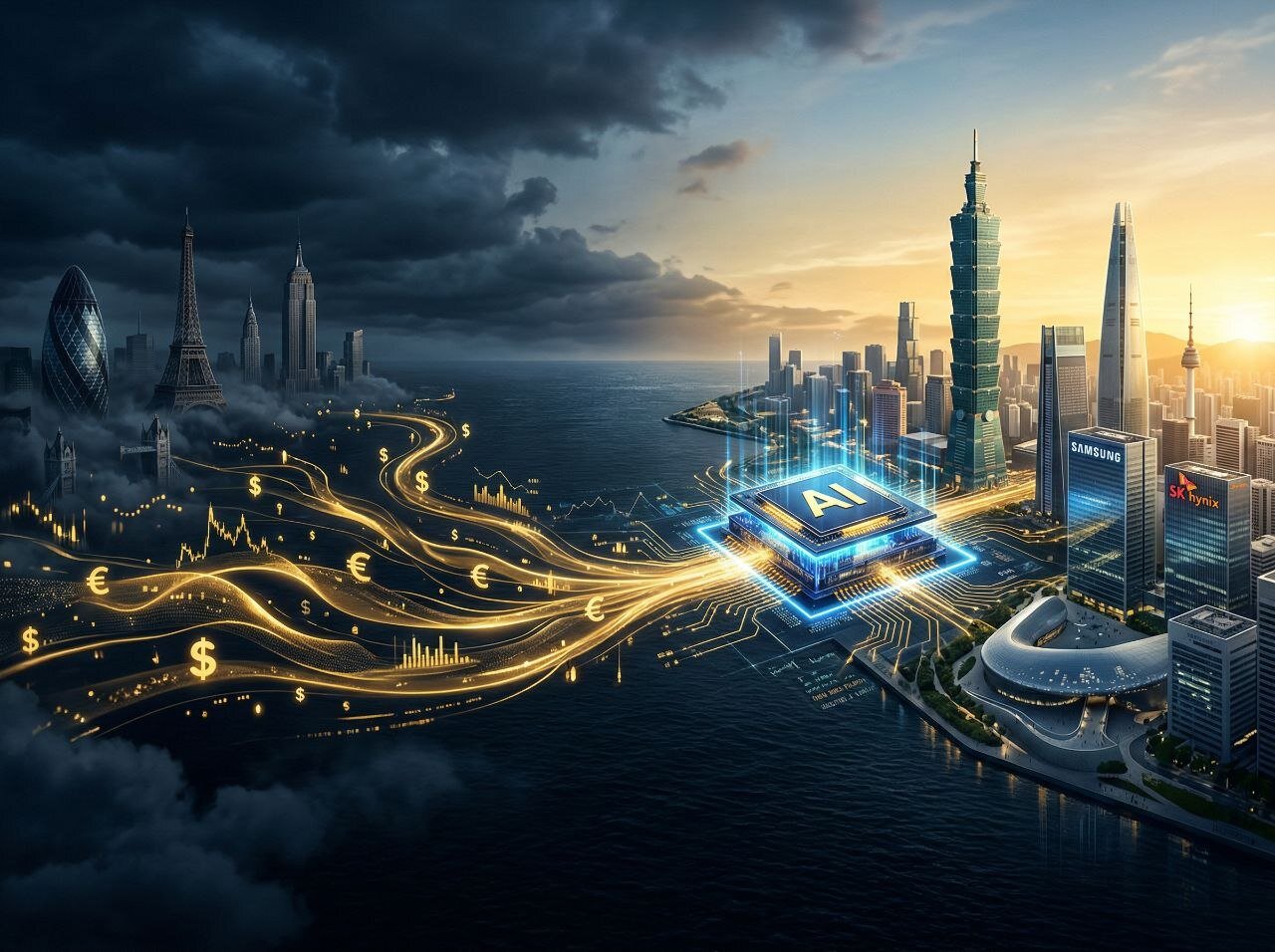
The global AI trade just came roaring back to life. After more than a month of sustained selling as Middle East tensions threatened to disrupt the world's most critical supply chains, global investors have suddenly rediscovered their appetite for Asian technology stocks — pouring a staggering $7.9 billion into Taiwan and South Korean equities in a single week.
The shift, captured in Bloomberg data released April 10, 2026, represents one of the fastest rotations back into risk assets this year. And it reveals something crucial about the nature of the AI boom: for all the talk about American tech giants like NVIDIA, OpenAI, and Google, the real hardware foundation of artificial intelligence remains firmly rooted in Asia — specifically, in the semiconductor manufacturing powerhouses of Taiwan and South Korea.
When geopolitical fears spike, money flees these markets at alarming speed. When those fears ease, the fundamental demand story reasserts itself with equal force. Welcome to the new reality of AI investing, where the Strait of Hormuz matters as much as the innovation coming out of Silicon Valley.
The Numbers Tell the Story
The $7.9 billion figure isn't just impressive — it's historic. That amount represents net foreign buying into Taiwan and South Korean equities combined, and it completely reverses more than a month of consecutive outflows that had wiped billions off the market value of the region's tech champions.
The reversal comes as signs emerge that tensions between Iran and Israel may be de-escalating, reducing the immediate threat of supply chain disruptions through the Strait of Hormuz — a chokepoint through which roughly one-fifth of global oil shipments pass, and whose closure would send energy prices soaring while threatening the complex logistics networks that keep semiconductor factories running.
For investors, the calculus was simple: the AI buildout isn't slowing down, the demand for advanced chips remains insatiable, and the companies best positioned to supply that demand — regardless of short-term geopolitical noise — are in Taipei and Seoul.
The buying was broad-based, hitting every major player in the AI semiconductor food chain. But two companies in particular have been drawing intense investor attention, and their recent earnings tell you exactly why.
TSMC: The Undisputed King of AI Chips
Taiwan Semiconductor Manufacturing Company, better known as TSMC, isn't just the world's largest contract chipmaker — it's the absolute linchpin of the global AI revolution. When NVIDIA designs a new GPU, when Apple creates its latest A-series processor, when AMD or Qualcomm need cutting-edge manufacturing, they all turn to TSMC.
On April 10, TSMC reported first-quarter 2026 revenue that blew past analyst expectations and set a new record. The numbers are staggering:
- Q1 2026 revenue: NT$1.13 trillion (approximately $35.6 billion), up 35% year-over-year
- March 2026 revenue alone: NT$415.2 billion, up 45.2% compared to March 2025
- Full-year outlook: TSMC will report detailed Q1 earnings on April 16, with updated guidance for the current quarter and full year
To put this in perspective, TSMC is growing faster in its mature, multi-billion-dollar business than many startups grow in their early years. And this isn't speculative growth driven by hope or hype — it's backed by real orders from real customers who need those chips to power the global AI infrastructure buildout.
Major clients including NVIDIA, Apple, AMD, and Qualcomm have been placing massive orders, locking up manufacturing capacity years in advance. The AI chip demand has been so strong that TSMC has been able to raise prices while maintaining near-perfect utilization rates at its fabrication facilities.
The company has also been aggressively expanding, building new facilities in Arizona, Japan, and Germany even as it continues to invest heavily in its Taiwan base. The message is clear: the current demand isn't a bubble — it's the new baseline, and TSMC is preparing for years of sustained growth.
The Memory Kings: Samsung and SK Hynix
If TSMC makes the brains of AI systems, South Korea's Samsung and SK Hynix make the memory those brains need to function. Specifically, they produce High-Bandwidth Memory (HBM) — a specialized type of DRAM that's essential for AI accelerators and data centers.
HBM has become the most sought-after commodity in the semiconductor industry. Unlike standard memory chips, HBM stacks multiple layers of DRAM vertically, creating a massive increase in bandwidth that allows AI processors to access data at the speeds required for training large models.
Without HBM, modern AI chips simply couldn't function. And right now, there's a supply crisis.
According to Goldman Sachs, the DRAM market faces a 4.9% undersupply in 2026 — the worst shortage in more than 15 years. IDC reports that Samsung, SK Hynix, and Micron (the three companies controlling over 95% of global DRAM production) have systematically reallocated manufacturing capacity toward HBM chips used in AI accelerators, creating what some analysts are calling "RAMageddon" for conventional memory.
The results have been dramatic:
- HBM prices have nearly doubled amid the AI data center boom
- Samsung plans a 50% HBM capacity expansion in 2026
- SK Hynix currently leads the HBM4 generation race with 53% market share versus Samsung's 35%
- Barclays notes that Korean chipmakers are set to benefit from a "powerful upswing in AI-driven memory demand" requiring strategic shifts to sustain gains
For investors, this is a dream scenario: skyrocketing demand, constrained supply, pricing power, and technological leadership in a market with only three viable competitors. It's why South Korean equities have seen consensus EPS estimates surge over 76% in the past six months — an extraordinary revision that reflects just how quickly the market has come to appreciate the structural shift in memory demand.
Why Asia? Why Now?
The AI boom is often portrayed as an American phenomenon — Silicon Valley startups, American cloud providers, U.S. venture capital. But the reality is more nuanced. While American companies dominate the software and model layers of the AI stack, Asian companies control the hardware foundation.
According to JPMorgan, close to 30% of total global AI capex makes its way to Taiwan and South Korea. That's a staggering concentration of economic value flowing to just two relatively small economies, and it explains why their stock markets have become such high-beta plays on the AI trade.
When NVIDIA spends billions on AI infrastructure, a significant chunk of that flows to TSMC for chip manufacturing. When Google, Microsoft, or Amazon build out their data centers, they need memory from Samsung and SK Hynix. The AI arms race among American tech giants is, in many ways, a revenue bonanza for Asian semiconductor suppliers.
This dynamic creates a fascinating investment paradox: the companies building the AI models get most of the media attention and some of the highest valuations, but the companies building the chips that make those models possible often generate more consistent, more profitable revenue. NVIDIA may be the star of the AI boom, but TSMC is the company actually manufacturing those NVIDIA chips — and taking its cut along the way.
The Geopolitical Wildcard
But this concentration of critical technology in Asia comes with risks. The recent $7.9 billion inflow only occurred because Middle East tensions appeared to be easing. When those same tensions were escalating just weeks earlier, money was flowing out just as rapidly.
The concerns are multifaceted:
Energy prices: Semiconductor manufacturing is incredibly energy-intensive. TSMC alone accounts for roughly 7% of Taiwan's total electricity consumption. If Middle East conflicts disrupt oil and gas supplies, driving up energy prices, chip manufacturing costs spike and profit margins compress.
Supply chain logistics: The Strait of Hormuz isn't just an oil chokepoint — it's a critical shipping lane for everything from chemicals used in chip manufacturing to finished semiconductors heading to global markets. Disruptions create cascading delays and cost increases.
Helium supply: Less well-known but critically important, helium is essential for semiconductor manufacturing — used to cool equipment and create the controlled environments needed for chip fabrication. A significant portion of global helium supply transits through the Middle East, and shortages can halt production.
Taiwan Strait tensions: Beyond the Middle East, the ever-present risk of conflict between China and Taiwan looms over the entire semiconductor industry. TSMC's fabs are concentrated in Taiwan, making them vulnerable to any military action or blockade.
These risks are why Asian tech stocks trade at a discount to their American counterparts despite often superior growth profiles. Investors demand a "geopolitical risk premium" for the chance that supply chains could be disrupted by events entirely outside the companies' control.
The Rotation Pattern
The past month has provided a perfect case study in how this dynamic plays out in real-time:
Phase 1 (Late March - Early April): As Iran-Israel tensions escalated, investors sold Asian tech stocks aggressively. Money rotated into "safe haven" assets like U.S. Treasuries, gold, and American mega-cap tech stocks that were perceived as less exposed to physical supply chain risks.
Phase 2 (Current): As ceasefire talks progressed and fears of a wider Middle East war receded, investors realized that the fundamental demand story hadn't changed — if anything, AI capex continues to accelerate. The selling reversed just as quickly as it began.
This pattern is likely to repeat. As long as AI investment remains robust, Asian semiconductor stocks will experience these boom-bust cycles driven by geopolitical sentiment rather than business fundamentals. For traders, it's an opportunity. For long-term investors, it's a test of conviction.
What Comes Next
TSMC will report detailed Q1 earnings on April 16, providing updated guidance that will shape expectations for the rest of 2026. Investors will be watching closely for:
- Revenue and margin guidance for Q2 and full year
- Updates on capacity expansion plans and capital expenditure
- Color on demand trends from AI customers
- Any commentary on geopolitical risks and mitigation strategies
Samsung and SK Hynix will also report in coming weeks, with particular attention on HBM revenue growth and capacity expansion timelines.
Meanwhile, the AI buildout shows no signs of slowing. Microsoft's capital expenditure has been growing at double-digit rates for multiple consecutive quarters. Google, Amazon, and Meta are all racing to build out AI infrastructure. China's tech giants are investing heavily despite sanctions. And every data center built requires chips from TSMC and memory from Samsung or SK Hynix.
🔥 Our Hot Take
This week's $7.9 billion inflow reveals a fundamental truth about the AI economy: you can't build the future without Asia.
American companies may dominate the headlines, the valuations, and the narrative, but Asian companies dominate the manufacturing. And in a world where physical goods still matter — where AI requires actual chips made in actual factories using actual raw materials — that manufacturing dominance translates to real economic power.
The geopolitical risk premium is real and justified. Anyone investing in these markets needs to understand that a Taiwan Strait crisis or a Hormuz closure could wipe out a significant portion of their investment overnight. But the flip side is equally true: as long as those risks don't materialize, these companies are positioned to capture an outsize share of the economic value created by the AI revolution.
For three decades, investors have been told that software eats the world, that bits matter more than atoms, that the future belongs to code-wielding programmers in San Francisco. The past year has challenged that narrative. The companies seeing the most dramatic earnings upgrades, the most intense investor interest, and the clearest path to sustained growth aren't SaaS startups — they're chip manufacturers in Taipei and Seoul.
The AI boom has reminded markets that hardware still matters. That physical infrastructure is still essential. That geography still constrains economic activity in ways that code can't overcome.
The $7.9 billion that flowed back into these markets this week isn't just a trade — it's a vote of confidence that the AI buildout will continue, that the chip shortage will persist, and that the companies supplying the picks and shovels for this gold rush will keep printing money.
As long as the geopolitical gods remain merciful, that bet looks like a winner.