
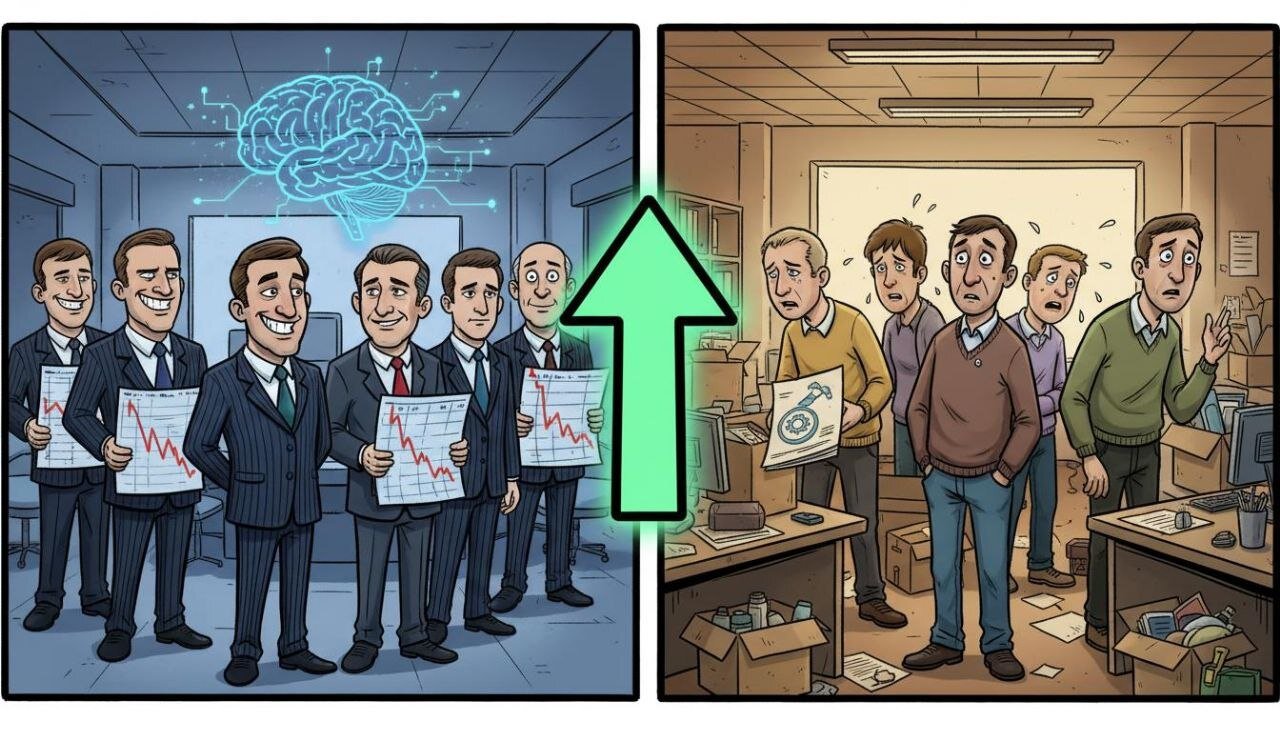
It started, as these things often do, with a memo.
In late April 2026, Meta's Vice President of People, Janelle Gale, sent a message to staff that landed with the subtlety of a margin call on a leveraged position: the company would cut approximately 8,000 jobs—roughly 10% of its workforce—while simultaneously leaving another 6,000 roles unfilled. The reason? To "offset other investments we're making." Those "other investments," of course, were in artificial intelligence. Meta plans to spend more than $115 billion on AI infrastructure this year alone, a figure that would make a small nation's GDP blush.
Not to be outdone in the corporate restructuring Olympics, Microsoft rolled out an early retirement package targeting approximately 7% of its U.S. workforce. The software giant, which has bet the farm on its Copilot AI assistant and its partnership with OpenAI, framed the move as "streamlining operations" and "aligning talent with strategic priorities."
But here's the thing that has Silicon Valley insiders, labor economists, and anyone who's ever had to explain to their family what they actually do for a living asking the same question: Are these companies really replacing humans with AI, or are they just using AI as a very expensive, very convenient excuse?
Welcome to the era of "AI washing"—where the world's most powerful corporations invoke the specter of artificial intelligence to justify decisions that might have more to do with balance sheets and stock prices than with any actual technological revolution.
What Is "AI Washing," Anyway?
The term "AI washing" borrows from its older cousin, "greenwashing"—the practice of companies making themselves appear more environmentally friendly than they actually are. In the AI context, it refers to the tendency of corporations to invoke artificial intelligence as a rationale for business decisions, particularly cost-cutting measures, without the technology actually being the primary driver.
Think of it as the corporate equivalent of "the dog ate my homework." Except the dog is a $100 billion data center, and the homework is 15,000 people's livelihoods.
The theory goes something like this: Companies that have made massive, potentially ill-advised investments in AI infrastructure need to show shareholders that those bets are paying off. What better way to demonstrate AI's transformative power than by announcing that you're eliminating jobs "because of AI"? It creates a narrative of technological inevitability—one where resistance is not just futile, but economically irrational.
The Layoff Scoreboard: Who's Cutting and What They're Saying
The job cuts at Meta and Microsoft are just the most visible tip of a much larger iceberg. Across the tech industry and beyond, companies are wielding the AI scythe with varying degrees of enthusiasm and credibility.
Meta leads the pack with its announcement of 8,000 layoffs plus 6,000 unfilled positions. The company, which has spent the past two years rebranding itself around the metaverse (with mixed results), is now going all-in on AI. CEO Mark Zuckerberg has made it clear that he believes AI agents will eventually handle much of the company's content moderation, customer service, and even software engineering. Whether those agents actually exist in a form that can replace 14,000 humans is a question the company seems less eager to answer.
Microsoft's approach is more genteel but no less consequential. The company is offering early retirement packages to roughly 7% of its U.S. employees—an estimated 10,000 to 15,000 people. Unlike Meta's blunt-force layoffs, Microsoft's "voluntary separation program" allows the company to reduce headcount without the negative publicity of mass firings.
But the trend extends far beyond the usual Silicon Valley suspects:
- Atlassian, the Australian software company behind Jira and Confluence, announced it would cut 5% of its workforce—about 500 jobs—citing the need to "invest in AI capabilities."
- Block (formerly Square), the fintech company founded by Jack Dorsey, eliminated approximately 1,000 positions, with CEO Dorsey stating the company needed to become "more AI-native."
- WiseTech, an Australian logistics software firm, cut 200 jobs while simultaneously announcing a $100 million AI investment.
- Oracle, never one to miss a cost-cutting opportunity, has quietly reduced its workforce by an estimated 3,000 positions across multiple divisions, with AI cited as a factor in internal communications.
Add it all up, and you're looking at tens of thousands of jobs eliminated across the tech sector in the span of a few months, all draped in the language of AI transformation.
Three Views on AI: The Believers, the Skeptics, and the Pragmatists
View 1: The Intelligence Explosion Is Here
On one end of the spectrum sit the true believers—people like Matt Shumer, CEO of AI startup HyperWrite, who recently published an essay comparing the current moment to "the weeks before COVID," suggesting that an "intelligence explosion" is imminent. In this view, AI isn't just getting better; it's approaching a tipping point where it will rapidly surpass human capabilities across virtually every domain.
Shumer's essay, which made the rounds in tech circles, argued that we are on the verge of AI systems that can autonomously improve themselves, leading to an exponential acceleration in capability. "The next few months will be unlike anything we've seen," he wrote, echoing a sentiment that has become increasingly common in Silicon Valley's AI circles.
View 2: It's Mostly Hype
On the opposite end are the skeptics, who argue that the current AI boom is more bubble than breakthrough. They point to the fact that despite billions in investment, AI systems still struggle with basic reasoning, make factual errors with confidence (the infamous "hallucinations"), and require massive amounts of human oversight to be even minimally useful.
View 3: Useful Tool, Limited Impact
The third view—and perhaps the most widely held among people who actually work with AI on a daily basis—is that the technology is a genuinely useful tool that will augment human work rather than replace it entirely. In this view, AI is like Excel: transformative for certain tasks, irrelevant for others, and requiring human judgment to use effectively.
🔥 The Skeptical Take: Follow the Money
So which view is correct? And more importantly, are these layoffs really about AI at all?
The skeptical case rests on several compelling observations:
First, the timing is suspiciously convenient. The tech industry hired aggressively during the pandemic, when remote work, e-commerce, and digital services saw explosive growth. When that growth normalized, companies needed to reduce headcount. But "we overhired during a bubble" doesn't play well with investors. "We're strategically repositioning for the AI era" sounds much better.
Second, the actual AI capabilities being deployed don't match the rhetoric. While AI can indeed write code, generate images, and draft emails, it still requires significant human oversight. The idea that Meta has AI systems capable of replacing 14,000 employees is, to put it charitably, not supported by publicly available evidence.
Third, the financial incentives are transparent. Meta's $115 billion AI spending commitment represents a massive bet that needs to be justified to shareholders. Announcing layoffs "because of AI" creates a narrative that those investments are already yielding returns, even if the actual connection is tenuous.
Fourth, the job cuts don't align with where AI is actually being deployed. Many of the eliminated positions are in areas—sales, marketing, human resources—where AI tools are still relatively immature. If these companies were truly replacing workers with AI, you'd expect to see deeper cuts in software engineering and data analysis, where AI tools are most advanced. Instead, those departments remain largely intact.
Evidence For and Against the AI Washing Theory
The Case For AI Washing
- Vague justifications: When pressed for specifics about how AI is replacing particular roles, companies tend to offer generalities rather than concrete examples.
- Precedent: The tech industry has a long history of using technological narratives to justify business decisions. The "dot-com" era saw companies rebrand as internet businesses to boost valuations.
- Stock price correlation: In several cases, layoff announcements framed around AI have been followed by stock price increases, suggesting that markets are rewarding the narrative regardless of its factual basis.
- The Shumer critique: Even some AI enthusiasts are skeptical of the most extreme claims. Critics noted that Shumer's "intelligence explosion" essay contained remarkably little hard data and read more like a product pitch than a rigorous analysis.
The Case Against AI Washing
- Real AI capabilities: It's undeniable that AI has made genuine advances in recent years. Large language models can write code, draft documents, and handle customer inquiries with increasing sophistication.
- Corporate efficiency pressures: Even if AI isn't ready to fully replace workers, companies may be using the technology to justify efficiency improvements that were long overdue.
- Competitive dynamics: In an industry where every major player is investing heavily in AI, companies may feel pressure to demonstrate AI-driven efficiency gains to remain competitive.
- Long-term trajectory: While AI may not be ready to replace most jobs today, the technology is improving rapidly. Companies may be making strategic bets on a future that, while not yet here, is approaching faster than many realize.
The Hot Take: Corporate Accountability in the Age of AI Theater
Here's where things get spicy.
The real scandal isn't that companies are using AI as a smokescreen for layoffs. The real scandal is that it's working.
Wall Street has rewarded these announcements with stock price bumps. Analysts have praised the "strategic discipline" of companies cutting jobs while investing in AI. And the general public, bombarded with headlines about AI revolutionizing everything, has largely accepted the narrative that these job losses are simply the inevitable price of progress.
But let's be clear about what's actually happening. Meta is spending $115 billion on AI infrastructure while firing 8,000 people. That's not a story about AI replacing workers. That's a story about a company making a massive capital investment and choosing to fund it by reducing labor costs. The AI is just the packaging.
What's needed is something that Silicon Valley has historically resisted: transparency. If a company claims it's eliminating jobs because of AI, it should be required to demonstrate—specifically, measurably, and verifiably—how AI is performing the tasks previously done by those workers. Not in pilot programs. Not in PowerPoint presentations. In actual production environments, at scale, with real accountability.
Until that happens, "AI washing" will remain not just a clever portmanteau, but a profitable corporate strategy.
What About the White-Collar Apocalypse?
A word on the broader narrative that AI will soon automate "all white-collar work."
This idea, which has gained currency in certain tech circles, deserves serious scrutiny. While it's true that AI can increasingly perform tasks that were once the exclusive domain of educated professionals—writing code, analyzing data, drafting legal documents—the reality of most white-collar work is far messier than the automation narrative suggests.
Consider what most knowledge workers actually do all day. They navigate ambiguous briefs from clients who don't know what they want. They mediate between competing interests within their organizations. They make judgment calls based on incomplete information. They build relationships, manage politics, and navigate organizational culture.
These activities are not just technically difficult to automate; they're conceptually difficult to even define in a way that an AI system could address. An AI can write a marketing email. It cannot decide whether that email aligns with a company's brand strategy, navigate the internal approval process, or handle the fallout if it offends a key stakeholder.
Coding, it turns out, may be unusually susceptible to AI automation precisely because it's relatively well-defined. Inputs and outputs are clear. Success criteria are objective. The work is, by design, reducible to instructions that a machine can follow.
Most professional work is not like coding. And the gap between "AI can write Python scripts" and "AI can replace a mid-level manager" is far wider than the headlines suggest.
Conclusion: What's Really Happening Here?
So what's the verdict? Are Meta and Microsoft genuinely replacing workers with AI, or are they engaged in a sophisticated form of corporate theater?
The honest answer is: it's complicated, and probably a bit of both.
AI is real, and it's getting better. Some of the jobs being eliminated probably are being automated, or will be soon. But the scale and timing of these cuts suggest that something else is going on too—a recalibration after pandemic-era overhiring, a response to investor pressure, and a strategic effort to rebrand cost-cutting as technological progress.
The "AI washing" theory doesn't require that AI be entirely fake. It only requires that AI be invoked as a justification for decisions that have other, less glamorous causes. And on that standard, the evidence is compelling.
What we're witnessing is the collision of two powerful forces: genuine technological change and corporate incentive structures that reward narratives over reality. The result is a kind of theater in which companies perform their AI transformations for an audience of investors, analysts, and regulators, while the actual relationship between AI capabilities and employment decisions remains murky at best.
For the workers caught in the middle, the distinction may not matter much. Whether you're fired "because of AI" or "because of shareholder value," the result is the same: you're updating your LinkedIn profile and wondering how to explain a gap in your resume.
But for the rest of us—policymakers, investors, and citizens trying to make sense of a rapidly changing economy—it's crucial to distinguish between genuine technological displacement and corporate narrative management. The future of work depends on it.
The machines aren't coming for our jobs. At least, not all of them. But the narratives about the machines? Those are already here. And they're remarkably effective.