
One morning last year, Jacobus Louw set out on his daily neighborhood walk to feed the seagulls. Except this time, he recorded several videos of his feet and the view as he walked on the pavement. The video earned him $14 — about 10 times South Africa's minimum wage, or for Louw, a 27-year-old based in Cape Town, half a week's worth of groceries.
The video was for an "Urban Navigation" task Louw found on Kled AI, an app that pays contributors for uploading their data to train artificial intelligence models. In a couple of weeks, Louw made $50 by uploading pictures and videos of his everyday life.
Thousands of miles away in Ranchi, India, Sahil Tigga, a 22-year-old student, regularly earns money by letting Silencio — which crowdsources audio data for AI training — access his phone's microphone to capture ambient city noise. He travels to unique settings, like hotel lobbies not yet documented on Silencio's map. He earns over $100 a month doing this, enough to cover all his food expenses.
And in Chicago, Ramelio Hill, an 18-year-old welding apprentice, made a couple hundred dollars by selling his private phone chats with friends and family to Neon Mobile, a conversational AI training platform that pays $0.50 per minute. For Hill, the calculation was simple: he figured tech companies already capture so much of his private data, so he might as well get a cut of the profit.
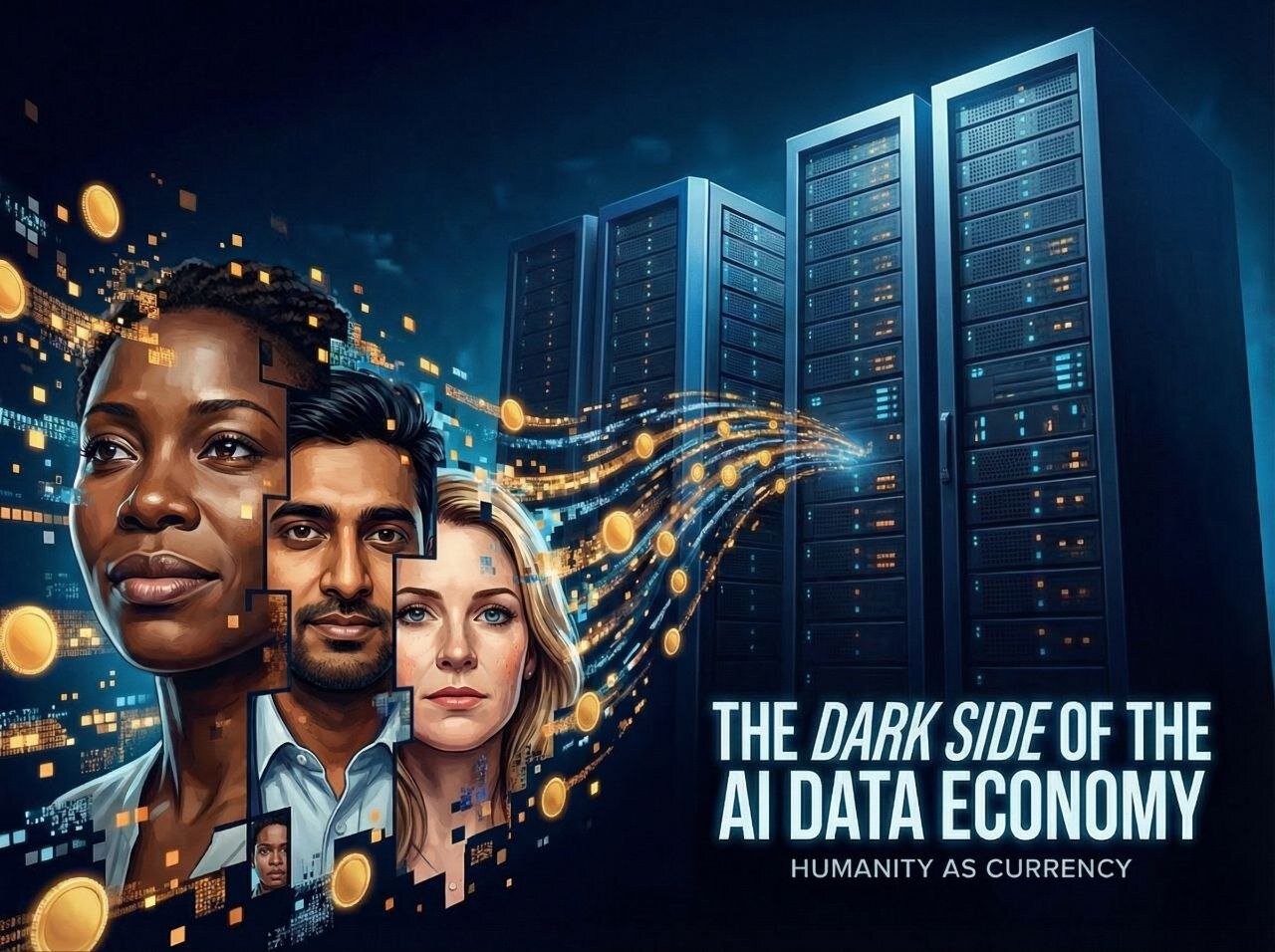
These gig AI trainers — who upload everything from scenes around them to photos, videos and audio of themselves — are at the frontlines of a new global data gold rush. As Silicon Valley's hunger for high-quality, human-grade data outpaces what can be scraped from the open internet, a thriving industry of data marketplaces has emerged to bridge the gap. From Cape Town to Chicago to India, thousands of people are now micro-licensing their biometric identities and intimate data to train the next generation of AI.
The Data Marketplace Ecosystem
The platforms operating in this space have created a sophisticated gig economy around the most valuable commodity in AI: human data.
Kled AI specializes in visual data — videos and photos of everyday activities, environments, and scenarios. Contributors complete tasks like "Urban Navigation" or "Morning Routine" and get paid per submission.
Silencio, backed by Y Combinator, crowdsources audio data. The app accesses your phone's microphone to capture ambient noise — traffic, restaurants, public spaces — along with voice recordings. Users are paid for the quantity and quality of audio they contribute.
Neon Mobile focuses on conversational data, paying $0.50 per minute for recordings of phone calls, chats, and natural dialogue. The platform explicitly markets itself as a way to monetize conversations you're already having.
ElevenLabs, the AI voice cloning company, allows users to digitally clone their voices and license them for various applications — audiobooks, customer service, content creation.
Luel AI, also Y Combinator-backed, acquires multilingual dialogue samples at roughly $0.15 per minute, building datasets for translation and language models.
Together, these platforms represent a new category: human data marketplaces. They're not scraping the web. They're buying lives, one gig at a time.
The Economic Math
For contributors in developed countries like the US, the payouts are modest side income — a couple hundred dollars for hours of personal data. But for contributors in developing economies, these platforms represent meaningful economic opportunity.
Jacobus Louw's $14 video payment equals 10 times South Africa's minimum wage. Sahil Tigga's $100 monthly income covers his entire food budget as a student in India. When you're earning $2-3 per day in the formal economy, $50-100 per month from data tasks is transformative.
This creates a perverse incentive structure. The platforms don't pay what the data is worth — they pay what contributors in the poorest markets will accept. A voice recording that might train a customer service bot handling millions of calls generates $10-20 for the speaker. The value created downstream is orders of magnitude larger, but it doesn't flow back to the source.
It's digital colonialism by another name. The Global South provides the raw material — biometric data, daily life, voices, conversations. The Global North extracts value through AI models that automate work, replace jobs, and generate profits. The asymmetry is stark.
The Irrevocable Problem
Here's where the gig economy model reveals its darkest side. These platforms don't just buy your data. They buy it forever.
The contracts contributors sign — often without reading, often without understanding — grant irrevocable, royalty-free licenses that allow companies to create "derivative works." A 20-minute voice recording today could power an AI customer service bot for the next decade. A video of your morning routine could train computer vision models used in surveillance systems worldwide.
You can't revoke the license. You can't demand additional payment if the model becomes massively successful. You can't stop your voice from being used in ways you never anticipated. The transaction is permanent, even though the payment was one-time.
This isn't employment. It's not even gig work in the traditional sense. It's permanent alienation of your biometric identity — your face, your voice, your patterns of movement, your way of speaking — in exchange for a small payout.
The power imbalance is extreme. Contributors are often desperate for income, unfamiliar with technology contracts, and unaware of the long-term implications. The platforms know exactly what they're buying and exactly what it's worth. They just don't pay that price.
Why This Is Happening Now
The AI industry is hitting a data wall. The easy sources — web scraping, books, Wikipedia, Reddit — have been exhausted. The highest-quality models require data that doesn't exist on the public internet: natural conversations, diverse voices, authentic human behavior in specific contexts.
Regulatory pressure is also making scraping harder. Lawsuits against AI companies for using copyrighted material without permission are proliferating. The EU's AI Act imposes transparency requirements. Companies can no longer just grab data from wherever they want.
The solution? Go direct to the source. Pay people for their data. It's cleaner legally — you have a contract, a license, permission. It's higher quality — contributors are incentivized to provide good data to get paid. And it's exploitable — you can pay Global South wages for data that will power Global North profits.
This is the next phase of AI development. The training data that built GPT-4 came from the internet. The training data that builds GPT-6 will come from people's lives, purchased one gig at a time.
The Consent Illusion
Supporters of this model argue it's consensual. People choose to participate. They're getting paid. What's the problem?
But consent requires understanding, and understanding requires transparency. Do contributors know that their voice might be used to replace call center workers in their own country? Do they know that their biometric data could be used to train surveillance systems? Do they understand that "irrevocable license" means forever?
The platforms aren't rushing to explain these implications. The contracts are long, legalistic, and often in English — a barrier for many Global South contributors. The marketing emphasizes easy money, not permanent consequences.
Ramelio Hill, the 18-year-old in Chicago, summed up the attitude that makes this possible: "Tech companies already capture so much of my private data, so I might as well get a cut of the profit."
He's not wrong. The surveillance economy has normalized the extraction of personal data without compensation. These platforms just formalize the transaction — and reveal how little we're actually worth to the tech industry in dollar terms.
🔥 The Hot Take: Data Dignity Is a Myth
There's a concept in tech ethics called "data dignity" — the idea that people should be compensated when their data is used to create value. These platforms claim to offer data dignity. They're lying.
Real data dignity would mean ongoing royalties when your data contributes to successful products. It would mean transparency about how your data is used. It would mean the ability to revoke consent if uses change. It would mean collective bargaining, not individual contracts signed under economic duress.
What these platforms offer is data exploitation dressed up as empowerment. They use the language of the gig economy — flexibility, opportunity, side income — to obscure a fundamentally extractive relationship. You don't get equity in the AI models trained on your data. You don't get a say in how they're used. You get a one-time payment and a permanent loss of control over your biometric identity.
The saddest part? For many contributors, this is the best option available. In economies with 30-40% youth unemployment, in countries where $100/month is the difference between eating and not eating, "selling your face to AI" sounds like opportunity. The platforms know this. They count on it.
This is what the AI economy looks like at the ground level: not gleaming data centers and billion-dollar valuations, but people in developing countries selling pieces of themselves for grocery money while tech executives talk about "democratizing AI." The democracy is thin. The extraction is real.
What Comes Next
As AI models become more sophisticated, the demand for high-quality human data will only increase. Current models can generate text and images. Future models will need to understand human behavior, emotion, and social dynamics at a deeper level. That requires data that can only come from real human experience.
The data marketplace industry will expand. More platforms will emerge. More people will participate. The payments might increase slightly as competition for contributors heats up, but the fundamental structure — irrevocable licenses, one-time payments, permanent alienation of biometric rights — will likely remain.
Regulators might eventually step in. The EU could mandate ongoing royalties or revoke-ability. US states might require clearer disclosure of how data will be used. But regulation moves slowly, and the AI industry moves fast. By the time meaningful protections exist, millions of people will have already sold their identities.
The only real solution is structural: AI companies should be required to share equity or ongoing revenue with the people whose data makes their products possible. If your voice trains a customer service bot that handles a million calls, you should get a fraction of the value created. If your face trains a facial recognition system, you should have a say in who can use it.
This isn't radical. It's how intellectual property works in other contexts. If you write a song, you get royalties when it's played. If you invent something, you get licensing fees. The only reason biometric data is treated differently is that the tech industry has convinced us that personal data isn't really property — it's just... raw material. Free for the taking.
The Bottom Line
The AI data gold rush is creating a new underclass: digital miners extracting value from their own identities for the benefit of distant corporations. They're not employees. They're not even contractors. They're sources.
Jacobus Louw, Sahil Tigga, and Ramelio Hill aren't villains. They're rational actors responding to economic incentives. The villain is a system that makes selling your biometric identity a reasonable choice — and a tech industry that profits from the transaction while pretending it's "empowerment."
As AI becomes more powerful, more ubiquitous, and more profitable, the demand for human data will only grow. The question is whether we'll build an economy where that data is treated with dignity — or one where it's just another resource to be extracted from the vulnerable.
Right now, the answer is clear. And it's not pretty.