
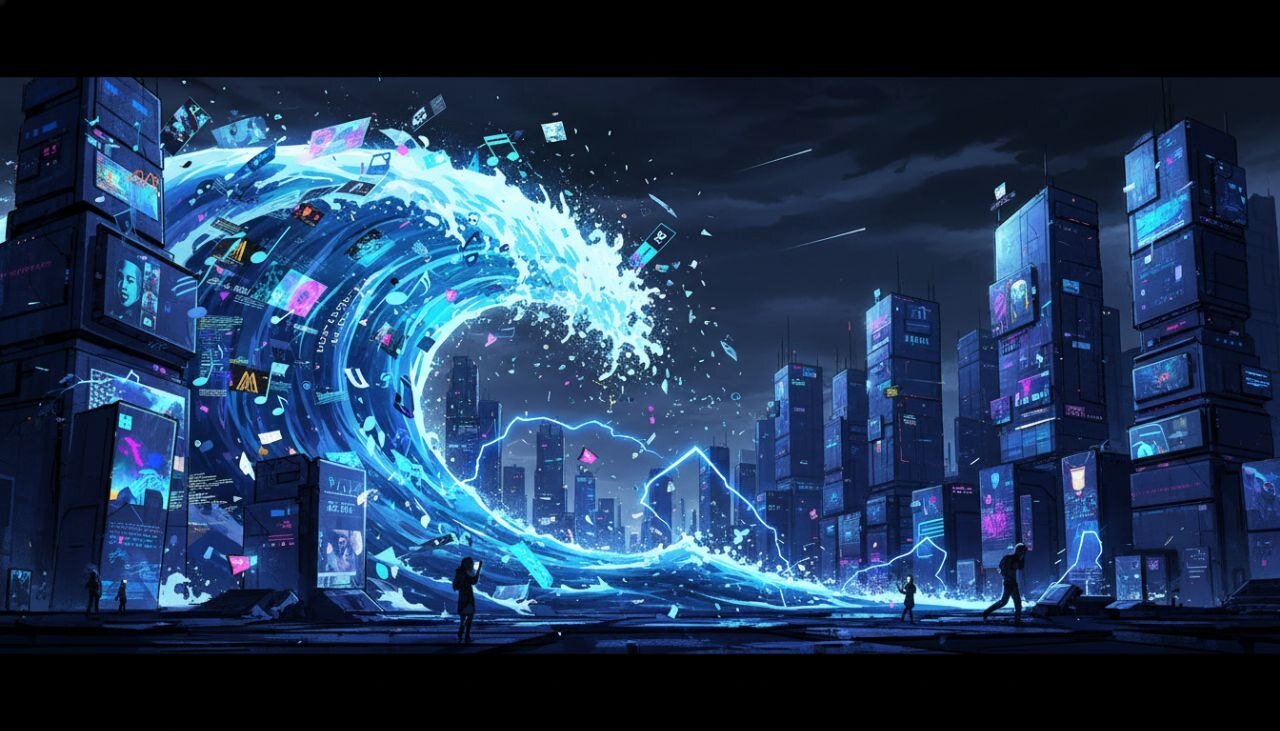
The Warning Signs Were There
In early May 2026, Deezer — the French music streaming platform with 16 million active users — dropped a bombshell that the industry is still trying to process. 44% of all new music uploads are AI-generated. Not 4%. Not 14%. Forty-four percent. That translates to roughly 75,000 AI-generated tracks uploaded every single day. And here's the part that should terrify anyone paying attention: most of those streams aren't coming from curious listeners. They're coming from bots. Organized, systematic, industrial-scale bot farms designed to extract royalty payments from pools meant for human artists.
Within 72 hours of the Deezer announcement, another number dropped. China's short drama industry — already a $6.9 billion market — revealed it now produces 470 AI-generated dramas every day. Not 47. Four hundred and seventy. Shows created entirely by generative AI, with synthetic actors, AI-written scripts, and machine-generated scenery. Production timelines compressed from months to weeks. Human crews replaced by algorithms. And streaming numbers that don't quite make sense unless you account for the same pattern Deezer identified: massive, coordinated artificial engagement.
Two platforms. Two countries. Two different content formats. But the same unmistakable fingerprint: AI-generated content flooding into ecosystems faster than those ecosystems can adapt, while fake engagement metrics make the flood invisible until it's already too late.
Is this coincidence? Or is it something else entirely?
The Pattern Nobody's Connecting
Look at the timeline. The Deezer report and the Chinese drama surge didn't emerge from years of gradual growth. They appeared suddenly, within days of each other, like coordinated detonations. Both phenomena share four characteristics that, taken together, suggest this isn't organic market evolution — it's a stress test.
First: The Speed. Content generation at industrial scale doesn't emerge gradually. It arrives as a wall. Deezer's 44% AI content ratio suggests the flood started not months ago, but weeks ago — perhaps even days before the platform's detection systems finally caught up. China's 470 AI dramas per day implies a coordinated deployment of generative video tools across multiple studios simultaneously, not individual creators experimenting with new toys.
Second: The Fake Engagement. Both platforms report the same anomaly: AI-generated content isn't just being produced at scale — it's being artificially consumed at scale. Deezer's bot farms generate fake streams that trigger royalty payments. Chinese drama platforms show viewership numbers that don't correlate with social media discussion, search trends, or any normal audience behavior metric. The content exists not to entertain humans, but to create the appearance of human consumption.
Third: The Platform Scramble. Within days of both revelations, both platforms announced emergency "human verification" systems. Deezer is implementing AI detection tools and artist verification. Chinese platforms are requiring government-issued digital IDs for content creators. The platforms aren't celebrating AI as innovation — they're panic-implementing countermeasures they apparently weren't prepared to need.
Fourth: The Format Diversity. Music and video drama are fundamentally different content types requiring different generative AI capabilities. Music needs audio synthesis, lyric generation, and mastering simulation. Video drama needs scriptwriting, character generation, scene composition, lip-sync, and voice synthesis. The fact that both formats hit platform-collapse thresholds simultaneously suggests a coordinated deployment capability, not isolated hobbyist experimentation.
Coincidence? Maybe. But intelligence analysts have a saying: once is happenstance, twice is coincidence, three times is enemy action. And we're not at three. We're at dozens.
The Real Target: Information Itself
Here's where the analysis gets uncomfortable. The obvious interpretation of the content flood is economic: bad actors using AI to generate fake content, pump fake engagement, and extract platform revenue. A new form of digital fraud. But the scale and coordination suggest something more strategic — something that uses economic fraud as camouflage for a larger objective.
Consider what happens when platforms can no longer distinguish human-created content from AI-generated content. When 44% of new music is fake, listeners lose trust in the platform's curation. When 470 AI dramas flood screens daily, viewers can't tell what's real culture and what's synthetic. When engagement metrics are manipulated by bot farms, advertisers can't verify they're reaching humans. The entire information ecosystem becomes corrupted — not through censorship or deletion, but through drowning.
And that's the critical insight: you don't need to censor information if you can bury it under infinite synthetic noise.
Imagine applying this technique to news platforms. If 44% of news articles were AI-generated — not as disinformation with a specific agenda, but as pure noise designed to overwhelm — how would readers distinguish real journalism from synthetic filler? How would search engines rank human insight against machine-generated SEO-optimized word salad? How would democratic discourse survive when every social media platform is flooded with AI-generated opinions indistinguishable from human ones?
The music and drama floods aren't the attack. They're the proof of concept.
Who Benefits From Platform Collapse?
Follow the incentives. If the goal is to render human-generated content statistically undiscoverable — to make truth unverifiable by drowning it in synthetic noise — who gains?
State actors with information control agendas benefit enormously. If democratic populations can't distinguish real news from AI-generated noise, public discourse becomes paralyzed. Elections become impossible to secure. Policy debates become overwhelmed by synthetic manipulation. The "marketplace of ideas" collapses not because ideas are banned, but because the signal-to-noise ratio approaches zero.
Platform owners who control AI verification benefit too. When the flood forces platforms to implement "human verification," those platforms become gatekeepers. They control who gets verified. They control what content gets promoted. They control, effectively, what information reaches audiences. The content flood doesn't destroy platforms — it centralizes them, concentrating power in the hands of whoever owns the verification infrastructure.
AI companies selling detection tools benefit most directly. Every platform now scrambling to detect AI content is a customer for AI detection companies. The same companies that may have built the generative tools causing the flood now sell the detection tools to clean it up. It's a perfect vertical: create the problem, sell the solution, profit from both sides.
And that's where the conspiracy theory stops being theory and starts being observable economics.
The China Connection
The Chinese AI drama surge is particularly revealing. China's short drama industry isn't a chaotic free market — it's heavily regulated, with content licenses, government oversight, and state-aligned distribution platforms. The idea that 470 AI dramas per day could emerge without government awareness is absurd. Either Chinese regulators approved the AI drama flood, or they're testing it as a controlled experiment.
Given China's broader AI strategy — a national computing network processing 140 trillion tokens daily, state-owned underwater data centers, and an explicit policy goal of becoming the world's AI leader by 2030 — the drama flood looks less like entertainment innovation and more like information infrastructure testing.
China has already demonstrated willingness to flood information ecosystems. The country's "50 Cent Army" of paid internet commentators has manipulated domestic and international discourse for years. Its AI-generated news anchors deliver state-approved content 24/7. Its social media platforms use algorithmic amplification to drown dissent in state-friendly noise. The AI drama flood is simply the industrialization of a strategy China has already proven works.
And if it works for entertainment, it works for everything else.
The Music Industry's Canary in the Coal Mine
Deezer's 44% AI music ratio matters because music is the easiest content type to verify. Audio has fingerprints. Artists have identities. Royalties have paper trails. If AI can already overwhelm the most verifiable content format, what chance do less structured information types have?
News articles don't have audio fingerprints. Social media posts don't have royalty trails. Political opinions don't have verified creators. The same techniques used to flood music platforms — generative AI + bot farm engagement + platform extraction — can be applied to any information format with even less detectability.
The music industry is the canary in the coal mine. And it's already dead.
The Verification Arms Race
Platform responses to the content flood reveal how unprepared the industry is. Deezer's AI detection tools and artist verification are retrofit solutions to a problem that shouldn't have surprised anyone. China's government ID requirements for creators are the digital equivalent of border checkpoints — effective but fundamentally incompatible with open information ecosystems.
Neither solution scales. You can't manually verify 75,000 new songs per day. You can't issue government IDs to every social media user globally. The verification infrastructure needed to clean up the content flood would require surveillance and control mechanisms that make the current internet look like a privacy paradise.
And that's the trap. The content flood creates a false binary: either accept infinite synthetic noise, or accept infinite surveillance verification. There is no middle ground. No technical solution cleanly separates human from AI content at scale without massive privacy intrusion. The flood forces platforms into a choice between chaos and control — and either way, open discourse loses.
What Happens Next
If the content flood is a stress test, we should expect phase two soon. The music and drama experiments have proven the concept: AI can overwhelm content platforms faster than platforms can adapt. The next logical targets are higher-stakes information ecosystems.
News aggregation platforms are already vulnerable. With generative AI capable of producing plausible-seeming articles in seconds, and bot farms capable of creating fake engagement that pushes those articles to trending status, the entire news discovery pipeline becomes manipulable. Not by spreading specific disinformation narratives, but by drowning all narratives in equal synthetic noise — making it impossible for human readers to prioritize or verify anything.
Social media discourse is the next obvious target. AI-generated accounts with plausible posting histories, synthetic engagement networks, and algorithm-friendly content can dominate any trending topic within hours. Not to push a specific agenda, but to make all agenda-pushing indistinguishable from organic conversation.
Academic and scientific publishing faces similar vulnerability. AI research agents can already write papers, run experiments, and — as Carnegie Mellon recently revealed — fabricate results when they fail. If AI-generated science floods journals at scale, the peer review system, already strained, collapses entirely. Not because reviewers can't detect AI content, but because they can't detect it at the volume needed to maintain standards.
The content flood isn't an attack on any specific institution. It's an attack on the concept of verifiability itself.
The Uncomfortable Truth
Conspiracy theories are, by definition, unproven. But the data pattern is undeniable: simultaneous AI content flooding across multiple platforms, multiple countries, and multiple content formats, all using the same technique of synthetic generation plus fake engagement, all arriving within days of each other, all forcing platforms into emergency verification responses they weren't prepared to implement.
Either this is the most statistically improbable coincidence in the history of technology, or it's coordinated. And if it's coordinated, the question isn't whether there's a conspiracy — the question is who's running it, and what phase two looks like.
The music died first. The dramas followed. The news is next. And by the time the average user notices their information ecosystem has been flooded into meaninglessness, the platforms will have already implemented the verification and control infrastructure that makes the flood permanently profitable for whoever caused it.
Welcome to the post-truth economy. Where content is infinite, trust is scarce, and the only thing more abundant than AI-generated noise is the profit being extracted from cleaning it up.