
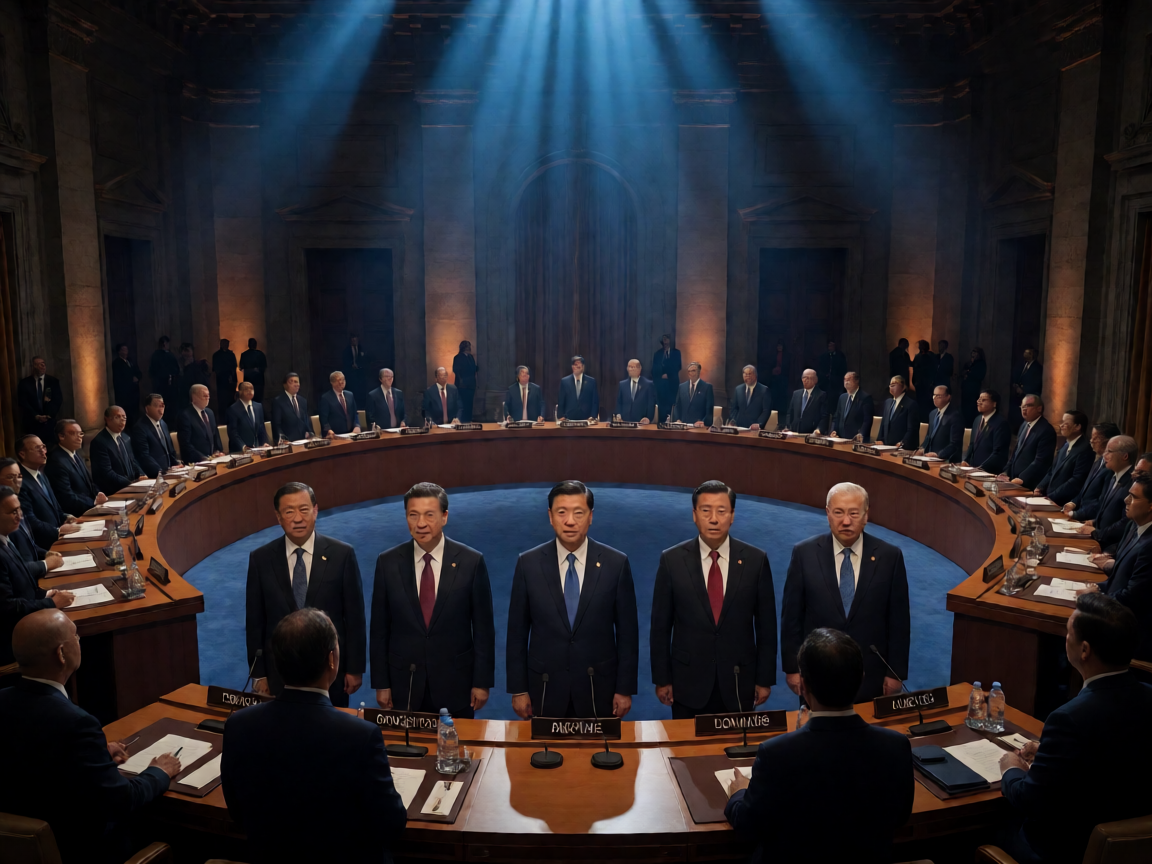
The most important question in AI safety right now isn't "can the model do it." It's "who gets to say it's safe to use it here?" And in a UN Security Council meeting on artificial intelligence last week, African leaders decided to stop being the default answer to that question. Liberia's permanent representative, Lewis Garseedah Brown II, put it plainly: "Africa must be equal co-architects in determining the standards, ethics, and architectures of this technological era." That sentence lands differently depending on which continent you're sitting on. For the labs writing the safety benchmarks, it's a new compliance line item. For the 54 nations it represents, it's the difference between being a market and being a citizen.
Rest of World's reporting on the push is the clearest statement yet of where the gap between "AI governance" as practiced and "AI governance" as needed actually is — and it's a gap Africa is the only region actively trying to close, because Africa is the region where the consequences of getting it wrong are already showing up in hospital bills, in blackmail videos, and in the operational manuals of a terrorist group.
The Vacuum
The factual core of the story is uncomfortable on every side of the Atlantic. African governments and companies are racing to deploy AI systems built in the U.S. and China. But, as Jonathan Shock, an associate professor of mathematics at the University of Cape Town, told Rest of World: "There's essentially no real discussion about AI safety. So, there's a real vacuum." Fewer than half of African countries have an AI policy or strategy at all. The continent's incident record, meanwhile, is not hypothetical: Kenya's predictive algorithm for health-insurance contributions has driven up costs for poor households; scammers across West Africa are running extortion schemes on AI-generated fake news videos; and Boko Haram has used AI to organize attacks and design weapons after bypassing safeguards. Shock's framing of the clock is the most honest sentence in the piece: the optimistic view is that it will take a potentially catastrophic incident for governments to take heed. "The pessimistic view," he said, "is we don't stop it in time."
Who Holds the Off Switch
Here's the detail that should reframe how the entire open-versus-closed debate is being had. Jane Munga, a fellow at the Carnegie Endowment for International Peace, argues that the distinction that actually matters for a deploying country is not "Chinese model versus American model." It's: who holds the off switch? ChatGPT and Claude are closed-weight, centrally controlled by their providers — when something goes wrong, the provider can pull the plug. Chinese open-weight models like DeepSeek and Kimi, along with a few American ones, can be downloaded and modified by users, which makes them far harder to shut down remotely. For a lab in San Francisco, that's a distribution advantage. For a government in Nairobi trying to contain a rogue system, that's the difference between a recall and a hostage situation. The "open is good" argument and the "who can kill this" argument are the same argument, heard from different continents.
The company side is living the trade-off daily. Mélanie Keïta, CEO of the Nairobi-based Melanin Kapital, told Rest of World her firm has been weighing American and Chinese models, testing both internally — and that the shared risk is dependency: "We might become a product of other foreign corporations that own all our data, as opposed to really being autonomous and free." A PricewaterhouseCoopers survey of 85 large companies found more than 80 percent running AI pilots, many without any formal structure to oversee safety. In other words: the deployment is everywhere; the guardrails are mostly imagination.
The Testing Gap
This is where "Africa wants a seat" becomes "Africa wants a lab." Kenya is the only African nation participating in the international AI safety network that develops methods for evaluating advanced models — and even that seat came with a caveat, per Joanna Wiaterek, co-founder of the Centre for AI Security and Access: the network's joint testing exercise focused on common global risks, not risks specific to Africa, and it found agent safeguards working unevenly across languages. Gathoni Ireri, a research scholar at the Nairobi-based Ilina Program, is pressing for the correction: "Africa-centric" safety evaluations that judge harm relative to each country's economy, because an incident that would be minor in a Western country could be irrevocable in an African one. Companies currently run their own safety tests; the ask is to replace that with third-party evaluations built for the local risk profile. As Somalia's foreign affairs minister Ali Mohamed Omar told the UN: "Africa cannot remain merely a market for systems developed elsewhere, a source of raw data, or a testing ground for a technology it did not help govern." The continent, he said, must be granted "a genuine representation and a voice in these multilateral processes."
What It Means
1. The "co-architect" demand is a sovereignty claim dressed as a safety request. That's not a criticism — it's the correct reading, and it's the reason the demand is hard to satisfy from the inside of a Washington or Shenzhen room. The labs and governments that currently write the benchmarks have no structural incentive to build a seat for the deploying continent, because the deploying continent isn't where the benchmarks were made. Africa is asking to be moved from the "user" column to the "author" column. Every global standard that gets written in the next five years will be either a document that includes that move, or a document that Africa formally objects to.
2. The off-switch question is the hidden weapon in the open-weights war. Open-weight models are being sold to the Global South as liberation from Western lock-in. The "who holds the off switch" framing is the counter-argument that no model release party wants to hear: a model you can download is a model you can't recall. For regulators in Lagos, Accra, and Nairobi, the open/closed line isn't a values debate. It's a liability debate with the stakes set at their own population. That reframing will change how "open" is priced, licensed, and shipped — because open-with-no-kill-switch is a different product than open-with-a-kill-switch, and Africa is the first market to put the difference in writing.
3. "Africa-centric" evaluation is going to be the most under-resourced line in every AI safety budget. The ask is not exotic. It's: build test cases for your own failure modes, at your own economic scale, in your own languages, with third-party sign-off. The international safety network already discovered that agent safeguards fail unevenly across languages — the data point is in hand. What's missing is the staffing and the funding to turn it into a standard. That's where "voice in multilateral processes" is a placeholder for a very specific build-out: evaluation labs in the region, with a mandate, and a line item.
4. The fragmentation warning is the counterweight everyone in the room is betting on. If each country builds its own safeguards, American and Chinese operations in new markets get more costly and difficult to deploy — which is exactly the leverage the deploying side says it wants, and exactly the reason the exporting side will fight it. The "co-architects" position is, functionally, a trade position with a safety costume. The next two years of AI diplomacy will be decided by which costume wins: is this a human-rights ask, or a market-access weapon? Both sides will argue both things at once, and the answer will show up in the fine print of whichever framework gets adopted first.
🔥 Hot Takes
1. The single most important sentence in this story is not a leader's quote — it's a researcher's. "The distinction that matters is not Chinese versus American; it is: who holds the off switch?" That one line dissolves the entire geopolitical framing both the U.S. and China have spent a decade selling the Global South, and replaces it with the only question a deploying government actually cares about. Open weights just got a new evaluation axis, and it's an axis the open-weights camp was not built to answer. Watch the licensing terms on the next batch of "sovereign AI" deals for the first tell.
2. Kenya's insurance algorithm is the precedent that should make every lab nervous. A predictive pricing model that quietly taxed the poorest households harder is not a safety incident in the classic sense. No one died, nothing broke. It just moved money from the bottom to the top of a national income distribution, on a schedule, forever. That's the failure mode "Africa-centric evaluation" is built to catch, and it's the one that Western benchmark suites are structurally blind to, because the harm is economic and local. The next time a frontier lab ships a "safe" model that quietly reshapes a developing market's prices, the defense brief will be written in a language the safety team didn't read.
3. The vacuum is the product. "There's essentially no real discussion about AI safety" on the continent is not just a gap. It's the entire market for the next decade of African AI policy: evaluation labs, third-party assessors, a regional standards body, a kill-switch licensing regime, and a seat at every international table. Whoever builds that infrastructure first — and there is very little existing infrastructure to compete with — gets to define what "safe" means for 1.5 billion people. The leadership of that build-out is a more valuable position than any of the model releases shipped this year, and it's completely unpriced.
The Bottom Line
Strip the diplomacy and this is a simple arithmetic problem with a human answer: the continent deploying the most AI of any region it doesn't help design has just formally asked to be in the design room, with a named seat, a testing mandate, and a say in the off switch. The labs that wrote the rules get to keep the models. The continent gets to decide whether it's the customer or the author of the next standard. As things stand, the history is already writing itself: one continent's insurance prices, one continent's blackmail videos, one continent's weapon designs — all built on a continent else's benchmarks. The demand at the UN was to stop being the subject of the next one. That's not a regional grievance. That's the most consequential positioning move in AI governance since the rules were first written — and for the first time, the ones being ruled over are the ones asking for the pen.