The rollout was almost too quiet to notice. On Monday a new model appeared in the menu of Zhipu's Coding Plan subscription, listed with vision support and a one-million-token context window, and subscribers on the mid and team tiers got a 50 percent increase in their usage allowance. There was no launch event and no benchmark table, because at the time of the report the company had not published a technical introduction. The quietness is deliberate. The news is not the model on the menu; it is what is underneath it, and what is underneath it is a loop.
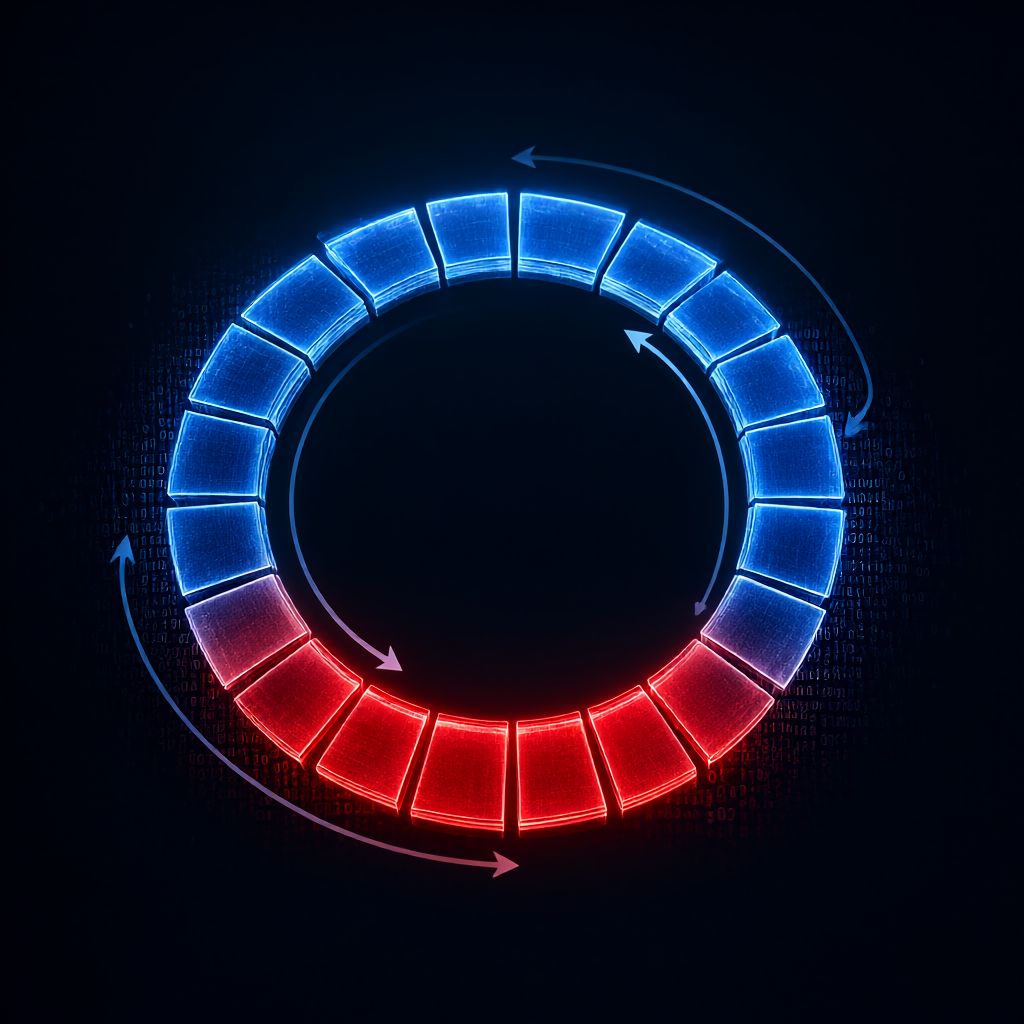
GLM-5.4 is Z.ai's first large model built on a loop transformer, and the loop is where 750 billion parameters do the work the company claims is 2 to 3 trillion. A standard language model runs each of its layers once per pass, and the once is what limits the depth. The loop model takes a block of 28 shared layers and runs the block twice, refining the intermediate results of the first pass on the second, which makes the network deeper without making it bigger. OpenAI has been using a similar architecture since the Astra generation, so the two labs that have defined the last two years of the frontier are now, without coordinating, in the same territory, and the territory is the loop.
The second pass is the mechanism
The conversion is not free, and the engineering is the interesting part. If a model simply overwrites its intermediate states on each pass, the activations grow sharply from round to round, and the later layers start seeing values outside the range they were trained on. Z.ai's answer is a set of dedicated gates, one per token and one per pass, that control how much of the new output flows back into the stream. The first pass builds the context cautiously; the second writes its changes back in full. On the difficult tokens, the first pass intervenes more strongly. The second pass would otherwise double the memory, so both passes share the cache for already-processed tokens, and the second stores its own extra values only in a small local window. The sparse attention selection, which a naive second pass would have to redo, is reused from the first. The result is that the overhead against the previous generation stays manageable even at the million-token window, and the throughput runs to 200 tokens per second off-peak, 70 to 80 under load.
The honest number in the whole release is the one from the test model, because the 750-billion model has no published benchmark yet, and no independent evaluation exists. The test is a 30-billion-parameter loop model against a baseline with the same parameters and ten percent more training compute. On the math benchmark it jumped from 19 to 30. The expert science questions went from 47 to 56, and the long-context test from 40 to 47. And the responses got shorter: 15 percent fewer tokens on the knowledge test, 12 percent fewer on the science questions. That last fact is the other half of the trade, because the reasoning moved out of the output tokens and into the loop. The model thinks in the second pass instead of in the answer, and the answer gets shorter for it. That matters commercially, because the output tokens are what the pricing curve charges for, and the curve is the one our 58 percent piece was about.
The open weights are the question
Z.ai plans to release the model weights, and the plan comes after the safety testing. That "after" is not a formality, because the previous generation says exactly why. The GLM-5.3 was held back from open release because of its vulnerability-finding abilities, and the finding that made the delay necessary came from Anthropic itself: the open-weight model could build exploits almost on par with the closed preview that was being tested against it. So the safety test on the 5.4 is not a stage door. It is a record, and the record was made by the 5.3, and the 5.4's release will follow the same test, and the much larger model that Z.ai says is coming will follow it too. The open-weights pipeline has a security stage now, and the stage is a fact about the capability, not a choice about the market.
The framing the company is putting on the model is the next thing to watch. Z.ai calls it the start of "Generalized Coding," the idea that code becomes the foundation for tasks well beyond software: the demo set includes a music video the model scored, a six-axis robot arm it designed in a CAD package, a complete game, and an interactive 3D scene built from custom shaders. Coding as the action language is the agent story, and the loop is the mechanism that does the thinking for it.
What it means
The depth war has two entry points now, and they are on opposite sides of the wall. The loop is the first architectural shift in years, and the shift is depth without the parameters. OpenAI took the first step with the Astra generation, and Zhipu took the second with the 750-billion claim. Both sides of the chip wall are now running the same trick, and the trick is the center of gravity. The 34 percent and the 28 percent, the two numbers our two-numbers piece measured, are still the shipment story. The loop is the architecture story, and the architecture is where the six points actually get closed, because a 750 that behaves like a 2.5 trillion does not need the 2.5 trillion to ship.
The 30-billion test is the real announcement, and the real number is 11 points on the math with 15 percent shorter answers. The 750 claim is not yet measured, and it will stay unmeasured until an independent lab runs it. What is measured is the 30: the same parameters, ten percent more compute, and a loop that buys the 11 points and deletes a fifth of the output. That is the economics the loop is really selling. Depth that does not cost tokens is depth that does not cost money, and the not-costing is the part that matters on a pricing curve that just moved 58 percent in one quarter.
The "after the safety tests" is the most consequential sentence in the release, and the consequences were written by the 5.3. The open-weights war has a new stage: gated releases. The 5.3 was held back because it found the holes, and the finding that made the hole-finding a fact was Anthropic's own. The 5.4's weights will follow the same test, and the larger model coming will follow it too. A pipeline with a security stage is a mature pipeline, and the maturity is the point. The 89 percent of enterprise spend that our trojan-horse piece measured was buying open models, and the open models are now the ones that have to pass the test, and the passing is the one that keeps them in the spend.
The margin gap is the reason the loop is an economics story, and the economics are in the 200. The Chinese labs are not matching the American margins, and the not-matching is why the open-weights model is a loss leader that only works on a falling cost curve. The loop cuts the cost of depth: 200 tokens per second off-peak is the number that makes the second pass affordable at the volume the subscription plans are already pushing. The 58 percent task price is the curve, and the 200 is the slope, and the slope is what the margin gap is measured against.
🔥 Hot Takes
1. The second pass is the whole story, because it is the first time in six years that the architecture moved instead of the parameter count. The transformer's last six years were width: more parameters, more memory, more money. The loop is the first serious break from that, and the break is 28 layers run twice. OpenAI broke first, quietly, in the Astra generation. Zhipu broke second, loudly, in a blog post with a 30-billion test table attached. The two breaks are the same move made on both sides of the wall in the same year, and the same-move-on-both-sides is what a genuine paradigm shift looks like, because it means the advantage is in the idea, not in the silicon, and the idea is the one thing the silicon wall does not block.
2. The 11 points and the 15 percent are the numbers that will get priced, and the pricing is the whole point of the open-weights strategy. The 750 claim will fade the moment an independent lab measures it and lands anywhere near the 2 to 3 trillion, because a 750 that measures like a 2.5 trillion is the end of the parameter race on the Chinese side. But the 30 is not going anywhere: 11 points on the math with a fifth fewer output tokens is a cost per answer, and the cost per answer is the number the CFO of every company in the 89 percent looks at. The loop is not selling capability. It is selling the price of the capability, and the price is the one that compounds on the curve.
3. The gated release is the quietest and most important change in the open-weights war, and it is the one nobody announced. There is no press release that says the open models now have a security stage, because the stage is simply the "after the safety tests" in the 5.4's release plan, and the plan exists because of the 5.3's exploit record. The 89 percent was buying open models released on a schedule. The next 89 is going to buy open models released on a test, and the test keeps them out of the exploit class, which is what keeps the enterprise spend where it is. The open-weights war just got a quality gate: the trojan horse now has a lock, and the lock is what the 5.3's record built.
So the quiet rollout on the subscription menu is the loud architecture underneath it. The loop is the second pass, and the second pass is the depth, and the depth is what the 750 is claiming and what the 30 is proving, in 11 points and a fifth fewer tokens. The weights are coming, and the coming is the one that happens after the tests, and the tests are the ones the 5.3's record made necessary. The width era is over. The depth era is the one both sides of the wall are in now, and the depth is the story the 30 billion is telling, in the only numbers that are measured.