
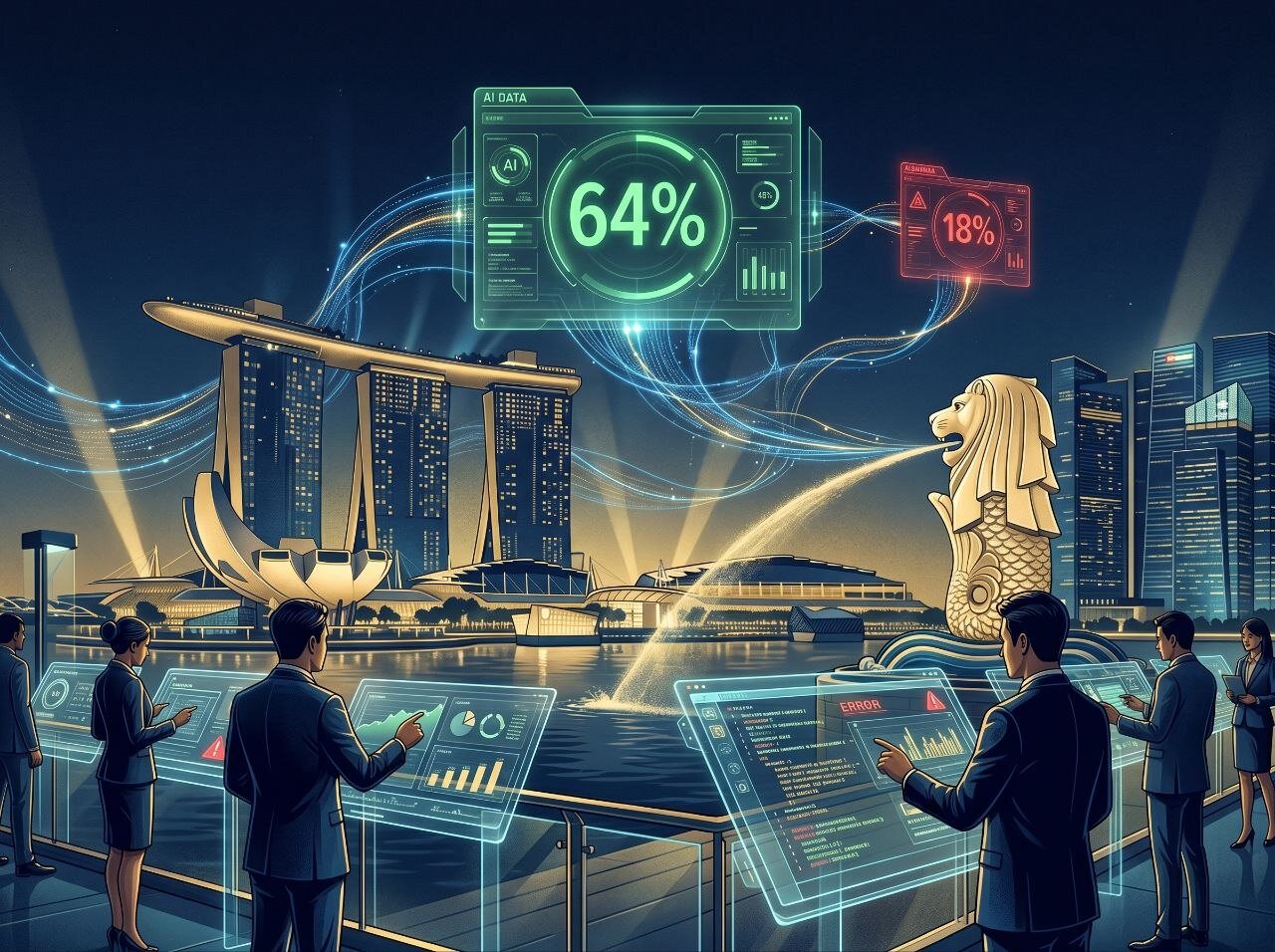
Singapore has a dirty little secret. Walk into any boardroom in the Central Business District and you'll hear the same buzzwords: "digital transformation," "AI-first strategy," "machine learning integration." The city-state has branded itself as Asia's premier tech hub, and the numbers seem to back it up — a new HubSpot study reveals that 64% of Singapore businesses now use artificial intelligence in their daily workflows. That is, on paper, impressive.
But dig deeper, and the cracks start showing. Because while nearly two-thirds of Singaporean companies have jumped on the AI bandwagon, a measly 18% have actually reached what the industry calls "advanced stage" — meaning AI systems that can make decisions autonomously and execute tasks without constant human babysitting. The other 46%? They're playing with AI toys, not building AI infrastructure. And that gap tells us everything we need to know about the state of enterprise AI in 2026.
📊 The Numbers Don't Lie
HubSpot's study, conducted across 500+ Singapore businesses from SMEs to multinationals, paints a picture of a nation that talks a big game about AI but hasn't figured out how to make it actually work. Let's break down what that 64% actually means:
- Early Stage (46%): Companies experimenting with ChatGPT for email drafts, using AI writing assistants for marketing copy, or deploying basic chatbots that are essentially fancy FAQ search engines. These organizations have "adopted" AI in the same way a tourist "adopts" local culture by buying a souvenir t-shirt.
- Intermediate Stage (36%): Businesses that have moved beyond experimentation and integrated AI into specific workflows — think automated data entry, predictive analytics dashboards, or AI-assisted customer segmentation. They're using AI, but they still need humans making the final calls.
- Advanced Stage (18%): The real deal. These companies have deployed AI systems capable of autonomous decision-making, end-to-end process automation, and self-optimizing operations. Their AI doesn't just assist — it executes.
That 46-36-18 split is the story nobody wants to talk about. Singapore's government has poured billions into AI initiatives — the National AI Strategy, AI Singapore (AISG), the Singapore Economic Development Board's constant courting of tech giants. And it's worked, in a sense. Companies are adopting AI faster than anywhere else in Southeast Asia. But adoption without maturity is just expensive theater.
🏢 Why Singapore's Stuck in AI Adolescence
There are reasons for this gap, and they aren't unique to Singapore. But the city-state's particular combination of factors makes it an especially interesting case study in what happens when you try to force-feed a nation AI.
The Skills Gap Is Real
Singapore has world-class universities churning out computer science graduates. NUS and NTU rank among the top engineering schools globally. But there's a difference between knowing how to code and knowing how to deploy AI at enterprise scale. The study found that 67% of Singapore businesses cite "lack of AI talent" as their primary barrier to advancement — not budget, not technology, but people who actually know what they're doing.
The problem is compounded by brain drain. Singapore's top AI talent gets poached by US tech giants faster than you can say "stock options." Google, Meta, OpenAI, and Anthropic all have Singapore offices specifically to vacuum up local talent. Why build AI systems for a local bank when you can earn 3x at a frontier lab working on AGI?
The Vendor Hype Cycle
Walk through the Singapore Fintech Festival or any AI conference at Marina Bay Sands, and you'll see the same pattern: vendors selling "AI solutions" that are really just repackaged automation tools with machine learning buzzwords slapped on top. The study found that 52% of Singapore businesses purchased AI solutions without a clear understanding of what the technology actually does or how it fits their workflow.
The result? Expensive implementations that don't deliver ROI, followed by disillusionment, followed by yet another vendor promising that THIS time it'll work. It's a cycle of hope and disappointment that's burning through enterprise AI budgets across the island.
The Cultural Factor
Singapore's business culture rewards compliance and risk management — both sensible traits that happen to be kryptonite for AI deployment. Advanced AI systems require delegating decision-making authority to algorithms, accepting uncertainty, and tolerating the occasional spectacular failure in exchange for long-term gains. Singaporean corporate culture, shaped by decades of stability-focused governance, struggles with this calculus.
The study's interviews reveal a telling pattern: Singapore businesses are more likely to deploy AI in "safe" areas like marketing automation or document processing than in core operations like supply chain management or financial trading. They're using AI, but not trusting it where it matters most.
🔥 Our Hot Take: Adoption Without Transformation Is Just Expense
Here's the uncomfortable truth that Singapore's policymakers need to hear: 64% adoption means nothing if you're not transforming how work gets done.
Singapore is in danger of becoming the world's most AI-literate nation of AI underachievers. They have the infrastructure — the government-built cloud platforms, the subsidized compute clusters, the regulatory sandboxes. They have the investment — AI Singapore has pumped hundreds of millions into local startups and research initiatives. They have the adoption numbers that look great in press releases.
What they don't have is the hard, messy work of actually rebuilding organizations around AI capabilities. That's what separates the 18% from the 64%. The advanced-stage companies aren't just using AI tools — they've restructured their decision-making processes, retrained their workforce, and accepted that some human jobs are now AI jobs. That's not a technology change. That's an organizational transformation.
The irony is thick. Singapore built its reputation as a tech hub by being ruthlessly pragmatic — the nation that went from third world to first by focusing on what works rather than what sounds good. But the AI rush has the city-state chasing headlines and vanity metrics instead of substance.
🌏 Regional Context: Singapore vs. The World
To be fair, Singapore's 18% advanced adoption rate isn't terrible by global standards. The US sits around 23%, Western Europe at 15%, and the rest of Asia-Pacific lags at roughly 12%. Singapore is competitive, but it's not the dominant AI leader it claims to be.
What's more concerning is the trajectory. Singapore's AI spending grew 47% year-over-year, but the percentage of companies reaching advanced stage grew by only 3 percentage points. They're spending more to get marginally more mature. That's not a scaling problem — that's a fundamental approach problem.
Compare this to South Korea, where the government tied AI adoption to specific industrial transformation goals. Korean manufacturing AI isn't just adopted — it's integrated into production lines with measurable efficiency gains. Singapore's approach has been more "build it and they will come," and the HubSpot study shows that while they came, they haven't figured out what to do with it.
⚡ What Needs to Change
The HubSpot study includes a roadmap that Singaporean businesses could follow if they want to move from the 64% to the 18% — and beyond. The recommendations are straightforward but require cultural shifts that won't happen overnight:
Start with problems, not technology. The study found that advanced-stage companies began with specific business pain points (inventory waste, customer churn, fraud detection) and then found AI solutions. Early-stage companies did the reverse — they bought AI tools and then looked for problems to solve.
Invest in internal talent, not just vendor solutions. Companies that built internal AI teams reached advanced stage 3x faster than those that outsourced everything. Singapore's reliance on foreign consultants and vendor implementations is creating a perpetual dependency.
Accept failure as part of the process. Advanced-stage companies averaged 2.3 failed AI pilots before finding successful deployments. Singapore's risk-averse culture treats these failures as wasted money rather than necessary learning — which means fewer companies attempt ambitious projects in the first place.
🎯 The Bottom Line
Singapore's AI story is a cautionary tale for any nation looking to become a "smart nation" or "AI hub." Adoption is easy. Transformation is hard. You can buy AI tools with government subsidies and vendor discounts. You can't buy organizational change.
The 64% number that Singapore will inevitably tout in press releases and investment brochures tells part of the story. The 18% number tells the rest. And the 46% gap between them? That's the difference between talking about AI and actually doing AI.
For Singapore to maintain its position as Asia's premier tech hub, it needs to stop celebrating adoption metrics and start demanding transformation. The city-state has built the infrastructure, attracted the talent, and spent the money. Now it needs the courage to let AI actually change how work gets done — even if that means accepting the risks, failures, and organizational upheaval that come with it.
The 18% are showing the way. The question is whether the other 82% will follow, or whether Singapore will remain a nation of AI dabblers pretending to be AI leaders.