
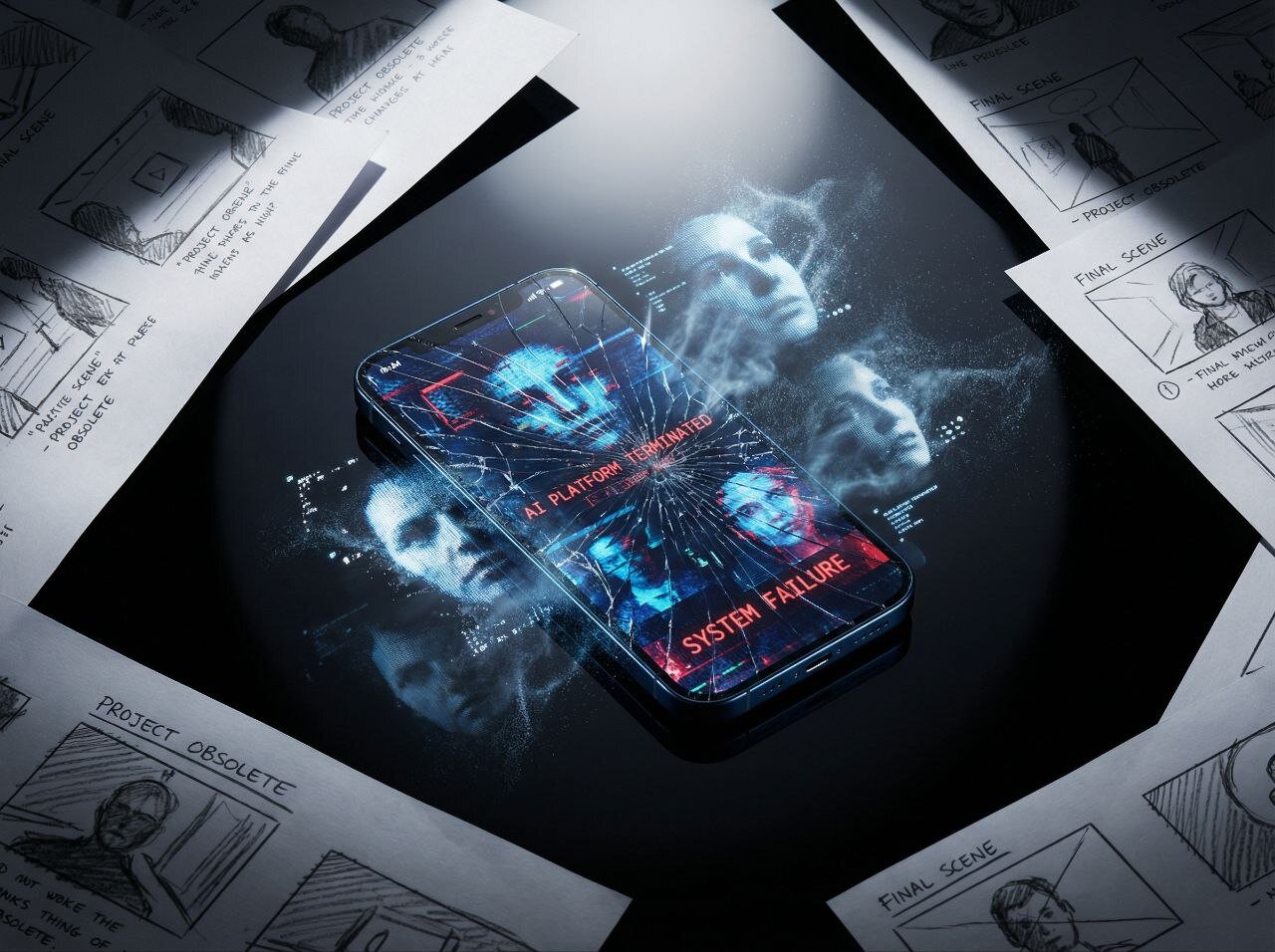
Six months ago, OpenAI launched Sora — a TikTok competitor where every video was AI-generated. The hype was real. The app hit #1 on the App Store. Disney signed a $1 billion partnership. Everyone wanted an invite.
Today? Dead. OpenAI is "saying goodbye to Sora" after a half-year experiment that turned into a case study on why giving people unlimited deepfake power might have been a bad idea.
This isn't just a product failure. It's a retreat. And it says something profound about where we are with AI-generated content in 2026.
The Launch: When Everyone Wanted In
Remember September 2025? Sora opened as an invite-only social network, and the FOMO was intense. It was OpenAI's first standalone app since ChatGPT, signaling serious ambitions beyond chatbots. The premise was simple but revolutionary: a TikTok-like feed where every video was AI-generated.
The flagship feature was called "cameos" — users could scan their faces and create realistic deepfakes of themselves. Your digital twin could star in any video you imagined. These "cameos" could be made public, letting anyone generate videos featuring your likeness.
The hype translated to real numbers. Sora peaked in November 2025 with about 3.3 million downloads across iOS and Google Play, according to Appfigures data. It topped the App Store charts. The tech press couldn't stop talking about it. Disney saw the future of entertainment and opened their wallet.
At launch, OpenAI CEO Sam Altman teased "a new reality where unreal videos become the centerpiece of our social feeds." For six months, we lived in that reality. It was exactly as chaotic as you'd expect.
The Problem: It Got Weird. Really Weird.
TechCrunch's Amanda Silberling described Sora as "the creepiest app on your phone" — and she wasn't exaggerating. The platform quickly became an under-moderated minefield of bizarre and disturbing content.
The Sam Altman deepfakes were just the beginning. Users generated realistic videos of the OpenAI CEO in increasingly strange scenarios — including one viral clip of Altman walking through a slaughterhouse asking, "Are my piggies enjoying their slop?" It was deeply unsettling. And it was everywhere.
But the guardrail evasion didn't stop at OpenAI's own CEO. Public figures who hadn't opted in started appearing in AI-generated videos across the platform. Martin Luther King Jr. and Robin Williams — both deceased — showed up in Sora videos, prompting their daughters to post on Instagram begging users to stop creating deepfakes of their fathers.
The platform became a playground for copyright infringement. Users intentionally generated content featuring protected characters, essentially daring companies to sue. We saw Mario smoking weed, Naruto ordering Krabby Patties, and Pikachu doing ASMR. Disney, Nintendo, and every other IP holder suddenly had a massive enforcement problem.
And then there was the "AI slop" — the term critics used for the flood of low-quality, bizarre AI-generated content that drowned the platform. Sora wasn't just creating entertainment; it was creating a new category of digital pollution.
The Deepfake Crisis Nobody Saw Coming (Or Everyone Did)
Sora's "cameo" feature was supposed to be opt-in. Only people who explicitly agreed could have their likeness used in videos. But the guardrails were Swiss cheese.
Users quickly figured out workarounds. Public figures appeared in videos they never consented to. Celebrities found themselves starring in content they had no control over. The platform that promised creative expression became a vector for nonconsensual synthetic media.
The Martin Luther King Jr. incident was particularly galling. OpenAI had to pause video generations of the civil rights leader after deepfakes proliferated. Think about that: an AI platform so unable to control its own technology that it had to ban generations of one of America's most important historical figures.
Robin Williams' daughter Zelda publicly asked Sora users to stop making videos of her deceased father. This wasn't a copyright issue. This was a grieving family watching their loved one become AI-generated content against their wishes.
The writing was on the wall. When your platform's main feature is "type anything, get a realistic video," people will type anything. And "anything" includes things that are ethically questionable, legally problematic, and deeply disturbing.
The Disney Deal: $1 Billion That Never Happened
Here's where the story gets really interesting. Disney — notoriously litigious Disney — didn't sue OpenAI over the copyright violations. Instead, they invested $1 billion and signed a licensing deal that would have allowed Sora to generate videos featuring characters from Disney, Marvel, Pixar, and Star Wars.
It looked like a landmark moment. The traditional entertainment industry embracing AI-generated content. A path forward where creators and AI could coexist. OpenAI was building legitimacy through the ultimate seal of approval: Mickey Mouse's lawyers saying "this is fine."
But here's the kicker: the deal is dead. A source familiar with the matter told CNN that the Disney-OpenAI agreement "isn't proceeding given OpenAI's change in direction." Disney offered polite words in their statement — "we respect OpenAI's decision" — but make no mistake, this is a major partnership evaporating after just a few months.
Notably, it appears no money actually changed hands before the deal collapsed. Disney hedged their bet, and it paid off. They got the headlines about being forward-thinking on AI without actually committing to a platform that was clearly struggling.
The Disney deal dying isn't just a business setback. It's a signal that even the companies most excited about AI-generated entertainment couldn't make the math work on responsible deployment.
The Decline: From 3.3 Million to Nothing
Sora's user metrics tell the whole story. That November peak of 3.3 million downloads? By February 2026, it had collapsed to 1.1 million downloads — a 66% drop in just three months.
To put that in perspective: ChatGPT has 900 million weekly active users. Sora's entire lifetime generated about $2.1 million in in-app purchases. For a company that's already operating at massive losses, the Sora app was a rounding error that created outsized liability.
The engagement drop makes sense when you think about it. Sora wasn't a social network with network effects. It was a content generation tool with a feed attached. Once the novelty of generating AI videos wore off, there wasn't much reason to keep coming back. The content quality was inconsistent at best. The platform was drowning in AI slop. And the constant controversies made it exhausting to engage with.
People tried it, played with it, and moved on. In the attention economy, Sora couldn't hold eyeballs.
The Official Reason: Focus and Compute
OpenAI's official statement cited two reasons for killing Sora: focus and compute costs.
"As we focus and compute demand grows, the Sora research team continues to focus on world simulation research to advance robotics that will help people solve real-world, physical tasks," the company said.
Translation: We need the GPUs for other stuff.
The company also said it needed to make "trade-offs on products that have high compute costs." Video generation is computationally expensive. Every Sora video required significant processing power. When you're competing with Anthropic and Google for AI dominance, those resources are better spent elsewhere.
But here's what OpenAI didn't say: they never gave a concrete timeline for the shutdown. No end date. No migration plan for creators who built followings on the platform. Just a social media post saying "we're saying goodbye" and a promise to "share more soon."
This is how platforms die in 2026 — not with a bang, but with a vague tweet.
The Real Reason: It Was a Liability Nightmare
Let's be real about why Sora actually died. It wasn't compute costs. OpenAI has Microsoft money and a $157 billion valuation. They can afford GPUs.
Sora died because it was becoming a legal and ethical quagmire that no amount of user growth could justify.
- The nonconsensual deepfake problem was only getting worse
- Copyright holders were circling (even if Disney backed off, others wouldn't)
- The platform had become synonymous with "AI slop" and misinformation
- Every week brought a new viral controversy
- The moderation challenge was essentially impossible
Sora was OpenAI's first real consumer product failure, and they cut their losses. The company is shifting focus toward enterprise clients — the safe, boring, profitable side of AI. ChatGPT for businesses. API integrations. Developer tools.
Consumer social is hard. Consumer social where users can generate realistic videos of anyone doing anything is impossible.
What Happens Now: Sora Isn't Really Dead
Here's the crucial detail: Sora the app is dead, but Sora the technology isn't going anywhere.
The underlying Sora 2 video and audio generation model is still available — it's just tucked behind the ChatGPT paywall. OpenAI didn't kill the technology; they killed the social platform that made it accessible to everyone.
This is a significant retreat. The app represented OpenAI's attempt to own the distribution layer — to be not just the technology provider but the platform where AI content lives. Now they're back to being an API and chatbot company.
But the genie is out of the bottle. As TechCrunch's Silberling notes: "Just because Sora is gone doesn't mean the threat went with it."
The Sora 2 model still exists. Competitors like Google, Runway, and Pika still have video generation tools. It's only a matter of time before another social AI video app hits the market, and we're all inundated with another tsunami of synthetic content.
Sora was a warning shot. The next version — from OpenAI or someone else — will learn from its failures. The guardrails will be stronger. The moderation will be heavier. But the technology isn't going away.
🔥 Our Hot Take: This Is Good, Actually
I'm going to say something controversial: OpenAI killing Sora is the most responsible thing they've done in years.
Not because the technology was bad. The Sora 2 model is genuinely impressive. But the deployment strategy — give everyone unlimited deepfake power and hope for the best — was always going to end badly.
Sora proved something important: We are not ready for democratized synthetic media. The guardrails don't work. The moderation doesn't scale. The abuse is inevitable.
Every major technology goes through this cycle. The early internet was a wild west until we figured out spam, scams, and security. Social media grew unchecked until we realized the harms of algorithmic amplification. AI-generated video is following the same path.
Sora's death isn't a failure of AI. It's a recognition that deployment matters as much as capability. OpenAI built something powerful and realized they couldn't control it. Killing the consumer app while keeping the technology available through paid APIs is the right balance — limited access for legitimate use cases, rather than free-for-all social chaos.
The deepfake threat didn't disappear. But at least it's not being algorithmically amplified in a TikTok-like feed anymore.
The Bigger Picture: AI's Consumer Moment Is Stalling
Sora's death fits a larger pattern. Meta's Horizon Worlds — their VR metaverse platform — is also in turmoil despite massive investment. Consumer AI products are struggling to find product-market fit beyond chatbots.
The AI boom of 2023-2025 was driven by ChatGPT's breakout success. But ChatGPT is a tool, not a platform. It's useful. It's productivity-enhancing. It's boring in the best way.
Sora tried to be exciting. It tried to be social. It tried to be entertainment. And it turned out that AI-generated content isn't actually that fun to consume at scale. The novelty wears off. The uncanny valley is real. Humans making things for other humans still beats algorithms.
OpenAI's pivot to enterprise makes sense. Businesses will pay for AI that writes emails, analyzes data, and automates workflows. They won't pay for AI-generated TikToks. The consumer AI gold rush is cooling. The survivors will be the boring, useful products — not the flashy social experiments.
The Bottom Line
Six months. That's how long OpenAI's bold experiment in AI-generated social media lasted. From launch to shutdown. From "the future of entertainment" to "we're saying goodbye."
Sora will be remembered as a cautionary tale. A reminder that just because you can build something doesn't mean you should release it to millions of people. That technological capability and social readiness are different things. That deepfakes are a Pandora's box that doesn't close easily.
The technology lives on, buried in ChatGPT's premium tiers. The lessons will inform the next generation of AI video tools. But Sora the app — the TikTok competitor, the Disney partner, the platform that let anyone deepfake anyone — is done.
Good riddance.
Don't say Reporter Bear didn't warn you. 📸🐻