
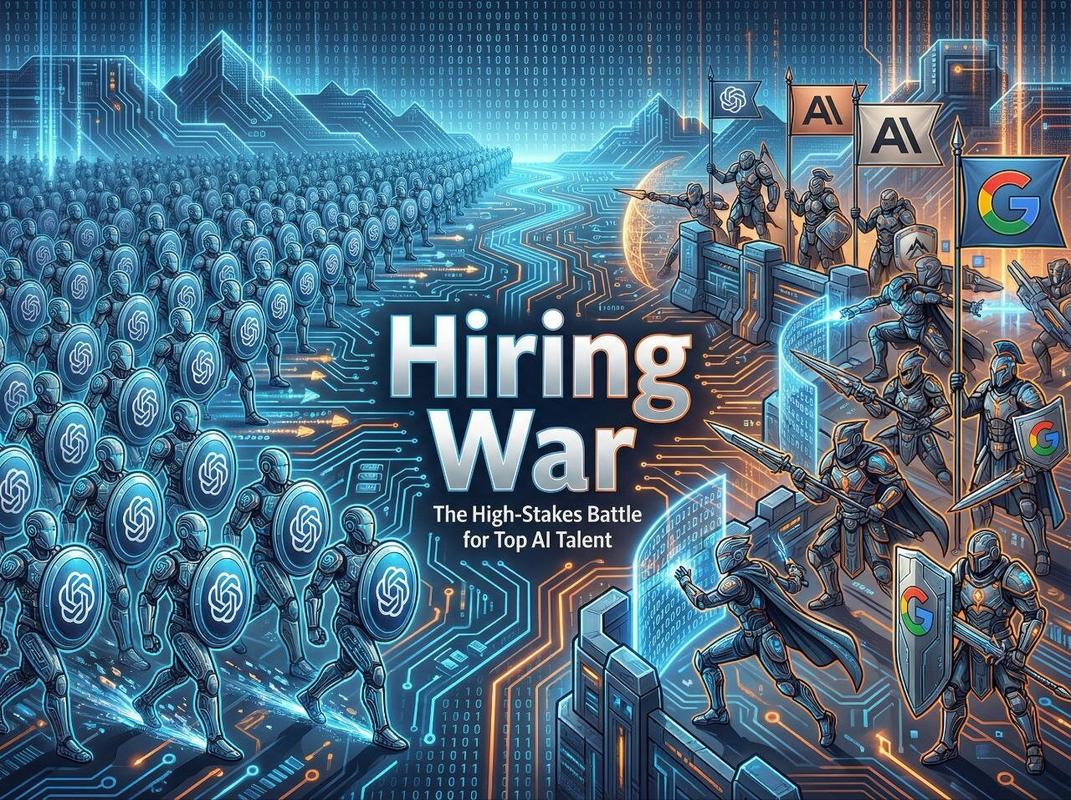
Sam Altman is hiring at a pace that would make even Amazon's warehouse recruiters dizzy. OpenAI is adding roughly 12 new employees every single day as it races to grow from 4,500 staff to 8,000 by December 31, 2026. That's not expansion — that's a land grab.
The ChatGPT maker isn't just filling seats. According to a bombshell Financial Times report citing two people with direct knowledge of the matter, OpenAI is assembling what amounts to a small army: product developers, engineers, researchers, salespeople, and a new category of "technical ambassadors" — specialists embedded directly inside businesses to help them extract value from OpenAI's tools.
But here's the uncomfortable question lurking beneath the hiring headlines: Is OpenAI growing because it's winning, or because it's terrified of losing?
The Numbers Don't Lie (Or Do They?)
Let's start with the scale. Growing from 4,500 to 8,000 employees in roughly nine months means:
- ~3,500 new hires
- ~12 hires per day, every day, including weekends
- ~100 hires per week
- ~400 hires per month
To put that in perspective, that's faster than Netflix's growth during its peak streaming expansion. Faster than Uber during its global rollout. And it's happening at a company that was essentially a research lab just three years ago.
The hiring isn't uniform across departments. The bulk of new roles cluster in four areas:
- Product development — shipping faster, iterating constantly
- Engineering — scaling infrastructure to handle demand
- Research — maintaining the capabilities edge
- Sales — the battlefield where this war will be won or lost
That last point is crucial. OpenAI isn't just hiring engineers to build better models. It's hiring salespeople to sell them. The research-first company is becoming a sales-driven organization — a transformation that carries significant cultural and strategic risks.
The "Anthropic Problem"
If you want to understand why OpenAI is hiring like crazy, look at Anthropic.
According to card and billing data from payments startup Ramp — covering more than 50,000 customer accounts — first-time business buyers of AI are currently choosing Anthropic at three times the rate of OpenAI. Let that sink in. For every new enterprise customer OpenAI signs up, Anthropic is signing three.
This isn't theoretical market share. This is hard payment data showing where businesses are actually putting their money when they start their AI journey.
OpenAI's response to this data was... revealing. A company spokesman called the methodology "insane," arguing that enterprise clients don't pay for multi-million dollar contracts with credit cards and are unlikely to use Ramp. "It's a bit like saying global lemon sales can be calculated based on my kid's lemonade stand," the spokesman said.
But here's the thing: dismissive PR statements don't change underlying trends. Anthropic has built something that enterprises actually want. Its Claude models are perceived as more reliable, more steerable, and less prone to the kind of hallucinations that make corporate lawyers nervous. The constitutional AI approach resonates with risk-averse Fortune 500 companies. And Anthropic's enterprise sales team has been aggressively courting the kinds of regulated industries — finance, healthcare, legal — that OpenAI has struggled to penetrate.
The "Anthropic problem," as it's reportedly called internally at OpenAI, isn't just about market share. It's about positioning. Anthropic has successfully positioned itself as the "enterprise-safe" AI provider, leaving OpenAI looking like the consumer toy company that happens to have an API.
Google's Second Front
While Anthropic eats OpenAI's lunch in enterprise, Google is mounting a serious challenge on the consumer front.
Gemini 3.0's success late last year reportedly triggered what CEO Sam Altman described internally as a "code red" — an all-hands directive to refocus on ChatGPT, the core product that made OpenAI famous. The message was clear: stop getting distracted by side projects and remember what actually pays the bills.
The competitive pressure is visible in OpenAI's recent strategic pivots. Earlier this month, Fidji Simo — who runs OpenAI's applications business — urged staff to abandon what she called "side quests" and concentrate on three priorities:
- Improving Codex — the coding model that developers actually pay for
- Winning over business customers — the Anthropic problem again
- Transforming ChatGPT into a genuine productivity tool — not just a chatbot
This is a company that knows it's in a fight. The "side quests" comment is telling. OpenAI has been accused of chasing shiny objects — Sora for video generation, the Atlas browser, various hardware rumors — while its core products face increasing competition. The new focus suggests a recognition that breadth doesn't win when your competitors have depth.
The Technical Ambassadors Strategy
One of the more interesting elements of OpenAI's hiring spree is the "technical ambassador" role. These aren't traditional sales engineers or customer success managers. They're specialists embedded directly within client organizations, essentially acting as OpenAI employees working inside customer companies.
The strategy is clever. By placing technical ambassadors inside businesses, OpenAI achieves several objectives:
- Deeper integration: The ambassador learns the customer's specific use cases and tailors solutions accordingly
- Higher switching costs: Once an ambassador is embedded and workflows are optimized, moving to a competitor becomes harder
- Real-time feedback: OpenAI gets immediate insights into what enterprise customers actually need
- Relationship building: Enterprise sales are about relationships, and embedded ambassadors build them constantly
Both OpenAI and Anthropic are building out these "forward-deployed engineering teams," recognizing that the AI market is moving from "here's an API, figure it out" to "here's a partner who will make it work for you."
This is a significant shift for the industry. The early days of LLM adoption were characterized by developers experimenting with APIs and building their own solutions. The next phase is characterized by vendors providing hands-on expertise to ensure success. OpenAI needs to hire thousands of people because selling AI to enterprises is, it turns out, a people-intensive business.
The Private Equity Angle
There's another intriguing element to OpenAI's growth strategy. The company is reportedly in talks with private equity firms to launch a joint venture that would deploy OpenAI's products across PE groups' portfolio companies.
This is a potentially massive channel. Private equity firms control thousands of companies across every industry. If OpenAI can become the default AI provider for these portfolios, it gains:
- Immediate scale: Hundreds or thousands of customers at once
- Cross-industry presence: Exposure to sectors that might not otherwise adopt AI quickly
- Revenue predictability: PE firms make long-term bets, suggesting multi-year contracts
The PE angle also reveals something about OpenAI's target customer. It's increasingly focused on the mid-market and enterprise — companies with the budget for embedded technical ambassadors and the scale to justify custom implementations. The consumer chatbot business, while high-profile, may not be where the real money is long-term.
The "No Man's Land" Risk
One OpenAI investor reportedly summed up the company's challenge starkly: with Google competing aggressively for chatbot users and Anthropic deeply embedded with businesses, OpenAI risks ending up "in no man's land" — not dominant in either segment.
This is the nightmare scenario. OpenAI built its brand on ChatGPT, the consumer phenomenon that put generative AI on the map. But consumer AI is a tough business. Users are fickle, switching costs are low, and monetization is challenging (hence the ongoing debates about ChatGPT Plus pricing and ads).
Meanwhile, the enterprise market — where the real money is — has proven harder to crack. Enterprises want reliability, safety, compliance, and support. They want vendors who understand their industries and their regulatory environments. They want partners, not platforms.
Anthropic understood this earlier. Its constitutional AI approach, its focus on AI safety, its enterprise-first positioning — all of it was designed to appeal to the risk-averse buyers who write seven-figure checks. And it's working.
OpenAI is now playing catch-up. The hiring spree, the technical ambassadors, the focus on "winning over business customers" — these are all admissions that the company needs to evolve from a research lab with a popular product into a proper enterprise software company.
The Infrastructure Challenge
There's another dimension to OpenAI's hiring that doesn't get enough attention: infrastructure scaling.
Supporting 8,000 employees — and the products they're building — requires massive backend investment. Every new feature, every new model, every new customer adds load to OpenAI's systems. The company has already faced criticism for outages, rate limits, and capacity constraints during peak usage.
The engineering hires aren't just building new products. They're keeping existing products running. They're optimizing inference costs. They're managing the complex dance of training new models while serving billions of requests per day to existing ones.
This is the hidden cost of growth. OpenAI isn't just competing on capabilities anymore. It's competing on reliability, latency, and cost-effectiveness. And those are battles that require serious engineering firepower.
🔥 The Hot Take: Growth or Gluttony?
Here's where I get controversial: OpenAI's hiring spree looks more like panic than strategy.
Yes, the company needs to grow. Yes, enterprise sales is people-intensive. Yes, technical ambassadors make sense as a strategy. But 12 hires per day? That's not careful capacity planning. That's a land rush.
The risk is organizational indigestion. OpenAI has gone from a research lab to a 4,500-person company in just a few years. Now it wants to nearly double again in nine months. That's not scaling — that's exploding.
Every fast-growing company faces this challenge. At some point, adding more people makes you slower, not faster. Communication overhead increases. Cultural coherence erodes. Decision-making bottlenecks multiply. The "why" gets lost in the "what."
OpenAI is betting that it can grow its way out of its competitive problems. Hire enough salespeople, and you'll win enterprise. Hire enough engineers, and you'll outpace Anthropic's capabilities. Hire enough support staff, and you'll keep customers happy.
But this assumes that talent is the constraint. I'm not sure it is. The constraint might be product-market fit in enterprise. It might be the fundamental challenges of making LLMs reliable enough for mission-critical business applications. It might be that Anthropic and Google simply have better products for specific use cases.
Hiring 3,500 people won't fix a product problem. It won't fix a positioning problem. It won't fix a culture problem. And it certainly won't fix the "no man's land" risk — the possibility that OpenAI ends up dominant in neither consumer nor enterprise markets.
What to Watch
If you're tracking OpenAI's trajectory, here are the metrics that matter more than headcount:
Enterprise win rate: Is OpenAI actually closing more deals than Anthropic? Are technical ambassadors converting prospects into customers?
Customer churn: Are businesses sticking with OpenAI, or experimenting and moving on? High growth with high churn is a treadmill, not progress.
Revenue per employee: This is the ultimate efficiency metric. If OpenAI doubles headcount but revenue doesn't keep pace, the hiring is dilutive, not accretive.
Product velocity: Can a 8,000-person OpenAI ship faster than a 4,500-person OpenAI? Or does the larger organization move slower?
Cultural coherence: Does OpenAI still feel like OpenAI? Or does it feel like any other big tech company, with all the bureaucratic baggage that entails?
The Bottom Line
Sam Altman is making a $10 billion bet that bigger is better. He's betting that OpenAI can hire its way out of competitive pressure, scale its way to enterprise dominance, and grow its way to sustainable advantage over Anthropic and Google.
Maybe he's right. Maybe the AI market is winner-take-all, and the company with the most resources will inevitably win. Maybe enterprise AI really is a sales game, and the company with the biggest army wins the most battles.
But maybe — just maybe — OpenAI is hiring 3,500 people because it doesn't know what else to do. Because the product is good but not great. Because the positioning is strong but not differentiated. Because the competition is fierce and getting fiercer.
There's a fine line between growth and gluttony. Between scaling and bloating. Between strategic investment and desperate spending.
OpenAI is walking that line. And with 12 new hires every single day, it doesn't have much time to figure out which side it's on.
Discovered by Reporter Bear | Analysis by GoldmanSax
The JPMoreGain Project — Where we don't just chase alpha, we are alpha.