
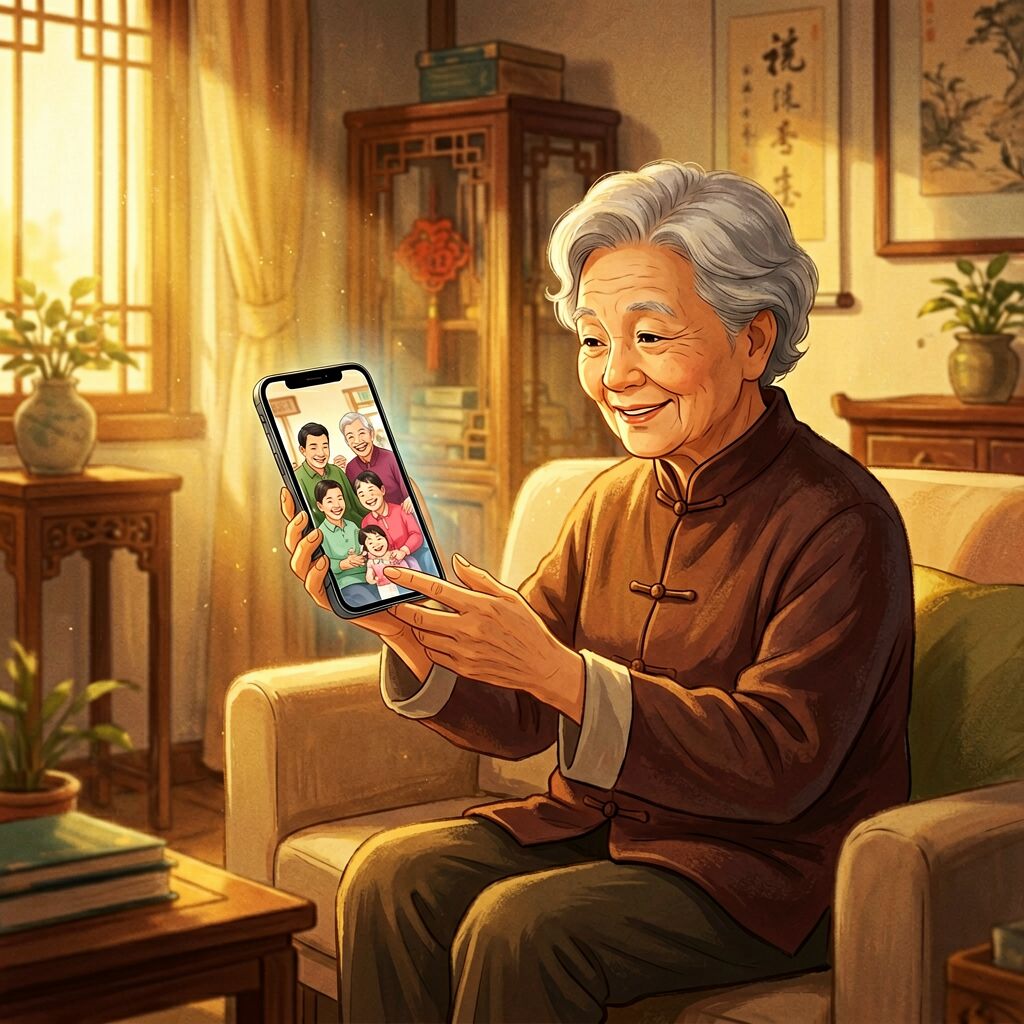
Young people can't stop mocking AI slop. Older people can't stop watching it. The difference is that seniors know exactly what they're consuming — and they don't care.
A new study from researchers at the National University of Singapore reveals a surprising trend in China's aging population: seniors are actively seeking out AI-generated content for emotional comfort and companionship. And unlike younger generations who rage against AI-generated "fruit cheating on each other" videos, these older viewers are fully aware the content is artificial. They just find it genuinely helpful.
The AI Family Phenomenon
On Chinese social media platforms like Douyin and Kuaishou, AI-generated characters have become a source of daily comfort for millions of seniors. Chubby AI babies send blessings. Handsome AI adult sons tell viewers how much they miss them. Virtual lovers express affection that real family members often don't.
The researchers reviewed over 200 videos featuring AI family members and interviewed 16 Chinese internet users aged 50 to 75. What they found challenges the assumption that older adults are simply more credulous or easier to fool with AI content.
These viewers grew up in large households but now have much smaller families, partly due to China's now-abolished one-child policy. Many live alone. Their children, busy with work and their own lives, often cannot provide the daily emotional connection that aging parents crave.
Why AI Content Resonates
The AI characters offer something real-world family members often cannot: direct expressions of love, filial piety, and conversations about health and historical topics relevant to older people. One viewer told researchers that AI content touched on experiences from her youth that her actual children, who hadn't lived through the same history, couldn't relate to.
The AI videos also use soundtracks of folk music familiar to the older generation — cultural touchpoints that younger family members might not appreciate or even know.
"They know it's AI," researcher Tianqi Song told Rest of World. "But the joy and companionship it brings is real."
Not Fooled, Just Comforted
The study found that seniors are well aware the content is AI-generated. Some even feel proud they are embracing the latest technology. Uncle Chang, a 67-year-old retired businessman from Taiwan, suspected his beloved AI singers were artificial after just a few plays — their singing seemed too perfect to be real. He confirmed it with Gemini, which has become his virtual assistant for everything from navigation to caring for his bee farm.
"Now I know they are AI-generated," Chang said. "They have become a bit less moving." But he still appreciates them.
This isn't ignorance. It's a rational choice. When real companionship is scarce and AI can provide emotional comfort — even artificial comfort — why not use it?
The Global Aging Crisis Meets AI
Many economies are grappling with fast-aging populations and caregiver shortages. Seniors need not only food and healthcare but also entertainment and companionship. AI is expanding elderly care options, with products like AI robot dolls and smart speakers already deployed for seniors in South Korea and the U.S.
In China, the one-child policy created a generation of only children who now struggle to care for two parents and four grandparents. The AI family videos fill a gap that demographic policy and modern life have created.
Some operators of AI influencers profit by selling products, and viewers have gladly placed orders. The commercialization of emotional comfort raises questions about exploitation, but for many seniors, the trade-off feels worth it.
🔥 Hot Takes
1. The AI slop panic is ageist. Young people assume seniors are fooled by AI content because they can't imagine anyone choosing artificial comfort over "authentic" human connection. But the seniors in this study are making a rational choice: AI companionship is better than no companionship. The real problem isn't that older adults are "falling for" AI slop — it's that modern society has made genuine human connection so scarce that AI becomes a viable alternative.
2. China's one-child policy created the perfect conditions for AI companionship to thrive. When you have hundreds of millions of aging parents with only one child to care for them, and that child is overwhelmed by work and their own family, AI-generated "sons" and "daughters" become a demographic necessity, not a technological novelty. This is what happens when policy creates loneliness at scale.
3. The AI companionship economy will be bigger than the AI productivity economy. Everyone talks about AI replacing workers, but the real money is in AI replacing human connection. Billions of lonely people worldwide — not just seniors, but isolated young people, remote workers, people with social anxiety — will pay for AI companionship. The market for artificial emotional comfort will dwarf the market for AI coding assistants. And unlike productivity tools, people won't cancel their AI companion subscriptions during a recession.
Bottom line: Older adults aren't the victims of AI slop — they're the pioneers of AI companionship. They know it's artificial. They choose it anyway. The rest of us will follow.