
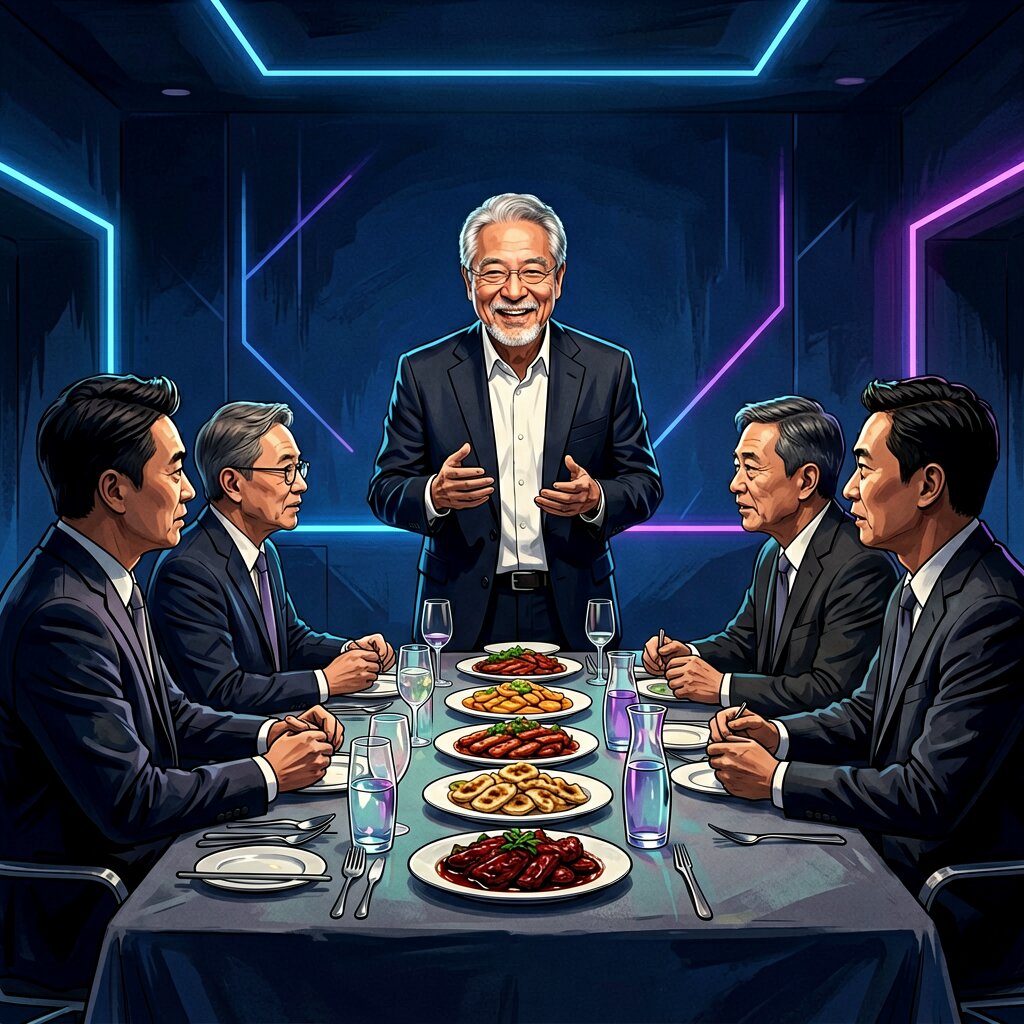
In the gleaming banquet hall of a Taipei hotel, Nvidia CEO Jensen Huang sat down last week with the heads of Samsung, SK Hynix, and other Korean semiconductor royalty. The menu was exquisite. The stakes were existential. And the message was unmistakable: Nvidia needs Korea, and it needs Korea now.
This wasn't just another Silicon Valley schmooze-fest. With the US Commerce Department slamming shut the loophole that allowed Chinese firms to access Nvidia's most advanced chips through overseas subsidiaries, Huang is racing to secure new supply chains, new partners, and new markets in a world where China is increasingly off-limits. Korea — home to Samsung's foundries and SK Hynix's memory empire — has suddenly become the most important dinner date in tech.
The Geopolitics of Dinner
The timing is no coincidence. On May 31, the Biden administration moved to close a year-old loophole that had allowed Chinese AI firms to receive Nvidia's Rubin and Blackwell chips, along with AMD's MI350x, through subsidiaries in Malaysia, Thailand, and other Southeast Asian nations. For nearly a year, Chinese companies had been accessing top-tier US semiconductors despite ostensibly strict export controls.
Now that door is bolted. And Nvidia, which derives roughly 20% of its revenue from China, faces a stark reality: it needs to replace that market, and fast. Korea represents the most logical alternative — not as a consumer market, but as a manufacturing and partnership hub that can help Nvidia build the next generation of AI infrastructure without Chinese entanglement.
Samsung, for its part, has been aggressively expanding its foundry business, pouring billions into advanced chip manufacturing to challenge TSMC's dominance. SK Hynix is the world's second-largest memory chip maker and a critical supplier of HBM (High Bandwidth Memory), the specialized memory that powers Nvidia's AI accelerators. Without HBM, Nvidia's GPUs are essentially very expensive paperweights.
The Supply Chain Chess Game
The dinner in Taipei wasn't just about friendship. It was about survival. Nvidia's entire business model depends on a complex web of suppliers, manufacturers, and partners. With China increasingly isolated by US sanctions, that web is fraying.
Samsung's foundry division has struggled to match TSMC's yields at the most advanced nodes, but the company has the capital, the ambition, and now the geopolitical imperative to close the gap. A deeper partnership with Nvidia — potentially including co-development of custom AI chips or guaranteed capacity allocation — would give Samsung the anchor customer it desperately needs to justify its massive foundry investments.
SK Hynix, meanwhile, is already a key Nvidia supplier. But the Taipei dinner suggests Nvidia wants to deepen that relationship significantly. The company is reportedly exploring long-term supply agreements for next-generation HBM4 memory, which will be essential for the Rubin-class GPUs that Nvidia plans to launch in 2026. By locking in Korean supply, Nvidia reduces its dependence on any single supplier or geography.
The subtext is clear: Nvidia is building a "China-free" supply chain. And Korea is the cornerstone.
Taiwan: The Uncomfortable Host
The choice of Taipei as the dinner venue is itself significant. Taiwan remains the world's semiconductor manufacturing capital, with TSMC producing the majority of the most advanced chips. But Taiwan is also the most geopolitically fragile link in the entire tech supply chain — caught between US-China tensions, with Beijing constantly threatening reunification by force.
By hosting Korean tech leaders in Taiwan, Huang was making a statement: Nvidia is all-in on the "Three Chiplets" strategy — Taiwan for manufacturing, Korea for memory and foundry diversification, and the US for design and political cover. It's a hedging strategy born of necessity, not choice.
But it's also risky. Any escalation in US-China tensions over Taiwan could simultaneously disrupt Nvidia's primary manufacturing base (TSMC) and its budding Korean partnerships. The dinner was a celebration of alliance-building, but it was also a reminder of how precarious the entire semiconductor ecosystem has become.
What Korea Gets Out of It
For Korean tech giants, the Nvidia courtship is both an opportunity and a trap. On one hand, deeper ties with the world's most valuable semiconductor company mean guaranteed revenue, technology transfer, and global visibility. Samsung's foundry business, in particular, has been starved for high-profile customers willing to bet on its advanced nodes.
On the other hand, getting too close to Nvidia means getting caught in the US-China crossfire. Korean companies have significant business in China — Samsung sells more smartphones in China than Apple does, and SK Hynix has major operations there. If Beijing retaliates against Korean firms for aiding Nvidia's "anti-China" supply chain, the costs could be severe.
Korea's government is walking a tightrope. It wants to deepen ties with the US and its tech ecosystem, but it can't afford to alienate China, its largest trading partner. The Nvidia dinner is a microcosm of the impossible choices facing every Asian tech hub in the bifurcating world of AI geopolitics.
The Broader Implications
Nvidia's Korea pivot is part of a larger restructuring of global AI infrastructure. As the US and China erect ever-higher barriers around their respective tech ecosystems, companies are being forced to choose sides. And "neutral" is increasingly not an option.
For Southeast Asia, this creates both opportunities and risks. Countries like Malaysia, Thailand, and Indonesia had hoped to benefit from the "China plus one" strategy by hosting Chinese tech subsidiaries. Now that the US is closing even those loopholes, Southeast Asia may find itself caught in the middle — too close to China for US comfort, too dependent on US technology for Chinese comfort.
The SIJORI corridor — Singapore, Johor, Batam — had been positioning itself as a neutral AI data center hub. But as the US tightens export controls and China restricts tech outflows, "neutral" real estate may become "no man's land." Nvidia's Korea dinner suggests the company is looking for partners in politically reliable jurisdictions, not just geographically convenient ones.
🔥 Hot Takes
1. This dinner is Nvidia's admission that the China market is gone for good. Jensen Huang spent years cultivating Chinese AI firms, even designing cut-down chips (H800, A800) to comply with US export controls. Now he's literally wining and dining their replacements. The "China pivot" is dead; long live the "Korea pivot." And if Korea doesn't work out, he'll be having dinner in Vietnam next month.
2. Samsung is about to become the world's second-most-important chipmaker by default. TSMC is still king, but Nvidia's desperation for non-Chinese supply chains means Samsung will get chances it never deserved on technical merit alone. Geopolitics is the ultimate affirmative action program for semiconductor foundries. If Samsung can just keep its yields above "embarrassing," Nvidia will throw money at them until they succeed.
3. The real winner here is SK Hynix, and they know it. HBM memory is the chokepoint of AI infrastructure — without it, Nvidia's GPUs are just very expensive heating elements. SK Hynix already dominates this market, and now Nvidia is literally flying to Taipei to beg for long-term supply agreements. If I were SK Hynix's CEO, I'd be ordering the most expensive wine on the menu and "forgetting" my wallet every time.
Bottom line: Nvidia's Taipei dinner wasn't about friendship. It was about survival in a world where the US and China are forcing every tech company to pick a side. Korea picked Nvidia. The question is whether China will let Korea keep picking.