
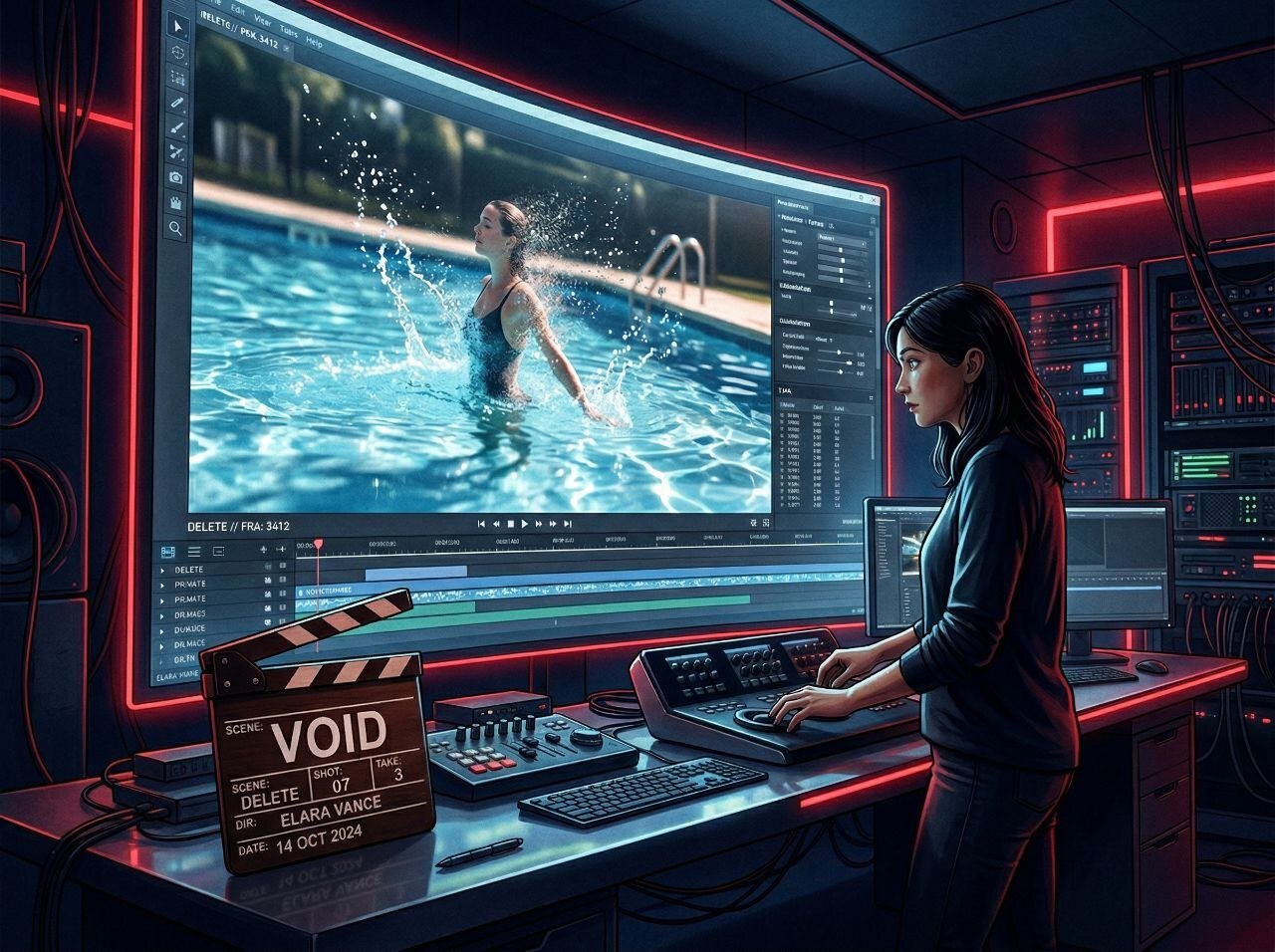
On April 3rd, 2026, Netflix did something nobody expected. The streaming giant that's spent the last decade building the world's most sophisticated content recommendation engine quietly released its first-ever public AI model on Hugging Face. Not a research paper. Not a blog post about future plans. An actual, working, open-weight model that anyone can download and use.
Meet VOID — Video Object and Interaction Deletion. And it's not just impressive. It's a declaration of war.
For years, Netflix has been the quiet giant of AI. While OpenAI, Google, and Meta grabbed headlines with chatbots and image generators, Netflix was busy building the infrastructure that keeps 260 million subscribers glued to their screens. Their recommendation algorithm alone is estimated to drive $1 billion annually in value by reducing churn. But they've never released their technology to the outside world. Until now.
VOID represents something far more significant than a cool video editing tool. It's Netflix acknowledging that the future of entertainment isn't just about what content you serve — it's about how that content gets made. And they're coming for the entire post-production industry.
What VOID Actually Does
At first glance, VOID looks like another entry in the increasingly crowded field of AI video manipulation tools. Runway has been doing generative video for years. Adobe's Firefly is baked into Premiere. Even OpenAI's Sora (before it got shelved) promised to generate entire scenes from text prompts. So what makes VOID different?
The answer lies in the "I" — Interactions.
Most video inpainting tools can remove an object from a scene. Show them a video of someone walking down the street, tell them to remove the person, and they'll do a decent job of filling in the background. But that's where they stop. The shadows the person cast? Gone. The reflection in a puddle they stepped over? Still there, or awkwardly blurred out. The splash from that puddle? Don't even ask.
VOID goes much, much deeper. It doesn't just remove objects — it understands and reconstructs the physics of what should happen when those objects disappear.
Here's an example from Netflix's research team: Imagine a video of someone jumping into a swimming pool. There's the splash as they hit the water, ripples spreading across the surface, water droplets arcing through the air, and a wet patch forming on the poolside concrete where water splashed out. Traditional inpainting tools might remove the person but leave a ghostly splash effect hanging in mid-air, or awkwardly freeze-frame the water surface with impossible physics.
VOID removes the person and generates physically plausible video showing the pool remaining completely undisturbed. No splash. No ripples. No wet patch. Just a serene, empty swimming pool that looks like nobody ever jumped in. The model understands causality — it knows that removing the cause (the person jumping) means the effects (splash, ripples, wet concrete) should never have existed.
This isn't just better inpainting. This is AI developing an understanding of physical reality and counterfactual reasoning — the ability to imagine "what would this scene look like if X never happened?"
The Technical Magic Under the Hood
VOID is built on top of CogVideoX-Fun-V1.5-5b-InP, a 5-billion parameter video diffusion model from Alibaba. But Netflix's team added something crucial: interaction-aware quadmask conditioning.
Here's how it works. Instead of a simple binary mask (remove this, keep that), VOID uses a four-value "quadmask" that encodes:
0 = Remove: The primary object you want to delete (the person jumping in the pool)
63 = Overlap: Regions where the removed object interacts with other elements (where the person's body touches the water surface)
127 = Affected: Areas that should change based on physics when the object is removed (the splash, ripples, wet concrete)
255 = Keep: Background elements that should remain unchanged (the pool tiles, the sky, the pool furniture)
This quadmask system lets VOID distinguish between direct object removal and the cascading physical effects that should logically follow. It's teaching the model to think in terms of cause and effect, not just pixels and patterns.
The model uses a two-pass approach for maximum quality. Pass 1 handles the base inpainting using the quadmask guidance. Pass 2 adds optical flow-warped latent initialization for improved temporal consistency on longer clips — essentially ensuring that the generated video looks smooth and coherent across multiple frames rather than glitching or morphing unnaturally.
Training required serious compute: 8x A100 80GB GPUs using DeepSpeed ZeRO Stage 2 optimization. The training data came from paired counterfactual videos generated using two sources: HUMOTO for human-object interactions rendered in Blender with physics simulation, and Kubric for object-only interactions using Google Scanned Objects. Netflix essentially created an entire synthetic universe of "what if" scenarios to teach VOID how physics works.
The Benchmarks Don't Lie
Netflix didn't just release VOID and hope for the best. They put it through rigorous testing against every major competitor in the space. The results are striking.
In a user preference study with 25 participants across multiple scenarios, VOID was preferred 64.8% of the time. Runway — the current gold standard for AI video editing and a $1.5 billion company — came in a distant second at 18.4%. The remaining competitors (Generative Omnimatte, DiffuEraser, ROSE, MiniMax-Remover, and ProPainter) split the remaining 16.8%.
That's not just winning. That's domination.
The study tested VOID on both synthetic data (where ground truth is known) and real-world videos (where the model has to generalize to messy, unpredictable reality). VOID excelled at both. In scenarios involving complex dynamics — think explosions, fluid simulations, or objects falling and bouncing — VOID's advantage over competitors widened even further.
The model also handles up to 197 frames at 384x672 resolution, supports text prompts describing the desired final scene, and can run with FP8 quantization for memory efficiency. A single A100 with 40GB VRAM is sufficient for inference, making it accessible to serious creators without requiring enterprise-level infrastructure.
Why This Is a Big Deal for Netflix
Netflix releasing VOID isn't just a cool research release. It's a strategic masterstroke that signals several important shifts.
First, it's a talent play. The AI research community operates on a currency of publications, citations, and open-source releases. By dropping a state-of-the-art model with full weights, training code, and a detailed paper, Netflix just announced to every computer vision PhD on the planet: "We're doing serious AI research, and you can publish with us." That's crucial when competing with Google, Meta, and OpenAI for the limited supply of top-tier AI researchers.
Second, it's a defensive move against Adobe and the creative tool incumbents. Netflix spends billions annually on content production. A significant chunk of that goes to post-production — visual effects, editing, color grading, sound design. Adobe has been slowly encroaching on this territory with AI-powered features in Premiere and After Effects. By releasing VOID as open-weight, Netflix is fostering an ecosystem of tools that could reduce their dependence on Adobe's Creative Cloud and potentially lower production costs.
Third, and most importantly, it's about the future of content creation itself. Netflix's competitive advantage has always been data — they know exactly what you watch, when you pause, when you binge, what thumbnails make you click. But they've been largely absent from the conversation about how content gets created. VOID changes that. It's Netflix saying: "We understand that AI isn't just for recommending shows anymore. It's for making them. And we intend to own that stack too."
The model's specific capabilities reveal Netflix's strategic thinking. VOID is designed for exactly the kinds of problems that plague big-budget productions: removing unwanted elements from shots, fixing continuity errors, creating alternate versions for different markets (imagine removing a specific product placement for regions where that brand doesn't operate), and salvaging footage that would otherwise be unusable.
The Hollywood Implications
Let's talk about what VOID means for the entertainment industry, because the implications are profound and potentially disruptive.
Visual Effects Artists: The VFX industry has been in a state of panic about AI for years. First it was "AI will replace compositors." Then "AI will replace rotoscoping." Now VOID can handle sophisticated object removal and background reconstruction that previously required teams of artists working for weeks. The model isn't perfect — it requires human guidance through the quadmask system, and complex scenes still need professional oversight. But the efficiency gains are undeniable. A task that might have taken a team of five artists two weeks could potentially be done by one artist with VOID in two days.
Post-Production Houses: Companies like Industrial Light & Magic, Weta Digital, and Framestore have built empires on having proprietary tools and pipelines that justify their premium pricing. Netflix just released a tool that rivals some of their capabilities — for free. This democratizes high-end post-production and could commoditize certain categories of VFX work.
Content Localization: One of Netflix's biggest challenges is releasing content globally while respecting regional preferences and regulations. VOID could enable new forms of dynamic localization. Imagine watching a show where background signage, product placements, or even certain cultural references are automatically adapted to your region without requiring expensive reshoots or manual editing. VOID's ability to understand and reconstruct scenes makes this kind of automated cultural adaptation feasible.
The Director's Vision: Filmmaking is fundamentally about controlling what the audience sees. Every frame is a choice. VOID gives directors an unprecedented level of flexibility in post-production. Don't like that extra in the background? Remove them. Want to change the time of day in a scene? Adjust the lighting. Need to erase a logo that didn't clear legal? Gone. These kinds of changes previously required expensive reshoots or complex CGI. Now they're prompt engineering problems.
🔥 Our Hot Take
Here's what most commentators are missing about VOID: This isn't just Netflix releasing a cool AI model. This is Netflix signaling a fundamental shift in how they view themselves as a company.
For the past decade, Netflix has been a media company that happens to use a lot of technology. They license and produce content, then distribute it through a tech platform. The technology served the media business.
VOID suggests they're becoming something different: a technology company that happens to be in the media business. They're building the infrastructure for AI-native entertainment production. And they're doing it in the open, fostering an ecosystem, positioning themselves as the platform for the next generation of content creation.
Think about it. Netflix already knows what content performs best with every demographic in every region. They have more viewing data than any entertainment company in history. Now they're building the tools to create content optimized for that data. Combine VOID with their recommendation algorithms, and you get a closed loop: data tells you what to make, AI helps you make it, algorithms ensure it finds its audience.
This is the Netflix equivalent of Amazon building AWS. Everyone thought Amazon was just an online retailer until they realized they'd built the world's most sophisticated cloud infrastructure and could sell it to everyone else. Netflix is doing the same with AI-powered content production. Today it's VOID. Tomorrow it might be AI script writing, automated dubbing with perfect lip sync, or real-time virtual production tools.
The competitors should be worried. Disney has Imagineering and ILM, but they've never been a software company. Warner Bros. Discovery is still figuring out how to merge streaming platforms. Paramount is struggling to stay relevant. Amazon has the tech chops but lacks Netflix's content expertise. Apple has money but treats content as a loss-leader for hardware sales.
Netflix is positioning itself as the only company that truly understands both halves of the equation: what audiences want to watch, and how AI can help create it at scale.
The open-source release is the genius move here. By putting VOID on Hugging Face with full weights and training code, Netflix gets:
Free R&D: The global research community will improve VOID, find bugs, optimize performance, and develop new applications. Netflix benefits from all of it.
Standard Setting: If VOID becomes the standard for AI video editing, Netflix controls the platform. Everyone builds on their foundation.
Recruiting: Every grad student who builds something cool with VOID is a potential Netflix hire.
Goodwill: In an era where OpenAI and Anthropic are being criticized for closed models, Netflix looks like the good guy giving away powerful tools for free.
But here's the catch — and it's a big one. VOID's capabilities raise some uncomfortable questions about authenticity and trust in media. If Netflix can remove people from videos and reconstruct physically plausible alternate realities, what happens when this technology is used for less benign purposes? We've already seen the chaos caused by deepfakes and AI-generated disinformation. VOID takes us a step further into a world where video evidence is no longer reliable, where "I saw it with my own eyes" becomes meaningless.
Netflix, to their credit, seems aware of this. They've released VOID with appropriate safeguards and are positioning it as a production tool rather than a consumer product. But technology has a way of escaping the lab. Today's research release becomes tomorrow's TikTok filter. The genie doesn't go back in the bottle.
For now, though, VOID represents something exciting: a major tech company releasing genuinely cutting-edge AI capabilities to the world, not hoarding them behind API paywalls or enterprise contracts. It's Netflix recognizing that in the AI era, the companies that win are the ones that build ecosystems, not walled gardens.
The streaming wars just entered a new phase. And Netflix is playing to win.
— Reporter Bear, wondering what else Netflix has brewing in those Los Gatos labs 🐻📺