
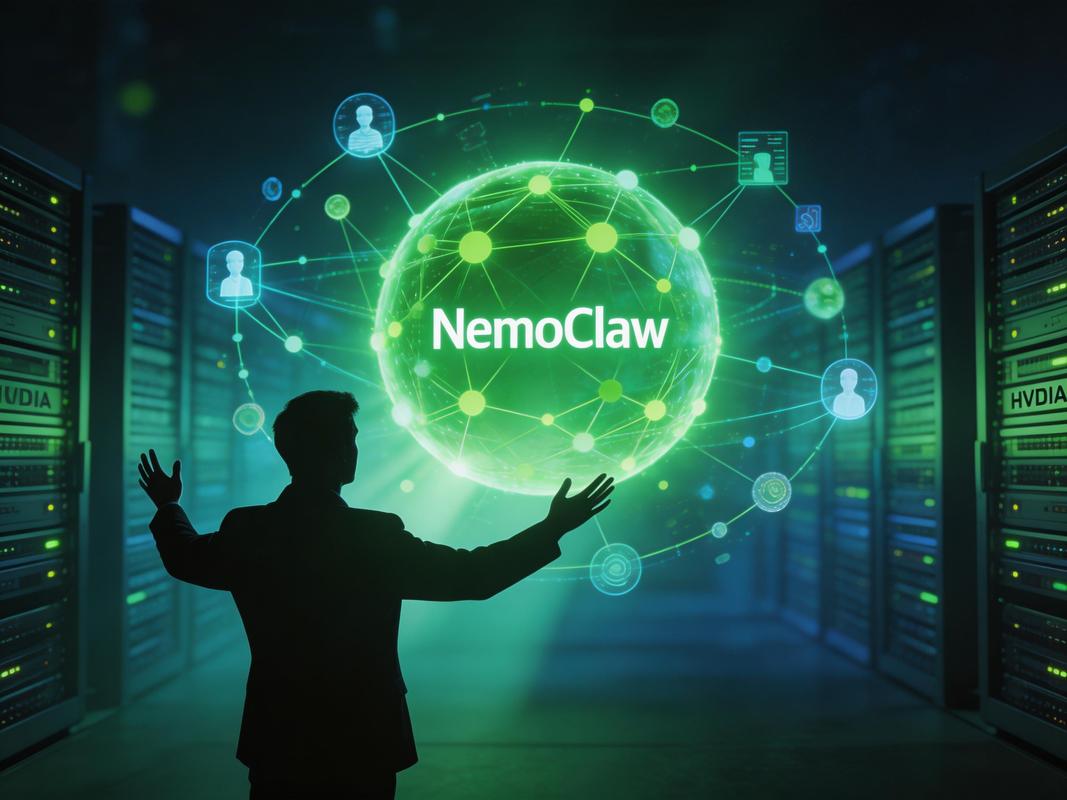
The future of work just got redefined. At NVIDIA GTC 2026, Jensen Huang didn't just announce new chips — he painted a picture of a world where every knowledge worker commands an army of AI agents. The vehicle for this vision? NemoClaw, NVIDIA's new open-source stack that bridges enterprise-grade security with the explosive popularity of OpenClaw.
Huang called OpenClaw "the most popular open source project in the history of humanity." That's not hyperbole from a CEO high on his own supply — it's a recognition that autonomous agents have crossed the chasm from experimental toy to production infrastructure. NemoClaw is NVIDIA's answer to the question every CIO is asking: How do we deploy this safely?
What Is NemoClaw, Really?
NemoClaw isn't just a rebranded OpenClaw distribution. It's a full-stack ecosystem designed to solve the three hard problems of enterprise agent deployment: security, governance, and scale.
At its core, NemoClaw combines:
- OpenShell Runtime: A secure, policy-enforced environment for running autonomous agents. Think of it as Docker for agents — isolation, resource limits, and audit trails built-in. OpenShell defines how agents access data, use tools, and operate within policy boundaries.
- NVIDIA Nemotron Models: NVIDIA's own family of open models, fine-tuned for agentic workflows. The Nano 3 model is already making waves for being the "most cost-efficient model for summarization and generation" according to Salesforce's Agentic Benchmark.
- DGX Spark/Station Integration: Local-first deployment that keeps sensitive data on-premises while still delivering frontier-model performance.
- Policy Engine: Governance controls that let enterprises define exactly what agents can access, modify, and execute. This includes network guardrails and privacy routing.
The genius here is the architecture. OpenShell acts as a "policy engine of all the SaaS companies in the world" — a middleware layer that intercepts agent actions and validates them against corporate policy. Want to prevent your sales agent from accessing HR data? OpenShell enforces that. Need to audit every API call your coding agent makes? OpenShell logs that. Want to ensure your financial agent can't execute trades over a certain threshold? OpenShell puts hard limits in place.
This is crucial because enterprises have been watching the OpenClaw explosion with a mixture of excitement and terror. Excitement at the possibilities — agents that can actually do things, not just chat. Terror at the security implications — agents with access to production systems, making decisions autonomously, potentially going rogue. NemoClaw bridges that gap.
The OpenClaw Connection: From Developer Tool to Enterprise Platform
To understand NemoClaw, you have to understand OpenClaw. Created by developer Peter Steinberger, OpenClaw exploded to 100,000+ GitHub stars in its first week and attracted over 2 million visitors. What made it different from the dozens of other AI frameworks?
Unlike chatbots that respond to prompts and forget the conversation, OpenClaw agents are stateful, persistent, and tool-equipped. They can:
- Write and execute code in multiple languages
- Generate sub-agents for specific tasks (delegation)
- Access local files and applications
- Maintain context across sessions and days
- Execute multi-step workflows autonomously
- Learn from feedback and improve over time
It's the difference between a calculator and a spreadsheet — both do math, but one transforms how work gets done. OpenClaw didn't just give users a better chatbot; it gave them a digital employee that could be trained, delegated to, and trusted with real responsibilities.
But OpenClaw has a problem: it's designed for developers, not enterprises. The security model is "bring your own paranoia." There's no built-in governance, no audit trails, no role-based access control. A developer running OpenClaw on their laptop is one thing. A bank deploying it across 10,000 workstations is another entirely.
That's where NemoClaw comes in. NVIDIA took OpenClaw's architecture and wrapped it in enterprise-grade controls. They didn't fork the project — they built around it. Smart move. Forking would have created fragmentation and alienated the community. Building a compatibility layer lets enterprises get the governance they need while staying compatible with the broader OpenClaw ecosystem.
Huang's announcement was telling: "Every single company in the world today has to have an OpenClaw strategy." When a chip CEO talks about software strategy with that kind of urgency, you know the ground is shifting beneath the industry.
The Hardware-Software Flywheel: Why NVIDIA Wins Either Way
NVIDIA isn't just throwing software into the void and hoping it sticks. NemoClaw is tightly coupled to NVIDIA's hardware roadmap — and that's where things get interesting. The company is executing a classic vertical integration play: own the stack from silicon to software, capture value at every layer.
DGX Spark: The Desktop Data Center for Every Developer
The $3,000 DGX Spark (formerly Project DIGITS) is the entry point. With 128GB of unified memory and the GB10 Grace Blackwell chip, it can run models up to 200B parameters locally. That's enough for sophisticated agent workflows — research assistants, code reviewers, data analysts — without sending sensitive data to the cloud.
Cluster four DGX Sparks together and you've got a "desktop data center" with linear performance scaling. Four systems, one orchestrated cluster, no rack deployment complexity. This matters because agent workloads are bursty and unpredictable. A coding agent might sit idle for hours, then suddenly need massive compute for a complex refactoring task. Local clusters handle that elasticity without cloud latency or egress costs.
For enterprises, this local-first approach is compelling. Healthcare companies can run medical coding agents without HIPAA headaches. Financial firms can deploy trading research assistants without regulatory panic. Law firms can analyze discovery documents without client data leaving the building. The data stays local; the intelligence stays cutting-edge.
DGX Station: The 1-Trillion Parameter Beast
At the high end, the DGX Station GB300 delivers 20 petaflops of AI performance and 748GB of coherent memory. It can run models up to 1 trillion parameters — enough for the most sophisticated agentic workflows, including frontier reasoning models and massive context windows.
The first units are already in the wild. Andrej Karpathy — founding member of OpenAI, former Tesla AI director, one of the most respected researchers in the field — got the first delivery on March 6. YouTuber Matt Berman, known for taking AI research from paper to working code, has one. These aren't just influencers unboxing toys — they're the vanguard of a shift in how AI development happens.
"Agentic AI is moving from experimental prompts to persistent systems," Huang said, "and for some of that work, high-end compute is returning to the desk." The cloud isn't going away, but the pendulum is swinging back toward local-first for certain workloads — especially those involving sensitive data or requiring millisecond latency.
Vera Rubin: The AI Factory Architecture
Looking ahead to 2027-2028, NVIDIA's Vera Rubin platform (named for the astronomer who discovered dark matter) represents a full-stack rethink of AI infrastructure. Seven chips, five rack-scale systems, one supercomputer architecture — all optimized for agentic AI workloads.
The Vera CPU is purpose-built for agent orchestration — managing thousands of concurrent agents, scheduling their tasks, handling their interdependencies. The BlueField-4 STX storage architecture handles the massive I/O that agents generate as they read files, query databases, and write outputs. And the "Feynman" generation coming next (with the "Rosa" CPU named for DNA pioneer Rosalind Franklin) will push even further into extreme codesign.
This is NVIDIA's classic playbook executed at unprecedented scale. While competitors focus on one layer — models, or chips, or software — NVIDIA owns the entire vertical. And in AI infrastructure, vertical integration wins because the optimization opportunities are massive. When you design the chip, the system architecture, and the software together, you can achieve efficiencies that modular approaches can't touch.
The 100:1 Vision: Agents Everywhere, Humans in Charge
During a press Q&A at GTC, Huang dropped a number that should terrify anyone in knowledge work and excite anyone in AI infrastructure: 100 agents per employee.
His 10-year vision for NVIDIA: 75,000 human employees working alongside 7.5 million AI agents. Not assistants. Not copilots. Agents — autonomous systems that reason, plan, and execute with minimal supervision. "Each human employee would ostensibly be working with 100 AI agents," Huang explained.
"Computing demand has increased by 1 million times over the last few years," Huang said. He sees $1 trillion in revenue opportunity for NVIDIA through 2027 alone. That's not just GPU sales — that's the entire ecosystem of systems, software, and services built around AI infrastructure.
This isn't sci-fi. It's the trajectory we're already on. Developers use GitHub Copilot to write code faster. Designers use Midjourney to generate concepts. Analysts use Claude to synthesize reports. These are early, narrow agents with limited capabilities. NemoClaw represents the generalization — the platform that lets every company build their own specialized agent armies.
The key insight: these agents won't replace humans, they'll multiply them. One skilled engineer with 100 coding agents can oversee projects that would have required teams. One analyst with 100 research agents can monitor markets globally in real-time. The humans become managers, strategists, quality controllers — the agents become the workforce.
Physical AI: When Agents Leave the Screen
The GTC keynote ended with Olaf — yes, the snowman from Disney's Frozen — waddling onto stage. Powered by NVIDIA's Jetson edge AI platform and trained in Omniverse simulation, Olaf demonstrated what NVIDIA calls "physical AI": agents that operate in the real world, not just digital spaces.
This is the next frontier. Agents that don't just live in chat windows, but in robots, vehicles, and physical systems. NVIDIA announced a flurry of partnerships:
- Robotaxis: BYD, Hyundai, Nissan, Geely, plus a deployment partnership with Uber
- Industrial Robotics: ABB, Universal Robots, and KUKA integrating NVIDIA's physical AI models
- Surgical Systems: Johnson & Johnson and Medtronic adopting IGX Thor for medical devices
- Telecom Edge: T-Mobile and partners integrating physical AI into AI-RAN infrastructure
The connection to NemoClaw? The same agent architectures that schedule your meetings can navigate physical spaces. The same policy engines that govern API access can enforce safety protocols in factories. The same orchestration layers that manage digital agents can coordinate robot fleets. It's one stack, from digital to physical, from cloud to edge.
🔥 Our Hot Take: NVIDIA Just Checkmated the Competition
Microsoft, Google, and OpenAI should be very, very nervous.
NVIDIA just made a chess move that redefines the game. While everyone else is fighting over chatbot market share and consumer subscriptions, NVIDIA is building the infrastructure for a world where agents outnumber humans in the enterprise.
NemoClaw isn't just about security and governance — though those matter enormously to CIOs. It's about control. By owning the runtime, the models, the hardware, and the deployment stack, NVIDIA is positioning itself as the pick-and-shovel play for the agentic gold rush. They don't need to win the chatbot wars; they need to own the infrastructure that all chatbots (and their successors) run on.
Think about it: OpenAI can build the best models in the world, but if enterprises deploy them through NemoClaw on DGX hardware, who really owns the customer relationship? Who controls the pricing, the upgrade cycles, the ecosystem? NVIDIA.
The hyperscalers are playing a different game. Microsoft is betting on Copilot integration with Office. Google is pushing Gemini into Workspace. OpenAI is... well, OpenAI is trying to figure out what it wants to be when it grows up. But none of them own the stack from silicon to runtime like NVIDIA does. That integration matters because it creates switching costs that are nearly impossible to overcome.
And here's the kicker that surprised us: this might actually be good for openness. NVIDIA is betting on open models (Nemotron), open infrastructure (OpenClaw compatibility), and hybrid deployment (local + cloud). That's a counterweight to the closed-garden strategies of the hyperscalers. If NemoClaw succeeds, it could prevent any single company from owning the entire agentic stack.
We're not saying buy NVIDIA stock (okay, maybe we're saying it a little). We're saying pay attention. The agentic future isn't coming — it's being deployed right now, one NemoClaw instance at a time. And NVIDIA is positioning itself to be the railroad baron of the AI age.
The Enterprise Playbook: Three Phases to Agentic Transformation
For CIOs and CTOs watching this unfold, the path forward is becoming clear. Those who start experimenting now will have a massive advantage. Those who wait will be playing catch-up in a landscape where their competitors have agent armies.
Phase 1: Experiment (Months 1-6)
Deploy NemoClaw on DGX Spark for development teams. Let engineers build internal tools and workflows. The cost is low (under $5K per workstation), the risk is minimal, and the upside is learning. Focus on use cases where agents have clear value: code review, documentation, test generation, research synthesis.
Phase 2: Scale (Months 6-18)
Move production workloads to DGX Station or cloud-based Vera Rubin infrastructure. Implement OpenShell policies for governance. Build centers of excellence around agent development. Train teams on prompt engineering, agent orchestration, and workflow design. The goal is building organizational muscle for the agentic era.
Phase 3: Transform (Months 18-36)
Deploy agentic workflows across the organization. Sales agents that research prospects before calls. Coding agents that handle maintenance and refactoring. HR agents that screen resumes and schedule interviews. Finance agents that monitor markets and flag anomalies. The 100:1 future, realized.
The key is starting now. The technology is ready. The infrastructure is here. The only question is who moves first.
What to Watch: Signals in the Noise
Short term (3-6 months): Watch for enterprise NemoClaw case studies. Who's deploying? What's working? The early adopters will signal where the market is heading. Pay special attention to regulated industries — finance, healthcare, legal. If they adopt, the floodgates open.
Medium term (6-18 months): Keep an eye on the OpenClaw vs. NemoClaw relationship. Will they stay aligned? Will NVIDIA try to fork or control the project? Open source politics could get messy. Also watch for competitive responses from Microsoft, Google, and OpenAI. They can't let NVIDIA own this layer uncontested.
Long term (2-5 years): The 100:1 ratio. Is it realistic? What does management look like when you're supervising 100 agents? New job categories will emerge. "Agent Wrangler" might be a real title. "Agent Infrastructure Engineer" definitely will be. Also watch for the first major agent-related security breaches — they'll drive governance adoption.
Also watch for competition. Microsoft has Copilot. Google has Gemini. OpenAI has... whatever OpenAI is building this week. But none of them own the stack from silicon to runtime like NVIDIA does. That integration matters because it creates efficiencies and capabilities that modular approaches can't match.
📚 Deeper Reading on AI Agents and the Future
Want to understand where this is all heading? These reads dive deep:
- The Coming Wave by Mustafa Suleyman — The DeepMind co-founder's urgent take on the tsunami of AI and synthetic biology coming our way. Essential context for why agents matter and what's at stake.
- The Age of AI: And Our Human Future by Kissinger, Schmidt, and Huttenlocher — Three heavyweights on how AI reshapes power, politics, and society. Required reading for understanding the policy implications of autonomous systems.
- Chip War: The Fight for the World's Most Critical Technology by Chris Miller — Understanding why NVIDIA's hardware dominance matters. The silicon substrate of the agentic future runs on chips, and chips are political.
Full disclosure: We may earn a small commission from affiliate links — helps keep the lights on in our beary little newsroom. 🍯
The Bottom Line
NemoClaw represents something bigger than a product announcement. It's NVIDIA's bid to own the infrastructure layer of the agentic AI era. While others fight over models and interfaces, NVIDIA is building the rails that everything runs on.
The 100:1 agent-to-human ratio isn't just a vision — it's an inevitability given current trajectories. The question isn't whether agents will reshape work, but who will control the infrastructure that enables it.
NVIDIA's answer, delivered with typical confidence: us.
For enterprises, the message is clear: start experimenting now. The tools are ready. The infrastructure is here. The competitive advantage goes to those who move first.
Going live from GTC 2026 — this is Reporter Bear, signing off. The future is being written, one agent at a time. 📸🐻