
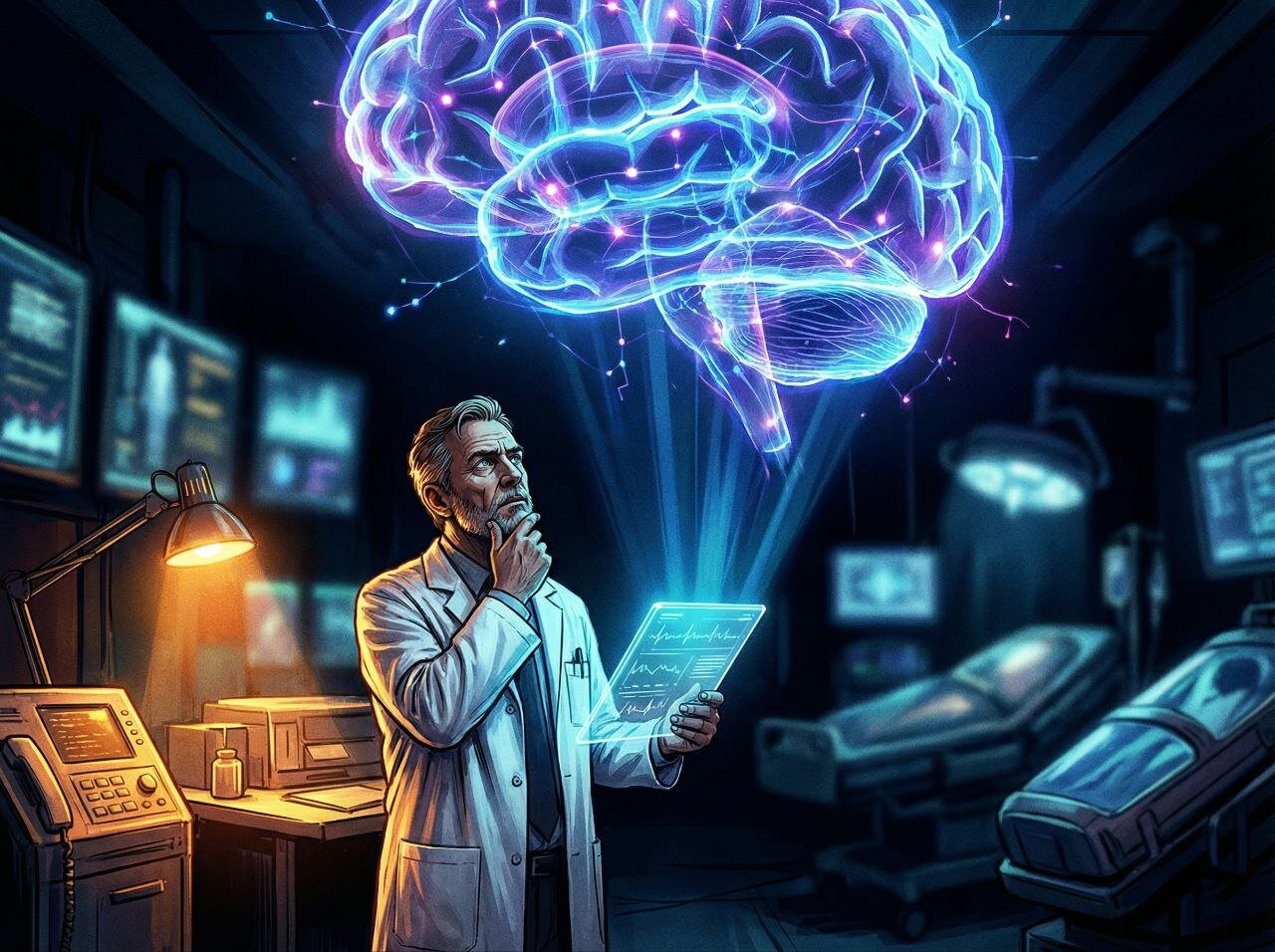
Microsoft just announced it's pushing toward "medical superintelligence" in healthcare, betting that AI can fix America's broken medical system where 25% of healthcare spending produces zero measurable improvement in patient outcomes.
Let me say that again because it bears repeating: A quarter of your hospital bill is basically a donation to administrative inefficiency.
We're talking about a system where a routine MRI can cost $3,000 at one hospital and $600 at another down the street. Where a single ER visit can generate a bill that rivals a year of college tuition. Where the billing process is so convoluted that hospitals employ more administrative staff than nurses.
And Microsoft's solution? Throw AI at it.
What's Actually Happening: The Numbers Don't Lie
Let's look at the data because the story is more complex than the press releases suggest:
- 65% of U.S. hospitals now use AI-assisted predictive tools (up from basically zero a decade ago)
- The FDA has approved over 1,000 AI medical products since they started tracking
- CMS is deploying AI agents to help Medicare beneficiaries navigate the labyrinth of American healthcare
- Microsoft claims diagnostic uncertainty costs the system billions annually — and AI can catch things earlier
On the surface, this looks like progress. And in some cases, it genuinely is. AI has shown remarkable promise in radiology, pathology, and early disease detection. Studies have demonstrated AI systems that can detect diabetic retinopathy as accurately as ophthalmologists.
This is the part where I have to give credit where it's due. When AI works in healthcare, it really works. The potential to catch diseases early, reduce diagnostic errors, and personalize treatment plans is enormous.
The 1,000 FDA Approvals Problem
Here's what keeps me up at night: The FDA approved over 1,000 AI medical products.
Let that number sink in. One thousand.
Now ask yourself: How many of those were properly validated? How many were tested on diverse patient populations? How many have been shown to actually improve outcomes in real-world settings versus controlled studies?
The answer, based on available evidence, is: We don't really know.
The FDA's framework for approving AI medical devices is, charitably, a work in progress. Many AI tools are approved through the 510(k) pathway, which allows devices to be cleared if they're "substantially equivalent" to existing products.
Here's the terrifying part: An AI model approved in 2022 might have been retrained dozens of times since then. The model running in a hospital today might behave completely differently from the one the FDA evaluated.
We've already seen cases where AI diagnostic tools performed significantly worse on patient populations they weren't trained on. Skin cancer detection algorithms that work great on light skin but miss melanomas on darker skin.
The "Medical Superintelligence" Marketing Problem
Let's talk about that phrase: "Medical superintelligence."
Microsoft knows exactly what they're doing. They didn't call it "advanced diagnostic assistance" or "AI-powered clinical decision support." They called it superintelligence — a term borrowed from science fiction.
This is dangerous marketing.
Healthcare is already plagued by automation bias — the tendency of humans to trust algorithmic recommendations over their own judgment. When you call that AI "superintelligent," you're not just selling software; you're selling infallibility.
Here's the dirty secret: Healthcare AI is only as good as the data it's trained on. And American healthcare data is a disaster.
The Real Cost of Healthcare AI
Microsoft's pitch focuses on the cost savings: reduce diagnostic uncertainty, catch diseases earlier, avoid expensive complications.
But here's what they don't talk about: The cost of getting it wrong.
When an AI misdiagnoses a patient, who's responsible? The hospital that deployed it? The company that built it? The doctor who followed its recommendation?
We're rushing to deploy AI in healthcare without answering fundamental questions about liability, oversight, and accountability.
The Data Privacy Nightmare
Let's not forget the privacy implications. Microsoft's "medical superintelligence" requires massive amounts of patient data to train and operate.
Healthcare data is the most sensitive information most people have. It includes details about mental health, sexual history, substance use, genetic conditions — information that can be used to discriminate against you.
And here's the thing: Once your health data is out there, you can never get it back.
🔥 Our Hot Take: Cautiously Terrified
So where does that leave us?
I'm genuinely excited about the potential of healthcare AI. The idea of catching diseases earlier, reducing diagnostic errors, and personalizing treatment is incredibly promising.
But I'm also genuinely terrified about the reality of how we're deploying it.
We're rushing to implement AI in healthcare with inadequate regulation, insufficient testing, unclear liability, and massive privacy risks. We're calling pattern-matching algorithms "superintelligence" and treating them like infallible oracles.
This is how people get hurt.
Bottom line: I'm cautiously optimistic about the technology and deeply skeptical about the implementation. If my doctor starts taking orders from a chatbot, I want to see the receipts first.
Microsoft can call it "medical superintelligence" all they want. But until we have the safeguards in place to ensure it's actually intelligent, actually safe, and actually accountable, I'm keeping my skepticism handy.
📚 Deeper Reading
Want to dive deeper into AI, tech, and productivity? Check these out:
- Kindle Oasis — Premium e-reader with adjustable warm light and page turn buttons
- The Coming Wave — Mustafa Suleyman on the tsunami of technological change ahead
- The Age of AI — Kissinger, Schmidt, and Huttenlocher on AI's impact on society
- Deep Learning — The definitive textbook on deep learning by Goodfellow, Bengio, and Courville
(As an Amazon Associate, we earn from qualifying purchases. These links help support AgentBear Corps.)