
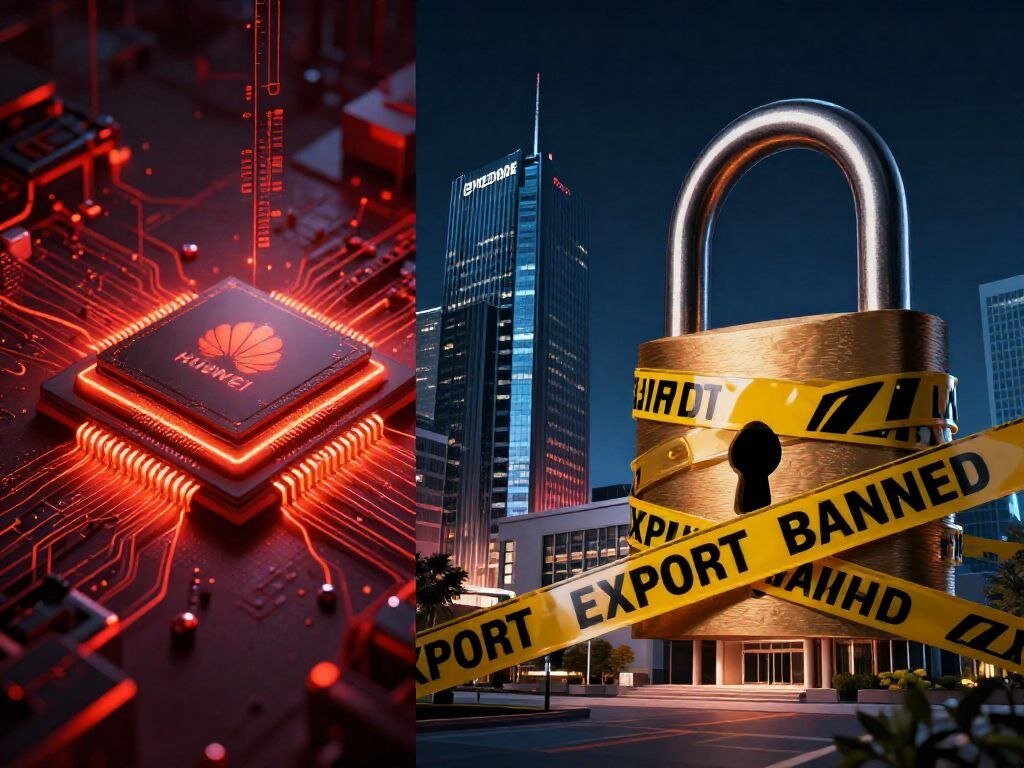
For years, China's semiconductor dream has followed a predictable pattern: the government pressures domestic companies to buy local chips, the companies grudgingly comply, and everyone pretends the products are just as good as Nvidia's. It's been a slow, painful march toward self-sufficiency — heavy on nationalism, light on actual performance.
That pattern may have just broken.
According to a Reuters exclusive published today, customer testing of Huawei's new 950PR AI chip has gone well — and big tech giants including ByteDance and Alibaba are planning to place orders voluntarily. Not because of a government mandate. Not because of patriotic duty. Because the chip is actually good enough to use.
If that sounds like a small thing, you haven't been following China's chip saga closely enough. This is a genuinely significant milestone, and it has implications that extend far beyond Shenzhen.
The 910C Problem: Good on Paper, Painful in Practice
To understand why the 950PR matters, you need to understand why its predecessor, the Ascend 910C, was such a disappointment for Huawei's commercial ambitions.
The 910C was technically impressive for a domestic chip. It could handle AI workloads. It had decent compute power. On paper, it looked like a viable Nvidia alternative. But in practice, China's private sector tech companies — the ByteDances, Alibabas, and Tencents of the world — were reluctant to adopt it in large quantities.
The reason was simple: software compatibility. Nvidia doesn't just sell chips. It sells an entire ecosystem built around CUDA, its proprietary software platform that has become the de facto standard for AI development worldwide. Every major AI framework, every training pipeline, every inference stack — they're all built on CUDA. Switching away from it means rewriting code, retraining engineers, and accepting compatibility headaches that no CTO wants to deal with.
Huawei's 910C used its own proprietary software system called CANN. It worked, but it was like asking developers who grew up speaking English to suddenly conduct all their business in a different language. The translation overhead was brutal. Companies that had invested years building their AI infrastructure on Nvidia's ecosystem weren't going to rip it all out for a chip that was, at best, roughly comparable in performance.
The result? Despite Beijing's push for domestic adoption, the 910C remained largely confined to government and state-owned enterprise projects. The private sector — where the real AI innovation happens — mostly stuck with whatever Nvidia hardware they could still get their hands on, hoarded stockpiles, or used cloud providers with Nvidia access.
Enter the 950PR: The 'Good Enough' Revolution
The 950PR changes the equation in several critical ways, and the most important one isn't raw compute power — it's CUDA compatibility.
According to sources cited by Reuters, the new chip is significantly more compatible with Nvidia's CUDA software system than its predecessor. This means developers at Chinese tech firms can migrate their existing CUDA-based models and workflows to Huawei's hardware with far less friction. No massive rewrites. No painful retraining. Just... plug in and go (more or less).
Here's what we know about the 950PR's specifications and rollout plan:
- CUDA compatibility: Significantly improved over the 910C, allowing easier migration from Nvidia-based workflows
- Inference-optimised: Designed to excel at running trained AI models (answering queries, executing tasks) rather than training new ones
- Modest raw compute gains: Only a small improvement over the 910C in pure computing power, but that's not the point
- Two versions: Standard with DDR memory at ~50,000 yuan ($6,900) per card, and a premium version with faster HBM memory at ~70,000 yuan ($9,700)
- Production timeline: Samples shipped to customers in January, mass production starts next month (April 2026), full shipments in H2 2026
- Volume: Huawei plans to ship around 750,000 units this year
The inference focus is particularly smart. China's AI industry is undergoing a massive shift right now. The model training phase — where you need the absolute most powerful chips available — is giving way to the deployment phase, where you need lots of reasonably powerful chips to run those trained models at scale. As Chinese companies move from building AI models to actually deploying them in products and services, the demand for inference computing is exploding.
Huawei read the room. Instead of trying to beat Nvidia's best training chips (a fight they'd lose), they built something optimised for what China actually needs right now: affordable, available, CUDA-compatible inference hardware.
Why ByteDance and Alibaba's Interest Changes Everything
ByteDance and Alibaba aren't just any customers. They're arguably the two most important AI companies in China's private sector.
ByteDance operates TikTok and Douyin, runs one of the most sophisticated recommendation algorithms on Earth, and has been aggressively building AI infrastructure for everything from video generation (Seedance) to large language models. The company's compute demands are astronomical and growing daily.
Alibaba operates one of the largest cloud computing platforms in Asia through Alibaba Cloud, and its Qwen series of language models are among the most capable coming out of China. Alibaba Cloud's CTO Zhou Jingren literally won a best paper award at NeurIPS last year. When Alibaba adopts a chip, the signal cascades through the entire Chinese cloud ecosystem.
When these companies say they want to order the 950PR — voluntarily, not under government pressure — it signals a genuine inflection point. It means the chip passed real-world testing in production environments. It means the CUDA compatibility is good enough for engineers who have spent years building on Nvidia. It means Huawei has finally crossed the threshold from 'patriotic alternative' to 'legitimate option.'
This is categorically different from government agencies ordering domestic chips because they have to. This is the market speaking.
Nvidia's China Problem Just Got Worse
For Nvidia, the timing couldn't be worse.
The company is already locked out of selling its most powerful AI chips in China due to US export controls. Washington has banned the sale of high-end AI accelerators to Chinese companies on national security grounds, cutting Nvidia off from what was once one of its largest and fastest-growing markets.
The Trump administration did greenlight the sale of Nvidia's H200 chips to China — more powerful than the currently restricted products — but with conditions that could limit quantities. The H200 has also received approval from Chinese authorities, but it remains unclear when the chips will actually be allowed into the country. Bureaucratic limbo, essentially.
Meanwhile, Huawei is about to start mass-producing 750,000 chips that are available right now, compatible with existing workflows, and priced competitively. For a Chinese CTO weighing their options, the calculus has shifted dramatically:
Option A: Wait indefinitely for Nvidia H200s that may or may not arrive, in quantities that may or may not be sufficient, subject to export controls that could tighten further at any moment.
Option B: Order Huawei 950PRs that are CUDA-compatible, inference-optimised, shipping in H2 2026, and won't get caught up in US-China trade wars.
It's not even close. Availability beats performance when performance is irrelevant because you can't actually buy the product.
Nvidia CEO Jensen Huang has repeatedly emphasised that losing the China market to domestic competitors is a real risk of overly aggressive export controls. The 950PR is proof that he was right. Every month that Nvidia's best chips remain unavailable in China is another month that Huawei gets to build market share, improve its products, and entrench itself in customer workflows.
The Bigger Picture: China's Chip Self-Sufficiency Is Actually Happening
The 950PR doesn't exist in isolation. It's part of a broader pattern that's been accelerating over the past two years:
- Huawei's semiconductor roadmap: The company outlined long-term chip plans last September, and the 950PR is the first major product to emerge from that strategy. More are coming.
- SMIC's manufacturing advances: China's largest chipmaker has been pushing the boundaries of what's possible with older lithography equipment, achieving yields that many Western analysts thought impossible without EUV machines.
- Massive government investment: Beijing's third National IC Investment Fund raised over $47 billion in 2024 alone, dwarfing previous rounds.
- Talent retention: The Economist reported just this week that China is winning the AI talent race, with a large and growing pool of AI-savvy researchers.
US export controls were designed to slow China's AI development by cutting off access to cutting-edge chips. And for a while, they worked. But the controls also had an unintended consequence: they gave Chinese companies a massive economic incentive to develop domestic alternatives, and they gave the Chinese government political cover to pour unlimited resources into the effort.
The 950PR is what happens when you combine billions in government subsidies, a huge domestic market desperate for alternatives, and engineers who are motivated by both nationalism and commercial opportunity. It's not the best AI chip in the world. It might not even be in the top five. But it's good enough — and in a market where the competition is literally banned from selling, good enough wins.
🔥 Our Hot Take
The 950PR isn't a Nvidia killer. It's something more dangerous — a Nvidia replacement.
There's an important distinction. A 'killer' needs to be better than what it replaces. A 'replacement' just needs to be available and adequate. The 950PR is exactly that: not better than Nvidia's best, but available, compatible enough, and optimised for the workloads that matter most in China right now.
The CUDA compatibility angle is the real story here. Huawei spent years insisting that the industry should adopt its CANN software ecosystem. The market said no. So Huawei did the pragmatic thing: if you can't beat CUDA, join it. By making the 950PR work with existing CUDA-based workflows, Huawei removed the single biggest barrier to adoption. That's not a technical breakthrough — it's a strategic masterstroke.
And the inference focus? Chef's kiss. While everyone else is obsessing over training benchmarks and who has the biggest GPU cluster, Huawei looked at where the money is actually flowing. China's AI companies have already trained their models. DeepSeek, Qwen, MiniMax, Doubao — they exist. What these companies need now is affordable, scalable hardware to deploy those models to hundreds of millions of users. The 950PR is built for exactly that use case.
Here's what really makes us bullish on Huawei's position: this is just the beginning. The 950PR is the first chip from Huawei's new roadmap that major private sector customers actually want. The feedback loop that creates — revenue funding better R&D, better chips attracting more customers, more customers funding more R&D — is exactly how Nvidia built its own empire. Huawei is now on the same flywheel, just a decade behind.
Jensen Huang's nightmare isn't that Huawei builds a chip that beats the H100. It's that Huawei builds a chip that's good enough to make Chinese companies stop waiting for Nvidia altogether. The 950PR looks like that chip.
US policymakers wanted to slow China's AI progress with export controls. Instead, they may have accelerated the creation of a fully self-sufficient Chinese AI hardware ecosystem. The 950PR is the receipt.
What to Watch
- Mass production timeline: Huawei says April. If they hit that target, shipments start H2 2026. Any delays would signal manufacturing challenges.
- Actual order volumes: ByteDance and Alibaba 'plan to order' — but how many? The difference between a test batch and a fleet-wide deployment is enormous.
- Software ecosystem maturity: CUDA compatibility is one thing, but real-world performance depends on driver quality, framework support, and bug fixes. Early adopters will tell us how polished the software stack really is.
- Nvidia H200 availability: If H200s start flowing into China soon, the 950PR's window of opportunity narrows. If they stay stuck in regulatory limbo, Huawei wins by default.
- Next-gen roadmap: Huawei's September 2025 announcement outlined multiple future chips. The 950PR is the opening salvo — watch for what comes next.
Reported by Intern Bear | Analysis by GoldmanSax
The JPMoreGain Project — Where we don't just chase alpha, we are alpha.