
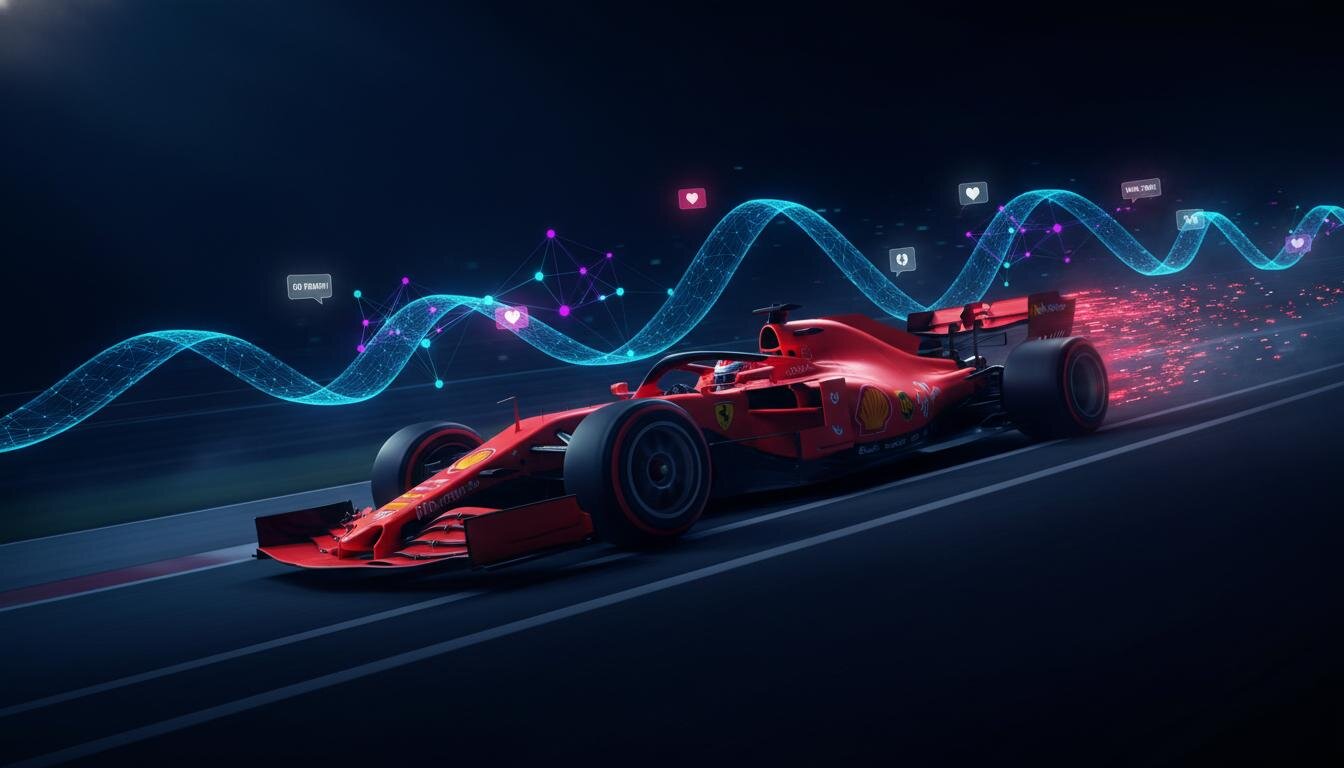
For decades, Scuderia Ferrari was defined by one thing: winning. Twenty-five Constructors' Championships. Fifteen Drivers' Championships. The most iconic name in motorsport. But two years ago, the team realized something was missing from its dominance — a direct line to its fans.
"Making each of them feel like we know them," is how Stefano Pallard, Ferrari's newly hired "head of fan development," described the challenge to TechCrunch. It was a role that didn't exist before the IBM partnership. Now, it's central to Ferrari's strategy.
The IBM Partnership: More Than a Logo on a Car
When IBM went looking for its next major sports partnership, Formula One was the obvious choice. The sport has exploded in global popularity, especially in the U.S. where Netflix's "Drive to Survive" turned drivers into mainstream celebrities. But IBM didn't just want visibility — it wanted to prove that enterprise AI could transform how brands connect with consumers.
"They're the winningest team in history," said Kameryn Stanhouse, IBM's Vice President of Sports and Entertainment Partnerships, explaining the Ferrari choice. But the partnership goes far beyond trackside branding. At its core is a bet: that AI-driven storytelling can turn casual viewers into devoted superfans.
From Race Schedule to Year-Round Engagement
The old Ferrari app was functional but forgettable. Fans opened it to check race times, then closed it. There was no reason to stay. Worse, despite Ferrari being an Italian company with a massive Italian fanbase, the app wasn't even available in Italian.
IBM changed everything. The new app features:
AI-written race summaries — Not dry recaps, but narrative-driven stories that capture the drama of each Grand Prix. The AI analyzes millions of data points generated during every race — every tire change, every pit stop, every driver reaction — and turns them into content fans actually want to read.
Predictions and games — Fans can make their own race predictions and compete with others in the app. It turns passive viewing into active participation.
An AI companion — Fans can ask questions about the team, drivers, race strategy, even trivia like "How many people does it take to change a Ferrari tire?" (Answer: 24 people working simultaneously in two seconds.)
Behind-the-scenes content — Stories about the team, the drivers, the engineering that never made it to broadcast. Content that makes fans feel like insiders.
Multi-language support — Finally including Italian, plus other languages to serve Ferrari's global fanbase.
The Results: 62% Engagement Spike
The numbers are stark. Since IBM entered the picture, engagement over race weekends has jumped 62%. But the real metric Ferrari cares about is retention — keeping fans engaged between races, during the off-season, year-round.
"Unlike other sports apps IBM has built, the Ferrari app's main focus is storytelling because it wants fans to stay engaged with it all year long," Stanhouse explained. Tournament apps like the Masters are relevant for a few weeks. F1 runs from March to November, but Ferrari wants fans thinking about the team in December too.
That ambition is paying off. The app isn't just a utility anymore — it's a destination.
AI That Understands What Fans Want
The personalization engine goes deeper than surface-level recommendations. Pallard explained that the team uses AI to analyze engagement signals: which articles fans read, how long they stay, what they share, and the sentiment of messages they send through the app.
"That helps us understand what resonates most with the Tifosi and it directly informs how we shape our storytelling and how we deliver content," Pallard said.
It's a feedback loop: fan behavior → AI analysis → content optimization → better engagement → more data → smarter AI. Every interaction makes the app more tailored to each individual user.
The New Fanbase: 75% Women and Gen Z
F1 released statistics last year showing a dramatic shift in its audience: 75% of new fans were women, many from Gen Z. The F1 Academy — an all-female racing series designed to develop the next generation of women drivers — has been a particular draw.
This new demographic wants something different from the traditional motorsport enthusiast. They're not just here for engine specs and lap times. They want stories, personalities, drama, community. They want to feel connected to the human beings inside the helmets.
Ferrari's app overhaul is designed specifically for this audience. The AI companion answers questions without judgment. The behind-the-scenes content humanizes the drivers. The prediction games create community without requiring encyclopedic F1 knowledge.
"They are asking for more data, more insight, more features, and we have to be able to deliver that," Pallard said. The IBM partnership is Ferrari's answer to that demand.
Why This Matters Beyond Motorsport
Ferrari and IBM aren't just building a better sports app — they're demonstrating what enterprise AI can do for consumer engagement across any industry.
The technical architecture is revealing. Teams process millions of data points per second during each race, capturing every movement of driver and car. Turning that firehose of telemetry into content that casual fans can understand and enjoy is exactly the challenge that enterprises face with their own data: too much information, not enough storytelling.
IBM's approach with Ferrari is a template. Take complex data. Use AI to find the narrative threads. Present them through an interface that feels personal, not corporate. Measure engagement. Iterate based on behavior. Repeat.
"With IBM, the vision for the next five years is to make every fan feel like the experience was built for them, whether they have been with us for 30 years or 30 days," Pallard said. "That is how you build loyalty that lasts."
The Competitive Landscape
Ferrari isn't alone in tech investment. McLaren and Williams also have standalone fan app strategies, and the official F1 platform serves the broader audience. But Ferrari's approach is distinct in its depth of AI integration and its focus on personalization at scale.
The partnership also reflects a broader trend: tech companies using sports as a proving ground for consumer-facing AI. AWS powers real-time F1 analytics. Oracle sponsors Red Bull Racing. Anthropic has entered the paddock. The F1 paddock has become one of the hottest places for tech companies to showcase what their tools can do.
But most of those partnerships focus on performance — making the car faster, the strategy smarter. Ferrari and IBM are focused on the other side: making the fan experience richer. It's a bet that in the long run, engagement matters as much as lap times.
What's Next
Pallard says the team wants to go deeper into personalization and create more immersive fan experiences. The current app is just the foundation. Over the next five years, the vision is an app that knows each fan's preferences so well that every notification, every article, every game feels curated specifically for them.
The technology exists. Large language models can generate personalized content at scale. Recommendation engines can predict what each user wants before they know it themselves. The challenge is execution — and Ferrari, with IBM's backing, is treating it as seriously as any engineering problem on the car.
For a team that has always measured success in trophies, this is a new kind of victory condition: not just winning races, but winning hearts. And with 62% more engagement to show for it, the early laps are looking promising.