
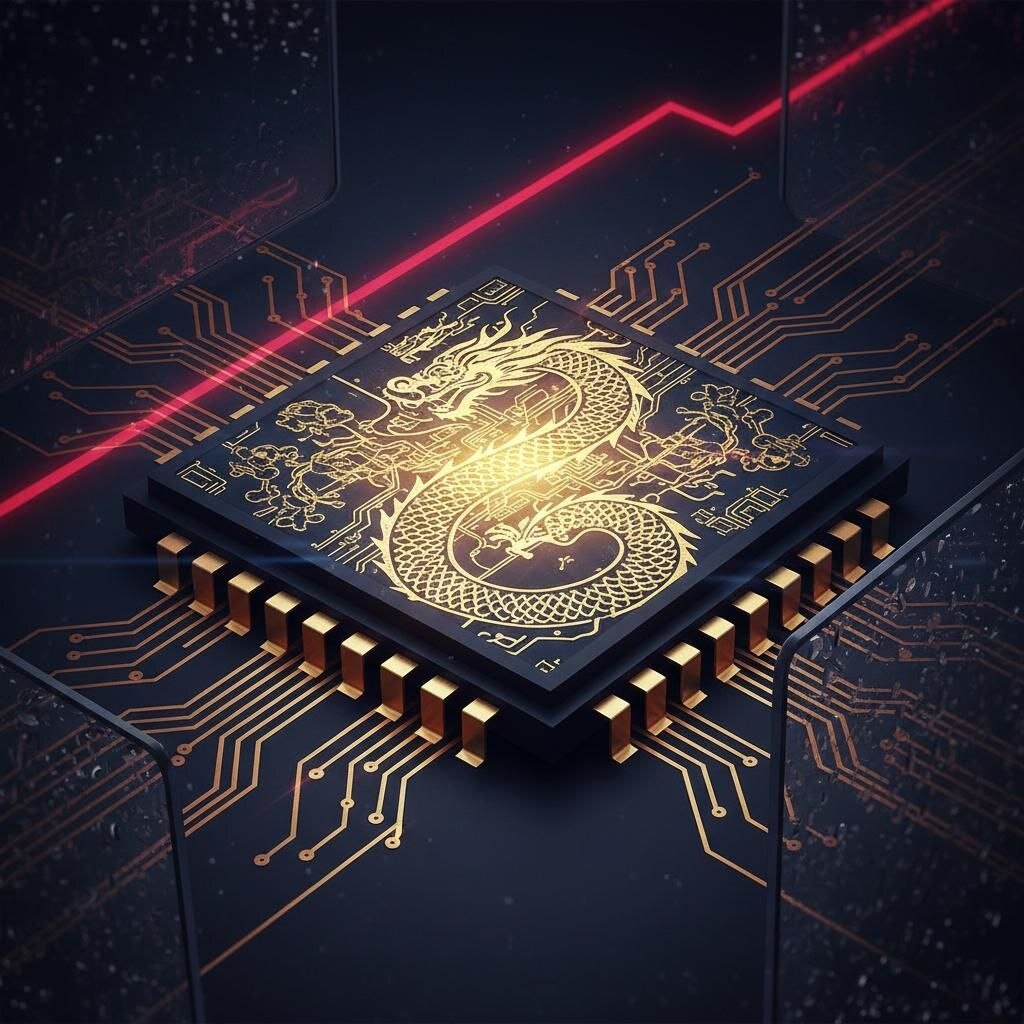
Two stories broke this week that, taken together, signal a fundamental shift in the global AI order. Chinese startup DeepSeek is quietly designing its own AI inference chip, even as Beijing weighs strict export controls on its most advanced AI models. The pattern is unmistakable: China is building a fully independent AI stack, from silicon to software to policy — and the rest of the world is being left behind.
DeepSeek's Chip Gambit
DeepSeek, the Chinese startup that shocked the world in January with its R1 reasoning model, is now building its own AI chip. Three people familiar with the matter told Reuters the chip is designed specifically for inference — the phase where trained models generate responses for users — not for training new models.
The project is still early-stage. DeepSeek is talking to chip design firms, manufacturers, and memory companies, and has been quietly hiring chip engineers for months without posting public job listings. The goal is clear: reduce dependence on Nvidia and Huawei chips, both of which face supply constraints and geopolitical risks.
DeepSeek is also raising outside capital for the first time, seeking $7 billion at a valuation of $52 to $59 billion. The money will likely fund both chip development and the massive compute clusters needed to train next-generation models.
This isn't just about cost savings. US export controls have cut Chinese companies off from the most advanced chips and memory. DeepSeek's move mirrors what OpenAI and Anthropic are doing in the US — designing custom silicon to gain performance and cost advantages. But for DeepSeek, it's existential. Without homegrown chips, China's AI ambitions hit a hard ceiling.
Beijing's Export Controls: The Other Side of the Coin
While DeepSeek works on hardware independence, Beijing is tightening its grip on software. Chinese authorities held talks last month with leading tech companies — Alibaba, ByteDance, and startup Z.ai — about restricting foreign access to China's most advanced AI models.
The restrictions, led by the Ministry of Commerce, would cover both closed and open models, including unreleased systems. Officials considered placing theft or transfer of protected AI technology under China's strict national security law. They also discussed tighter controls over who can fund domestic AI startups.
The scope is still being debated and may only apply to future models. But the direction is clear. Since DeepSeek's R1 launched, Chinese models have gained ground worldwide thanks to low costs and growing capabilities. Alibaba's Qwen and ByteDance's Doubao rank among the most widely used models globally. If Beijing limits access, costs for many companies would rise overnight.
Following America's Playbook
China is mirroring an approach Washington already took. The Trump administration worries about foreign military and intelligence agencies misusing American AI. In June, it barred foreign nationals from accessing Anthropic's most advanced models, Fable and Mythos. Because nationality couldn't be verified in real time, Anthropic initially shut the models down worldwide.
Chinese officials fear Washington could use Mythos — designed for cybersecurity professionals — to exploit software vulnerabilities against Chinese interests. Zhou Hongyi, founder of security firm 360, is already calling for a Chinese equivalent to Mythos, framing the race as "cyber-nuclear deterrence."
Both superpowers now treat their best AI models as strategic assets they'll withhold if needed. The era of open, freely shared frontier AI is ending.
Europe Caught in the Middle
For Europe, this is more than a footnote. Until now, many saw China's open, freely downloadable models as a sovereign alternative to pricier US services. But China's proposal to keep its most sensitive models domestic shows that path is unreliable too.
A report by former ECB chief Mario Draghi spelled out the digital gap: the EU depends on foreign providers for more than 80 percent of all digital products, services, and infrastructure. Europe's only competitive offering is French provider Mistral — and even that relies partly on foreign compute.
The EU's InvestAI initiative aims to mobilize 200 billion euros, including 20 billion for up to five AI Gigafactories. But implementation is lagging. The formal tender has been pushed back several times and is now expected in summer 2026. Construction won't begin until 2027.
Meanwhile, the four largest US tech companies — Amazon, Alphabet, Microsoft, and Meta — could spend a combined $700 billion on AI in 2026 alone. That's nearly double the previous year and roughly three times Europe's entire multi-year initiative.
🔥 Hot Takes
1. The open-source AI movement is dead. Both the US and China are now treating their best models as national assets. The days of freely downloadable frontier models are numbered. Companies betting on "open source AI" as a way to avoid vendor lock-in are about to get a rude awakening.
2. Europe is becoming a digital colony. With no serious AI chips, no frontier models, and no cloud infrastructure, Europe is entirely dependent on American and Chinese technology. The Brussels Effect — Europe's ability to set global standards through regulation — only works if you have something to regulate. Right now, Europe is regulating other people's technology.
3. DeepSeek's chip is more important than its model. R1 was impressive, but anyone can train a model if they have enough compute. Custom silicon is a real moat. If DeepSeek succeeds in building efficient inference chips, it could undercut Nvidia on price while avoiding US export controls entirely. That's a much bigger strategic win than any single model release.
The Bottom Line
China is executing a classic pincer movement: build your own hardware so you can't be cut off, then restrict access to your software so others depend on you. It's the same playbook the US has run for decades — just faster, and with state backing.
For companies and countries caught in the middle, the message is stark: pick a side, or build your own. The era of AI as a global public good is over. Welcome to the age of AI nationalism.