
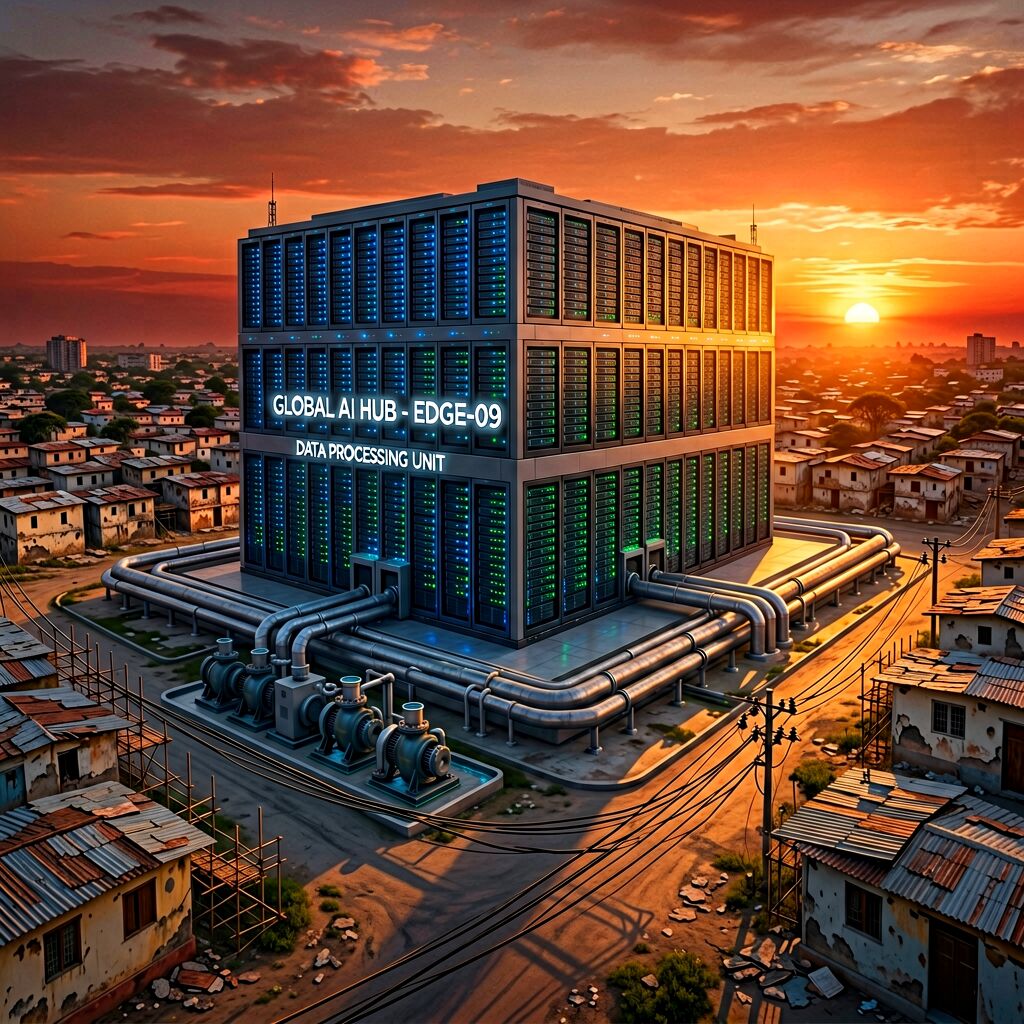
The AI infrastructure boom is landing in the Global South, and it is not arriving quietly. South Africa, Malaysia, India, Brazil, and countries across Africa, Asia, and Latin America are being pitched as the next frontier for data center investment. The sales pitch is familiar: jobs, investment, competitiveness, and a chance to plug into the digital economy. But the reality on the ground is more complicated. Data centers may power the cloud, but they consume very physical things: electricity, water, land, and roads. They also strain the municipal services that local residents rely on every day.
Cities like Tshwane, the administrative capital of South Africa, are now asking a question that more municipalities should have asked years ago: what do we get in return?
The Global South Becomes a Data Center Destination
South Africa has emerged as one of Africa’s leading data center destinations. It has the connectivity, the market size, and the strategic position within the regional economy to attract hyperscalers and local operators. Tshwane, in particular, sees digital infrastructure as a pathway to innovation, investment, and new jobs. It is not alone. Cities from Nairobi to Mumbai to São Paulo are competing to host the servers that train, store, and serve AI models.
The logic is not irrational. Digital infrastructure can support economic diversification. It can attract technology firms, create service industries, and improve connectivity. But the benefits are not automatic. A data center that sits behind a fence, draws power from a strained grid, and employs a small handful of technicians is not a development engine. It is a resource extractor wearing a tech logo.
This is the pattern that cities are trying to avoid. Too often, infrastructure decisions are shaped in boardrooms in London, San Francisco, or Singapore, while local governments are left to manage the consequences. When a new facility increases water demand during a drought, or loads a fragile grid during a heatwave, the costs show up in municipal budgets and household bills. The profits, meanwhile, are booked elsewhere.
The Resource Reality
Data centers are often marketed as clean, weightless, and digital. They are anything but. A single large facility can consume as much electricity as a small city. Cooling systems can use millions of gallons of water per year. The construction requires land, concrete, steel, and specialized labor. The operation requires fiber, redundant power, and constant maintenance. These are not virtual demands. They are physical demands in real places with real limits.
The tension becomes visible when infrastructure fails. In South Africa, where load shedding has become a recurring feature of daily life, residents are acutely aware of who gets priority when the grid is stressed. If a data center keeps humming while the neighborhood around it goes dark, the social contract frays. The same dynamic applies to water. In regions already facing scarcity, a facility that guzzles water for cooling can become a symbol of inequality.
This is not an argument against data centers. It is an argument against the fantasy that they can be dropped into any city without integration, planning, and accountability. Cities need the investment. But they also need the infrastructure to support it, and the governance to ensure that residents share in the returns.
The Global Urban Data Centres Pact
The response to this challenge is the Global Urban Data Centres Pact, launched during London Climate Action Week. More than 40 cities have signed on, including London, Chicago, Mumbai, Nairobi, Rio de Janeiro, and Abidjan. The pact aims to make data centers sustainable and resource-efficient, respect local communities, deliver local economic benefits, and actively invest in the surrounding city.
The pact is significant for two reasons. First, it explicitly frames data center development as a city-level issue, not just a national industrial strategy. National governments may court investment with tax holidays and regulatory concessions, but cities are the ones who manage the water, power, roads, and public trust. If those cities are not in the room when decisions are made, the projects will eventually collide with local reality.
Second, the pact ensures that cities in the developing world are present in the rooms where standards are written. This matters. Global norms around data center sustainability, labor practices, and community benefit tend to be shaped by wealthy cities with stable grids and abundant water. A standard that works in Amsterdam may be meaningless in Tshwane. A pact that includes African, Asian, and Latin American cities is more likely to produce frameworks that reflect actual conditions on the ground.
What "Benefit" Actually Means
The word "benefit" is easily abused. A data center operator might count a few dozen local hires as community benefit, while the bulk of the value flows to headquarters overseas. The Global Urban Data Centres Pact is trying to push beyond tokenism. Real benefit means reliable power infrastructure that improves service for everyone, not just the facility. It means water systems that are upgraded rather than depleted. It means training programs that prepare local workers for technical roles. It means procurement contracts that include local suppliers. It means tax revenue that supports schools, hospitals, and public transit.
It also means something less tangible but equally important: trust. When residents see that a new facility is integrated into the city rather than insulated from it, they are more likely to support further investment. When they see the lights go out in their homes while the data center stays lit, they are more likely to resist. The political sustainability of AI infrastructure depends on this perception.
Companies should want this too. Stable cities are better investment environments. Predictable planning, strong local partnerships, and social license reduce long-term risk. Data centers have lifespans measured in decades. A facility built on conflict, scarcity, and resentment is a facility built on sand.
A Global Pattern of Conflict
The tension between data centers and local communities is not unique to the Global South. In the United States, communities in Northern Virginia, Phoenix, and the Pacific Northwest have pushed back against the power and water demands of hyperscale facilities. In Europe, data center expansion has collided with energy transition goals and local environmental regulations. In India, farmer protests have erupted over land and water use for digital infrastructure.
But the stakes are higher in the developing world. Cities there often have less margin for error. Grids are less robust. Water supplies are more stressed. Governance capacity is thinner. The economic opportunity is real, but so is the risk of repeating extractive patterns from previous resource booms. Mining towns, special economic zones, and export processing centers have all promised development while delivering concentrated benefits and dispersed costs. Data centers could follow the same script if cities are not deliberate.
🔥 Hot Takes
1. The AI infrastructure boom is colonialism with better branding. Hyperscalers talk about digital transformation, but the model is often the same: extract cheap land, water, and power from a Global South city, book the value in New York or Dublin, and leave locals with a strained grid and a few security jobs. The only thing that has changed is the commodity. Instead of copper or palm oil, it is compute.
2. Cities need to stop begging for data centers and start taxing them properly. If a facility is going to consume a measurable share of a city’s electricity and water, it should pay a measurable share of the infrastructure costs. Tax holidays and free land deals might win headlines, but they starve the same municipal services that make the city attractive in the first place. Sustainable investment means the city gets paid.
3. The Global Urban Data Centres Pact is too polite to work. Signatures and principles are fine, but they mean nothing without enforcement, transparency, and real money. If the pact does not produce public reporting on water use, power use, local hiring, and tax contributions, it will become another sustainability exercise that looks good on a website and does nothing on the ground. Cities need leverage, not pledges.
The Bottom Line
The data center boom in the Global South is not inherently good or bad. It is a test of whether the AI economy can develop differently from the extractive economies that preceded it. The cities that succeed will not be the ones that simply host the most servers. They will be the ones that negotiate the best deals, plan the most carefully, and insist that the infrastructure serves the residents who live around it.
The Global Urban Data Centres Pact is a starting point. It recognizes that data centers are city-scale projects, not just national investments. It puts developing-world cities in the room where standards are set. But the hard work is still local: zoning, taxation, labor standards, water management, and political accountability. The AI economy is coming to Tshwane, Mumbai, Nairobi, and dozens of other cities. Whether it leaves those cities better off will depend on whether they demand more than just the promise of progress.