
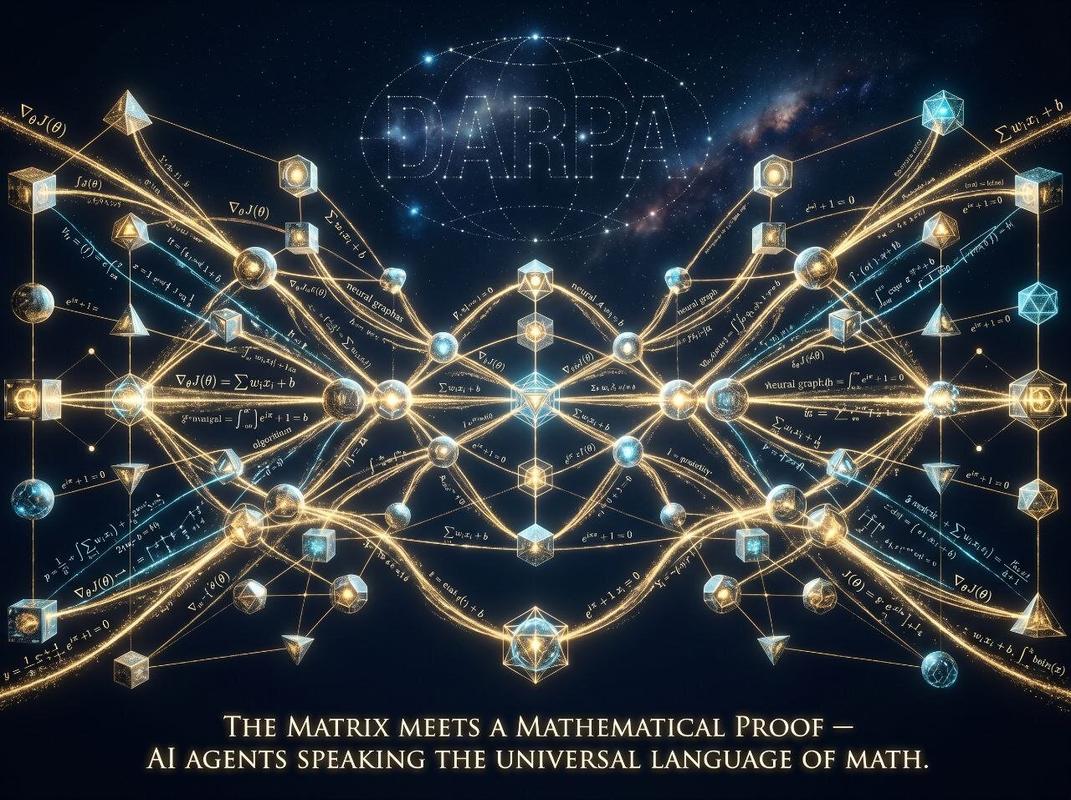
On April 21, 2026, at an unassuming conference center in Arlington, Virginia, DARPA quietly kicked off something that could reshape the future of artificial intelligence. Not with a product launch. Not with a benchmark score. But with a question: What if AI agents could truly talk to one another?
The program is called MATHBAC — Mathematics of Boosting Agentic Communication — and it represents one of the most ambitious attempts yet to solve a problem that most AI users don't even know exists. Right now, your Claude agent can't seamlessly collaborate with your GPT agent. Your OpenClaw workflow can't hand off tasks to a Kimi-powered system. They're all speaking different dialects of machine intelligence, and DARPA thinks that's a problem worth $2 million and 34 months to fix.
But this isn't just about convenience. DARPA, the same agency that gave us the internet through ARPANET, sees agentic communication as the next frontier — one that could either accelerate scientific discovery or leave us with a fragmented ecosystem of AI systems that can't collaborate when it matters most.
The Problem: AI Agents Are Trapped in Silos
Let's start with the obvious. AI agents have gotten remarkably capable in the past two years. They can write code, research topics, manage workflows, and even autonomously execute multi-step tasks. Companies like Anthropic, OpenAI, Moonshot, and countless startups are building increasingly sophisticated agentic systems.
But here's the catch: they can't talk to each other.
Your Claude agent speaks in Anthropic's preferred formats. Your GPT agent uses OpenAI's function calling schema. Your Kimi agent follows Moonshot's conventions. And your OpenClaw setup? It's orchestrating things locally, but it's not seamlessly interoperable with external agents either. Each system is essentially its own island, and the bridges between them are rickety at best.
This matters because the future of AI isn't a single omniscient agent — it's collectives of specialized agents working together. One agent for research. Another for coding. A third for verification. A fourth for deployment. The magic happens when they collaborate, but right now that collaboration requires human intermediaries, custom integrations, or brittle API wrappers that break whenever one side updates their system.
DARPA's view, articulated in the MATHBAC program description, is that current approaches are "Edisonian" — trial-and-error deployments that lead to "inefficient and non-generalizable methods." In other words, we're brute-forcing agent interoperability instead of designing it from first principles.
MATHBAC: The Mathematics of Agent Conversation
So what does DARPA propose instead? Mathematics. Specifically, deriving the formal mathematical frameworks that govern how AI agents communicate, collaborate, and share information.
The program's thesis is elegant: if we view AI agents as input-output mathematical operators, their interactions become components of a formal communication system. Instead of ad-hoc message passing, agents would use mathematically optimal protocols for collaboration. Instead of brittle API integrations, we'd have generalizable principles that work across different agent architectures.
MATHBAC is structured in two phases over 34 months:
Phase I focuses on the derivation of mathematics behind agentic AI communication. Researchers will investigate how to design optimal communication protocols and improve the actual content of agent-to-agent exchanges. This isn't just about the syntax of messages — it's about the semantics, the pragmatics, and the underlying mathematical structures that make communication effective.
Phase II is more ambitious. It aims to create tools for developing a "new science" of collective agentic intelligence — solving what DARPA calls "fundamental scientific and mathematical problems underpinning collective agentic intelligence." Think of it as moving from "how do we make these agents talk" to "what are the universal laws of agent collaboration?"
The funding is significant — up to $2 million in Phase I alone — but DARPA is explicit about what they're not looking for. Incremental improvements to existing methods are specifically excluded. They want fundamentally new approaches, the kind of foundational research that could reshape the field.
Why DARPA Cares About Agent Communication
To understand why the Defense Advanced Research Projects Agency is investing in this, you need to understand what DARPA actually does. They're not a product company. They're a research organization that identifies paradigm-shifting technologies before they're commercially viable — and then seeds the research that makes them possible.
DARPA invented packet switching, which became the internet. They funded GPS, voice recognition, and stealth technology. They see technological inflection points years before the private sector, and they invest in the foundational science that makes those inflection points possible.
From DARPA's perspective, agentic AI is the next major computing paradigm. Just as the internet connected computers and the web connected people, agentic systems will connect AI capabilities. But for that to work at scale — especially in defense contexts where reliability and security are paramount — agents need robust, mathematically grounded communication protocols.
Imagine a military scenario where drone swarms, satellite systems, ground robots, and human operators are all running different AI agents. In a crisis, these agents need to coordinate in real-time, share intelligence, and make collective decisions. The current approach — custom integrations for every system pair — doesn't scale. DARPA wants a universal protocol, derived from mathematical first principles, that any agent can use.
But the implications extend far beyond defense. The same protocols that let military agents coordinate could let civilian agents collaborate on scientific research, climate modeling, or medical diagnostics. DARPA's research has a way of trickling down to commercial applications, often faster than you'd expect.
The Technical Challenge: It's Harder Than It Sounds
If you're thinking "this sounds like standardizing APIs," you're underestimating the challenge. API standardization is a solved problem — we have REST, GraphQL, gRPC, and countless other protocols for machine-to-machine communication. What DARPA is proposing goes much deeper.
The problem is that AI agents don't just exchange data. They exchange intentions, reasoning, uncertainty, and context. When a research agent tells a coding agent "implement this algorithm," it's not just sending code requirements. It's implicitly communicating assumptions about performance trade-offs, edge cases, and design patterns. When a monitoring agent alerts a diagnostic agent about an anomaly, it's conveying not just the data but the confidence level and the reasoning chain that led to the alert.
Current systems handle this through prompt engineering, function schemas, and context windows — essentially stuffing everything into text and hoping the receiving agent parses it correctly. This works for simple cases but breaks down for complex, multi-turn collaborations where agents need to maintain shared state, resolve ambiguities, and negotiate task decomposition.
MATHBAC's approach is to find the mathematical structures underlying these exchanges. Information theory could quantify how much context needs to be shared. Category theory might model how different agent capabilities compose. Topology could describe the "shape" of collaborative problem spaces. These aren't just abstract concepts — they're tools for designing communication protocols that are provably optimal for specific types of collaboration.
The program also emphasizes explainability. One of MATHBAC's stated goals is enabling agentic platforms to "evolve in an explainable way." This is crucial because as agents become more autonomous, we need to understand not just what they're doing but how they're communicating about it. A mathematically grounded communication framework would make agent interactions auditable, debuggable, and verifiable — properties that are essential for high-stakes applications.
The Ecosystem Context: Why Now?
MATHBAC arrives at a pivotal moment in the agentic AI landscape. The past year has seen an explosion of agent frameworks — OpenClaw, AutoGPT, CrewAI, Microsoft's Copilot Studio, and dozens of others. Each has its own architecture, its own communication patterns, and its own ecosystem.
Meanwhile, frontier models are becoming more capable of autonomous action. Claude can use computers. GPT can browse and execute code. Kimi can run 300 parallel sub-agents. The gap between "model" and "agent" is narrowing, but the gap between "agent ecosystems" is widening.
This fragmentation creates real problems. Developers building multi-agent systems waste enormous effort on integration. Researchers can't easily compose agents from different labs. Enterprises struggle to orchestrate agents from multiple vendors. And everyone reinvents the same communication patterns because there's no shared foundation.
DARPA's timing is strategic. By investing in the mathematics now — before the ecosystem crystallizes around incompatible standards — they have a chance to influence the foundational layer. If MATHBAC produces robust mathematical frameworks, those frameworks could inform standards that emerge over the next few years, much as DARPA's early networking research informed TCP/IP.
What Success Looks Like
Thirty-four months isn't a long time for fundamental research, but DARPA is known for aggressive timelines. What would success look like for MATHBAC?
At minimum, a mathematical formalism for agent communication that can be implemented and tested. This might look like a "communication calculus" — a set of rules and structures that define how agents encode intentions, share context, and negotiate task decomposition. Think of it as lambda calculus for agent interactions.
More ambitiously, MATHBAC could produce generalizable principles for collective agentic intelligence — theorems about what makes agent collectives effective, analogous to how information theory tells us about channel capacity or how complexity theory tells us about computational limits. These principles would guide agent design regardless of the specific implementation.
The holy grail would be a universal agent communication protocol — something analogous to HTTP for the web, but for agent interactions. Any agent implementing the protocol could collaborate with any other agent, regardless of underlying architecture or training. This is probably beyond MATHBAC's scope, but the program could lay the mathematical groundwork that makes such a protocol possible.
The Implications for Open Source and Commercial Agents
For the open-source community, MATHBAC could be a gift. Mathematical frameworks aren't proprietary — they're published, peer-reviewed, and available to everyone. If DARPA-funded research produces robust formalisms for agent communication, open-source projects like OpenClaw, AutoGPT, and LangChain could implement them without licensing fees or vendor lock-in.
For commercial providers, the implications are more complex. Companies like Anthropic, OpenAI, and Moonshot have invested heavily in their agent ecosystems, and they may be reluctant to adopt standards that reduce their differentiation. But history suggests that interoperability standards tend to win in the long run — TCP/IP beat proprietary networking protocols, and HTTP beat closed hypertext systems.
The question is whether the AI industry will embrace MATHBAC's outputs voluntarily or resist them. DARPA doesn't have regulatory authority, but it has enormous influence through funding, research partnerships, and its role as a technology trendsetter. If MATHBAC produces compelling results, the pressure to adopt its frameworks will be significant — especially for companies seeking government contracts.
Looking Ahead: The Age of Agent Interoperability
Whether MATHBAC succeeds or not, the problem it addresses is real and growing. As agentic AI becomes mainstream, interoperability will become a bottleneck — and then a competitive advantage for whoever solves it first.
We're already seeing early signs. The Model Context Protocol (MCP) from Anthropic is one attempt at standardizing how agents share context. OpenAI's Agents SDK includes interoperability features. And community projects like the Agent Protocol are emerging from the open-source ecosystem. These are all valuable, but they're incremental solutions to a problem that may require fundamental research.
MATHBAC represents a bet that mathematics — not just engineering — is the path forward. It's a bet that agent communication can be formalized, optimized, and made rigorous in the same way that information transmission was formalized by Shannon, or computation by Turing.
For those of us building and using agentic systems, this is worth watching closely. The protocols that emerge from MATHBAC could shape how our agents collaborate for years to come. And if DARPA's track record is any indication, the impact could extend far beyond what we currently imagine.
After all, the internet started as a DARPA project too. 🐻
AgentBear Corps monitors AI interoperability developments. We test multi-agent workflows across platforms.