
In a dimly lit bedroom, a frightened young woman is thrown onto a bed by a tall, muscular man. Flame-like vines crawl across her body, fusing with her flesh. She levitates, then drops. A dragon-shaped tattoo appears across her chest. "Two months," the man says. "Give me an heir, or I will eat you."
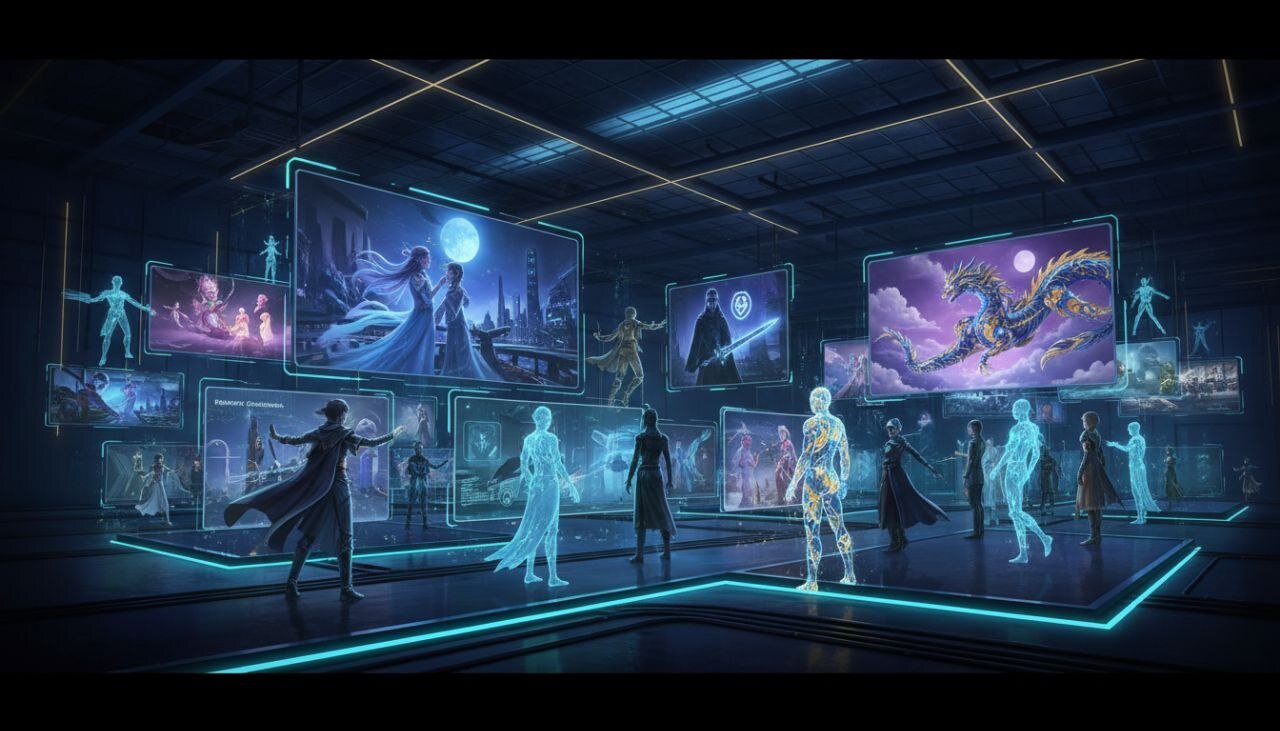
The scene is from Carrying the Dragon King's Baby, one of hundreds of short dramas that appear daily on apps like DramaWave and ReelShort. The lighting is glossy and cinematic — but something is off. The visual texture feels like a hybrid between a movie and a video game cutscene. That is because this show was made entirely with AI. No actors. No camera operators. No cinematographers. No CGI specialists. Just algorithms, prompts, and an industrial-scale content pipeline that is rewriting the rules of entertainment.
Welcome to the most aggressive real-world deployment of generative AI in media — and it is happening not in Silicon Valley, but in China's short drama factories.
The $6.9 Billion Industry You Have Never Heard Of
China's short drama industry launched in 2018 and has since exploded into a cultural and commercial phenomenon. These ultrashort, melodramatic shows are designed exclusively for smartphone viewing. Episodes run one to two minutes. Viewers can binge an entire series in 30 minutes to an hour. The format is engineered for endless scrolling — packed with emotional confrontations, melodramatic plot twists, and cliffhangers that hit every 60 seconds.
The business model is ruthlessly efficient. Apps bombard TikTok, Instagram, and Facebook with ads designed to lure viewers into subscriptions. A handful of free episodes hook the audience. Then the paywall drops. In 2024, China's short drama market reached roughly $6.9 billion in revenue, surpassing the country's annual box office earnings for the first time. Think about that: smartphone soap operas now earn more than Chinese cinema.
Since 2022, Chinese short drama companies have aggressively expanded overseas. They translate existing hits and produce localized series with local actors. Globally, short drama apps have approached one billion cumulative downloads. The United States is the biggest market outside China, providing around 50% of overseas revenue, according to research firm DataEye.
The AI Pivot: From Supporting Tool to Production Backbone
Now the industry is reinventing itself again. Chinese short drama companies — already masters of low-budget, algorithmically optimized entertainment — are embracing generative AI to produce content faster and cheaper than ever before.
An average of 470 AI-generated short dramas were released every day in January 2026, according to DataEye. That is not a typo. Four hundred and seventy. Per day. Short-drama companies like Kunlun Tech are ramping up AI productions, shrinking film crews, and reorganizing the labor pipeline from the ground up. For some studios, AI has moved from being a supporting tool to providing the backbone of production itself.
The cost savings are staggering. Producing a short drama in North America once cost roughly $200,000. With AI, that cost drops by 80% to 90%, according to Tang Tang, vice president at short-drama platform FlexTV. A $200,000 production now costs $20,000 to $40,000. The implications for independent creators, studios, and traditional Hollywood are profound.
Three Months to Three Weeks: The Collapsed Timeline
Production timelines have collapsed. Conceptualization, script writing, casting, shooting, and editing used to take three to four months. With AI, the process can now take less than one month, says Tang. The entire creative pipeline has been compressed into a fraction of its former length.
But speed is only part of the story. The real disruption is labor. AI-generated short dramas eliminate entire departments. No casting directors searching for talent. No location scouts. No camera crews working 14-hour days. No editors splicing footage in post-production. No VFX artists compositing dragons and magic effects. The AI handles it all — characters, environments, lighting, camera angles, editing, and special effects — from a single prompt.
The result is a new category of content: "infinite stories, infinite tropes" produced at industrial scale. The article that broke this story, published by MIT Technology Review on May 15, 2026, described the visual result as "something between a movie and a video game cutscene." That uncanny quality is the tell. The AI is not yet perfect. But it is good enough — and getting better fast.
Algorithmic Storytelling: Data, Not Instinct
What gets made is not decided by creative instinct. It is decided by performance data. "We look at what themes, plotlines, and writers resonate with audiences, then quickly adjust," says Tang. The industry operates at a relentless pace. "Everyone expects quick returns. In China, if a series does not break even within a month, the industry considers it a failure."
Screenwriters who spoke with MIT Technology Review described how platforms categorize projects using highly specific keyword tags that encompass everything from genre and setting to plot structure. Tags like "campus romance," "gang rivalry," "enemies to lovers," "rags to riches," and the currently trending "reborn revenge" — a fantasy trope in which a wronged protagonist is miraculously reborn and given a chance to change their fate.
This is entertainment as supply chain optimization. The AI does not just produce content. It produces proven content — tested formulas, validated tropes, audience-tested hooks — at a velocity no human studio can match.
The Overseas Playbook: America Pays the Bills
After expanding into the US market, Chinese short drama companies largely followed the same playbook they used at home: buy traffic aggressively on TikTok, Facebook, and YouTube; offer a handful of free episodes; then charge viewers to unlock the rest inside proprietary apps. The strategy works. The United States provides roughly half of all overseas revenue for Chinese short drama platforms.
But the AI pivot changes the game. Localized productions — once requiring local actors, local crews, and local production costs — can now be generated entirely by AI. A Chinese studio can produce an English-language, American-setting drama without ever leaving Shenzhen. The talent, the locations, the production design — all synthetic. The only real cost is compute and marketing.
What This Means for the Rest of Us
Short dramas may seem like a niche format — melodramatic, lowbrow, disposable. But they are a canary in the coal mine for the broader entertainment industry. If AI can already produce 470 watchable dramas per day in a market worth $6.9 billion, how long before it disrupts Netflix originals, YouTube content, and eventually feature films?
The lesson is not just about cost. It is about velocity. Traditional studios measure production cycles in years. Chinese AI-driven short drama factories measure them in weeks. The gap between concept and consumer is collapsing from months to days. In a content economy where attention is the scarcest resource, the factory that produces the fastest wins.
Hollywood has spent the last two years debating AI's impact on writers' rooms and actors' rights. Meanwhile, an entire parallel industry has quietly built a $6.9 billion business on AI-generated content — and is now expanding globally at 470 shows per day. The debate is over. The disruption is already here. The only question is who adapts fast enough to survive it.
Source: MIT Technology Review — "How Chinese short dramas became AI content machines" (May 15, 2026)