
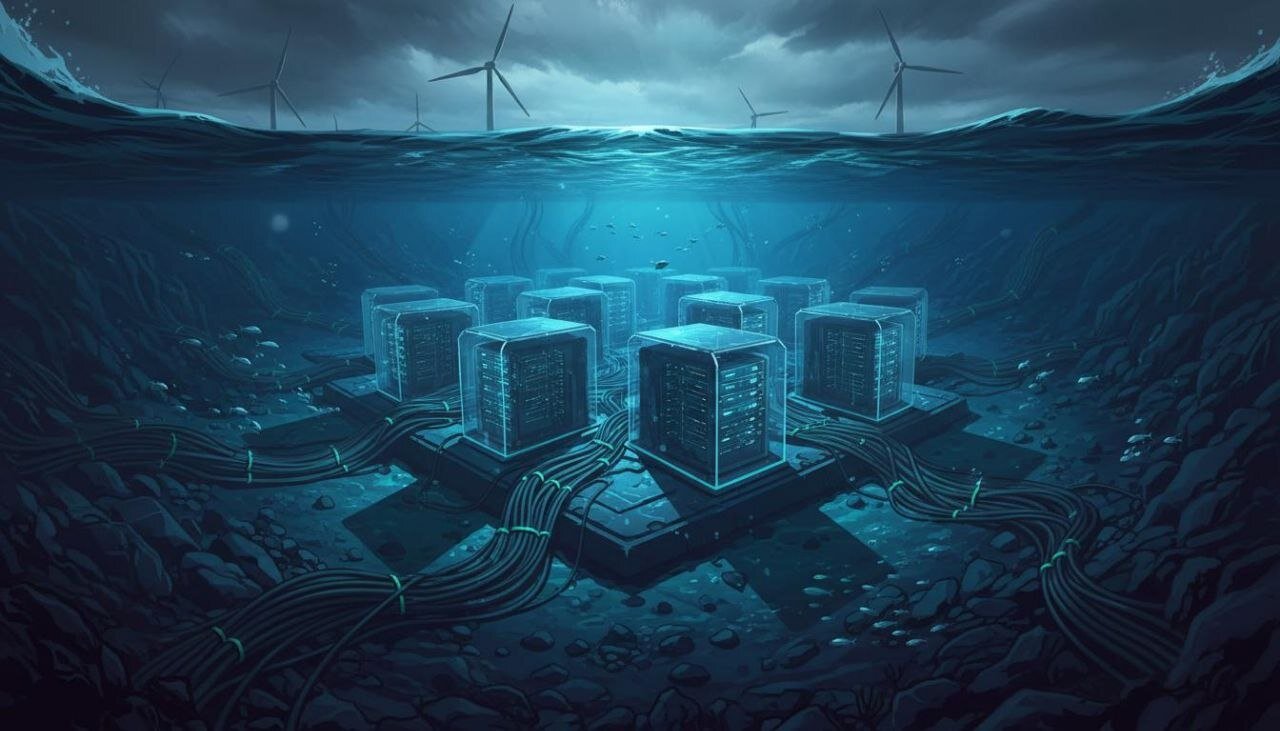
At 3:12 PM local time on May 18, 2026, a crane lowered the final pressure-resistant module into the murky waters of the East China Sea, about 20 kilometers off the coast of Shanghai's Lingang Special Area. Inside that module were 144 high-performance GPU servers. Around it, eleven identical modules already sat on the seabed, connected by fiber optic cables to the mainland and by power lines to a nearby offshore wind farm. The moment that last module touched down, China officially activated the world's first commercial offshore underwater AI data center — a facility that exists entirely beneath the waves, powered by wind, cooled by seawater, and already training domestic large language models.
The numbers are striking. The facility houses nearly 2,000 servers across twelve submerged modules, drawing 24 megawatts of power from Lingang's offshore wind turbines. Its Power Usage Effectiveness (PUE) rating — the industry metric for data center efficiency — sits at approximately 1.15. To put that in perspective, the most efficient land-based hyperscale data centers operated by Google, Microsoft, and Amazon typically achieve PUE ratings between 1.10 and 1.20, but only after billions of dollars in cooling technology investments. China's underwater facility hits comparable efficiency using gravity, ocean water, and wind — without the massive freshwater consumption, land acquisition battles, or urban heat island effects that plague traditional facilities.
For an industry that consumes more electricity than most countries and faces mounting pressure to reduce its environmental footprint, China's experiment represents either a genuine breakthrough or an audacious publicity stunt. The answer, as with most things in China's tech sector, appears to be both.
The Project: From Demo to Commercial Reality in 11 Months
The underwater data center didn't appear overnight. The project traces back to June 2025, when the Lingang Special Area Administrative Committee signed partnership agreements with Shanghai Lingang Special Area Investment Holding Group and HiCloud Technology, a local computing infrastructure company. Additional operational partners — China Telecom, Shenergy Group, and CCCC Third Harbor Engineering — came aboard shortly after.
The first phase was deliberately modest: a 2.3-megawatt demonstration facility with a single underwater module. Engineers used this pilot to validate the core concept — that sealed server modules could survive submerged, that seawater could effectively dissipate heat without corroding equipment, and that power and data connections could remain reliable in a marine environment.
Construction on the full-scale facility began after the pilot succeeded. By October 2025, the underwater infrastructure was complete, and trial operations began early in 2026. Full commercial launch followed in May — remarkably fast for infrastructure of this complexity, suggesting either exceptional execution or shortcuts that may reveal themselves over time.
The total reported cost: approximately ¥1.6 billion, or roughly $226 million USD. For a 24-megawatt AI-focused facility, that cost profile is competitive with land-based alternatives, especially when factoring in the absence of land acquisition costs, building construction, and conventional cooling infrastructure.
How It Works: Engineering Beneath the Waves
The twelve submerged modules are positioned between the first and second phases of Lingang's offshore wind farm, at depths that put them below surface turbulence but within practical range for maintenance diving operations. Each module is a pressure-resistant cylinder — effectively a submarine hull repurposed for computing — containing server racks, power distribution units, and network switching equipment.
Cooling is elegantly simple. Seawater circulates through heat exchangers on each module's exterior, carrying waste heat away into the ocean. The thermal conductivity of water is roughly 25 times that of air, meaning submerged heat exchangers can be dramatically smaller and more efficient than the massive cooling towers and chillers used in land-based facilities. No freshwater is consumed. No refrigerants are used. The cooling system has no moving parts — just passive heat transfer between the module's interior and the surrounding seawater.
Power comes directly from the offshore wind turbines, with undersea cables connecting the generation infrastructure to the computing modules. During periods of low wind, the facility can draw supplemental power through cables running back to the mainland grid. The arrangement effectively creates a localized microgrid where renewable generation and high-intensity computing are co-located, minimizing transmission losses and land use conflicts.
Network connectivity runs through redundant fiber optic cables, with latency to Shanghai reportedly under 2 milliseconds — perfectly adequate for cloud computing workloads and AI training clusters that don't require real-time interaction.
China Telecom and LinkWise, a local computing provider, have already deployed GPU clusters inside the underwater modules specifically for AI processing and data-intensive workloads. The facility is actively supporting domestic large language model training, big data annotation pipelines, and 5G infrastructure services.
Why Underwater? The Logic Beneath the Surface
China's motivation for building underwater isn't just technological showmanship — it's a response to genuine constraints facing the country's AI ambitions.
First, land. Shanghai and the surrounding Yangtze River Delta are among the most densely populated and expensive real estate markets in the world. Building a 24-megawatt data center on land would require acquiring industrial zoned property, fighting through years of permitting and environmental review, and dealing with community opposition to the noise, heat, and visual impact of massive cooling infrastructure. Putting the facility offshore sidesteps all of that.
Second, power. China's eastern coastal regions have strained electrical grids, and data centers are voracious consumers. The Lingang offshore wind farm was already generating power that needed somewhere to go. Co-locating computing with generation reduces transmission losses and avoids the need to build additional long-distance power lines.
Third, cooling. China's inland data centers, particularly in northern regions, have struggled with water scarcity. Cooling a large facility can consume millions of liters of freshwater daily. Using seawater eliminates freshwater consumption entirely — a significant advantage in a country where water resources are unevenly distributed and increasingly stressed.
Fourth, and perhaps most strategically, control. An underwater facility in Chinese territorial waters is immune to foreign surveillance, physical tampering, and the kind of infrastructure attacks that have worried Western data center operators. The modules are effectively unreachable without Chinese naval or diving support, adding a layer of physical security that land-based facilities cannot match.
The Efficiency Question: Is 1.15 PUE Real?
Power Usage Effectiveness of 1.15 is exceptional if accurate. In data center terminology, PUE measures total facility power divided by IT equipment power. A PUE of 1.0 would mean zero overhead — all power goes to computing. A PUE of 2.0 means half the power is consumed by cooling, lighting, and infrastructure. Google's best facilities have achieved PUE as low as 1.10, but only in ideal conditions with advanced cooling technologies and favorable climates.
China's claim of 1.15 for an underwater facility is plausible but unverified by independent auditors. The physics support it — seawater cooling is inherently efficient, and offshore wind co-location eliminates transmission losses. However, long-term maintenance of submerged electronics, corrosion management, and biofouling (marine growth on heat exchangers) could degrade performance over time.
The facility's real efficiency test will come during Shanghai's hot summer months, when surface seawater temperatures rise and cooling capacity decreases. If the modules can maintain their PUE rating through July and August, the technology will have passed its most significant challenge.
Implications for Global AI Infrastructure
If China's underwater data center proves durable and economically viable, it could trigger a fundamental shift in how AI training infrastructure is deployed globally.
Coastal cities with limited land and strained power grids — Tokyo, Mumbai, Singapore, Los Angeles, New York — could theoretically adopt similar approaches. Any jurisdiction with shallow coastal waters, offshore wind potential, and permissive maritime regulations becomes a candidate for submerged computing.
The model is particularly compelling for AI training workloads, which are batch-oriented and can tolerate the occasional latency of underwater maintenance. Training a large language model doesn't require millisecond response times — it requires sustained, intensive computation over days or weeks. Underwater facilities could serve as "training bunkers" where models are trained in bulk, with inference and user-facing services remaining in conventional land-based facilities closer to population centers.
For China specifically, the underwater facility addresses a critical vulnerability in its AI strategy. US export controls on advanced AI chips have forced Chinese companies to make the most of every GPU they can acquire. Maximizing utilization through superior infrastructure efficiency — lower PUE means more power available for actual computing — becomes a strategic imperative. China's underwater data centers could extract more AI training per watt than equivalent American facilities, partially offsetting the chip disadvantage.
Environmental Considerations
The environmental case for underwater data centers is more nuanced than the efficiency numbers suggest.
On the positive side: no freshwater consumption, no refrigerants, renewable power, and minimal land use. The heat dissipated into the ocean is trivial compared to marine heat sources like volcanic vents or submarine cables, and the modules are positioned away from sensitive ecosystems.
On the concerning side: concentrated heat discharge can create localized thermal plumes that affect marine life. The construction process disturbs seabed ecosystems. The materials used in pressure-resistant modules — likely steel alloys, copper, and various coatings — will eventually corrode and require replacement, generating marine waste. And if a module fails catastrophically, recovering or safely abandoning it is far more complex than decommissioning a land-based facility.
China has not published environmental impact assessments for the Lingang facility, and independent marine biologists have not yet had access to monitor the site's effects on local ecosystems. The environmental benefits are theoretically sound but empirically unverified.
Security and Sovereignty Dimensions
An underwater data center in Chinese territorial waters is, by definition, beyond the reach of foreign intelligence services that might otherwise intercept data flows or compromise physical infrastructure. The undersea cables connecting the modules to shore can be monitored and secured more easily than the sprawling terrestrial networks that connect conventional facilities.
For AI model training — particularly the development of large language models and military AI applications — this physical security is strategically significant. The US, UK, and other Western intelligence agencies have well-documented capabilities for intercepting data center communications and potentially injecting supply-chain compromises into equipment. Submerged facilities with tightly controlled supply chains reduce these attack vectors.
The security advantage cuts both ways, of course. The same isolation that protects against foreign interference also makes independent verification of China's efficiency claims, environmental compliance, and operational practices effectively impossible without Chinese cooperation.
What Comes Next
China has not indicated whether it plans to replicate the Lingang model at other coastal locations, but the logic is compelling enough that expansion seems likely. Potential sites include the Bohai Sea near Beijing, the Pearl River Delta near Shenzhen, and the Taiwan Strait — though the latter would carry obvious geopolitical complications.
The underwater approach is also likely to evolve. Deeper installations, perhaps at 100 meters or more, could access colder water and improve cooling efficiency further. Modular designs that allow individual server racks to be swapped by autonomous underwater vehicles could reduce maintenance costs. Integration with tidal or wave power, rather than just wind, could provide more consistent renewable generation.
Western companies are watching closely. Microsoft conducted an experimental underwater data center project called Project Natick off the coast of Scotland, but abandoned it in 2020 after limited testing. China's commercial deployment suggests that the concept, while challenging, is viable at scale with sufficient investment and regulatory support.
For the global AI infrastructure race, the Lingang facility adds another dimension to China's strategy. While American companies focus on chip design and software optimization, China is attacking the problem from the infrastructure layer — finding ways to train more AI with less power, less land, and less water. If the underwater experiment succeeds, it won't just be an engineering curiosity — it'll be a template for how the next generation of AI training infrastructure gets built.
Whether that template spreads beyond China depends on whether the facility can maintain its efficiency claims through a full year of operation, whether environmental concerns prove manageable, and whether other countries can replicate the unique combination of shallow waters, offshore wind, permissive regulation, and government-backed investment that made Lingang possible. For now, the servers hum beneath the waves, training models and consuming wind power, while the rest of the industry watches from shore.