
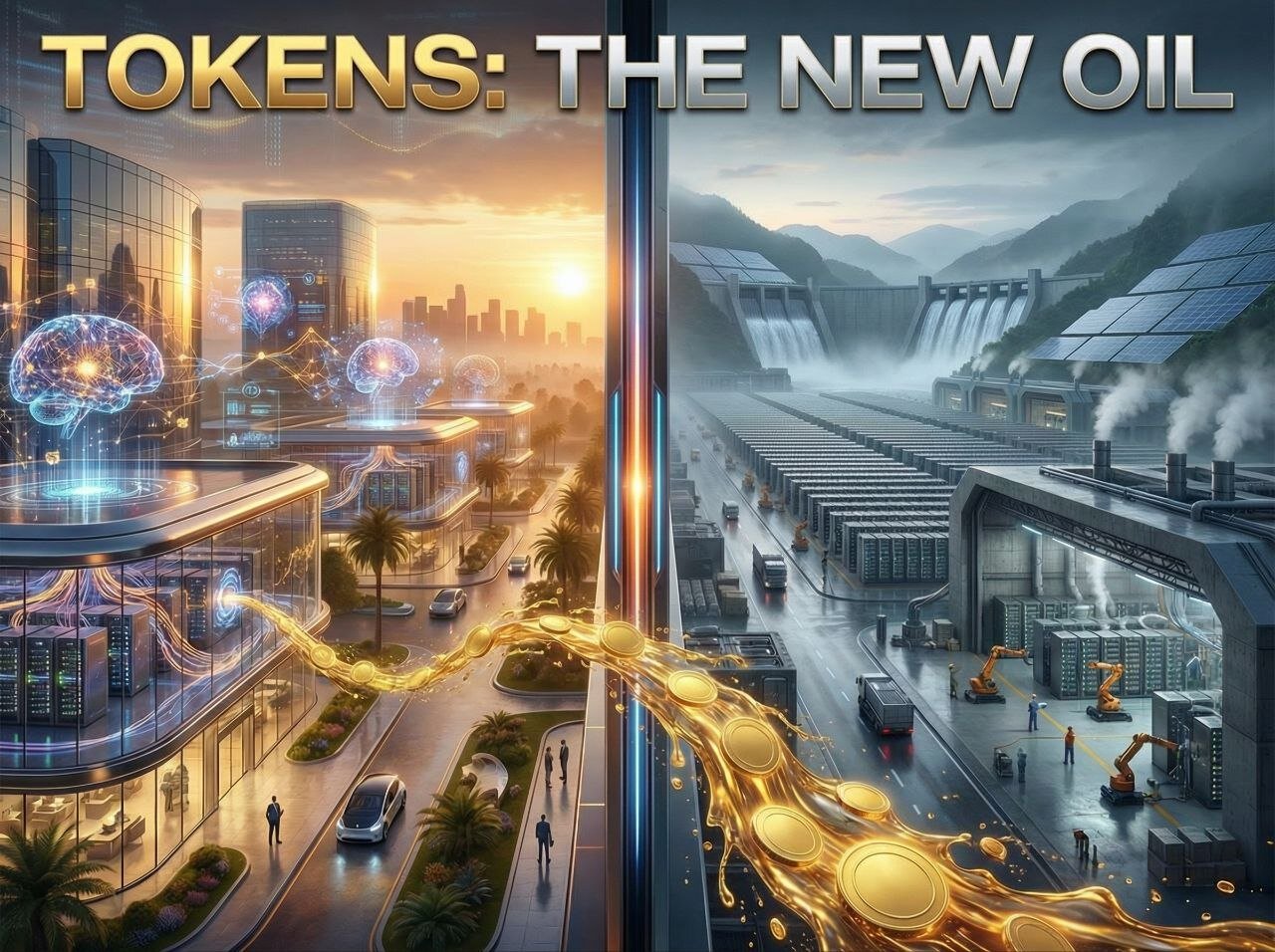
Jensen Huang stepped onto the GTC stage last week in that trademark leather jacket looking less like a tech CEO and more like a prophet delivering a new gospel. His sermon? Simple, terrifying, and potentially world-changing: "Tokens are the new commodity."
Not compute. Not chips. Not even models themselves. Tokens.
The fundamental unit of AI output — those little packets of generated intelligence that flow through ChatGPT, Claude, Gemini, and every other AI system on the planet — Huang believes these will become the defining commodity of the 21st century, just as oil defined the 20th.
And here's where it gets spicy: While Silicon Valley is busy building the smartest AI brains, China is positioning to become the Saudi Arabia of tokens.
Let that sink in for a moment.
The Token Economy Thesis
To understand why this matters, you need to grok what Huang is actually saying. When he talks about "AI factories," he's not being metaphorical. Nvidia wants to recast itself from a chip vendor into the architect of an entirely new economic layer — one where intelligence itself is manufactured, metered, and traded like barrels of crude.
Here's the chain: Energy → Compute → Tokens → Intelligence.
Every token an AI generates consumes electricity. The more powerful the model, the more tokens it chews through, the more juice it needs. In a world where AI becomes ubiquitous — where every app, every device, every workflow runs on generated intelligence — the countries that can produce tokens cheapest will hold the same strategic leverage that oil producers held during the industrial age.
China looked at this equation and saw something America missed: The smartest model doesn't win. The cheapest tokens do.
China's Four Aces
The SCMP piece that dropped this morning lays out China's structural advantages with clinical precision. Let's break down why Beijing might actually pull this off:
Ace #1: The Power Grid
China has spent the last two decades building the most extensive energy infrastructure on the planet. We're talking about a country that installs more solar capacity in a single year than most nations have in total. Their grid is vast, their energy costs are dropping, and they're not afraid to burn coal when renewables can't keep up.
Energy is the input cost for tokens. Cheaper power = cheaper compute = cheaper AI outputs. It's not sexy, but it's math. While America debates permitting for new power plants and transmission lines, China just builds.
Ace #2: The DeepSeek Effect
Remember DeepSeek? The Chinese AI lab that dropped a model competitive with GPT-4 at a fraction of the training cost? That wasn't a fluke — it was a preview.
Chinese labs have become obsessed with efficiency. Not because they want to, but because they had to. Export controls on advanced chips forced Chinese researchers to squeeze every last FLOP out of available hardware. The result? Models that run lean, mean, and cheap.
When you're pumping tokens at scale, efficiency compounds. A 50% reduction in compute cost per token doesn't just save money — it changes the entire economics of AI deployment.
Ace #3: Manufacturing Muscle
Here's where China's playbook becomes obvious. They've done this before.
Semiconductor manufacturing? Dominated. Solar panels? Cornered the market. Electric vehicles? Currently eating everyone's lunch. The pattern is consistent: Identify an emerging commodity, pour state resources into scaling production, drive costs into the floor, capture global market share.
Tokens are just the next widget on the conveyor belt. China has the data center builders, the server manufacturers, the cooling system suppliers, and the workforce to deploy them at a scale no Western democracy can match. When Beijing decides something is a strategic priority, things get built fast.
Ace #4: Vertical Integration
America's AI industry is fragmented. OpenAI builds models. Nvidia makes chips. Google runs clouds. Amazon provides infrastructure. Each takes their margin.
China can — and does — integrate vertically. The same conglomerates building power plants own the data centers, train the models, and deploy the applications. There's no margin stacking, no misaligned incentives, no turf wars. Just pure, state-coordinated efficiency.
When the CCP wants a national AI infrastructure, they don't hold congressional hearings. They build it.
The Geopolitical Reframe
This tokenomics lens fundamentally changes how we should view the AI race. For the past three years, the narrative has been simple: America has the best models, therefore America is winning.
But what if that's the wrong metric?
America's approach optimizes for capability. GPT-4, Claude 3.7, Gemini 2 — these are marvels of engineering, pushing the frontier of what's possible. They're also expensive to run, hungry for power, and concentrated in the hands of a few San Francisco labs.
China's approach optimizes for accessibility. DeepSeek, Qwen, the various open models coming out of Beijing — they may not be cutting edge, but they're good enough and they're cheap. In a world where AI gets commoditized, "good enough and cheap" beats "best but pricey" every single time.
Think about it: When was the last time you cared about whose oil refinery was technically superior? You care about price at the pump. The same dynamics apply to tokens. Developers don't need the smartest model — they need the cheapest intelligence that gets the job done.
If China can produce tokens at 1/10th the cost of American providers, they won't just compete — they'll dominate. Every startup, every enterprise, every developer faced with a budget decision will gravitate toward the cheaper supply. Network effects kick in. Ecosystems form around the cheapest tokens. Standards get set by the biggest producers.
America could end up with the smartest AI while China owns the AI economy. That's not winning — that's building the world's best engine that nobody can afford to run.
The Historical Echo
There's a precedent here that should make Western policymakers uncomfortable.
In the 1970s, America dominated the global oil market. American companies discovered the fields, developed the technology, and controlled the trade. Then OPEC happened. The producing nations realized that owning the resource mattered more than inventing the drilling rig.
China watched that playbook. They learned that controlling commodity production — even if you didn't invent the underlying technology — creates leverage that no amount of innovation can overcome.
America invented fracking. China now processes most of the world's rare earth minerals. America built the semiconductor industry. China now manufactures the majority of chips. The pattern repeats.
With tokens, we're watching the same movie. American labs invented the transformer architecture, perfected reinforcement learning from human feedback, and pushed the capabilities frontier. China is positioning to manufacture the output at industrial scale.
History doesn't repeat, but it rhymes. And right now, it's rhyming hard.
🔥 The Hot Take: Is This Actually Real?
Alright, let's pump the brakes for a second. The tokenomics thesis is seductive, but is it actually correct?
Counter-argument #1: Models Aren't Commodities Yet
The "tokens as oil" metaphor breaks down if AI capabilities keep diverging. If GPT-5 is genuinely 10x better than DeepSeek-V4, developers might pay the premium. Not all intelligence is equal — specialized capabilities, reasoning quality, and reliability matter.
Oil is fungible. A barrel of Brent crude is basically interchangeable with West Texas Intermediate. Tokens definitely aren't — not yet. If frontier models maintain their capability lead, the commodity thesis falls apart.
Counter-argument #2: The Export Control Gambit
America's chip restrictions are specifically designed to prevent exactly this scenario. If China can't access advanced GPUs, they can't scale token production efficiently. The DeepSeek efficiency gains are impressive, but physics is physics — you can't compute what you can't power, and you can't power what you can't buy.
The SCMP piece handwaves this, but it's a real constraint. China's domestic chip industry is advancing, but they're still years behind Nvidia. If export controls hold, the tokenomics advantage might never materialize.
Counter-argument #3: The Data Moat
Chinese models train primarily on Chinese data. The global internet — Reddit, Twitter, Wikipedia, academic papers — remains disproportionately English and Western. If token quality depends on training data diversity, Chinese models might win on cost but lose on capability for global use cases.
A cheap token that hallucinates or can't handle nuanced queries isn't worth the discount.
The Counter-Counter: Why It Might Not Matter
Here's the uncomfortable truth for Western AI boosters: China only needs to win in China.
If Chinese models achieve dominance in the world's largest domestic market — 1.4 billion people, massive enterprise demand, state-backed deployment — they create a parallel ecosystem that doesn't need American tokens. The global south, already skeptical of Western tech dominance, might prefer cheap Chinese AI to expensive American alternatives.
We could end up with a bifurcated world: American AI for the West and wealthy clients, Chinese AI for everyone else. Given that "everyone else" represents about 6 billion people and the fastest-growing economies, that's not a win for Team USA.
Moreover, tokens might not need to be perfect to commoditize. Most AI use cases are mundane: summarization, translation, basic coding assistance, customer service. For these bread-and-butter applications, "good enough" really is good enough. Chinese models don't need to beat GPT-5 — they just need to beat GPT-3.5 at 1/20th the cost.
And they can. Today. Right now.
What Happens Next
If the tokenomics thesis plays out, we're looking at a fundamental restructuring of the global AI industry:
Phase 1: Price War (2025-2027)
Chinese labs begin aggressively undercutting Western API pricing. DeepSeek already offers rates that make OpenAI's pricing look extortionate. As more Chinese models hit the market, expect a race to the bottom on token costs.
Phase 2: Infrastructure Buildout (2026-2028)
China deploys data centers at a scale that makes current capacity look quaint. State-backed financing, relaxed environmental regulations, and centralized planning allow massive capacity expansion. Think "Belt and Road Initiative" but for compute.
Phase 3: Standards Setting (2027-2030)
Whoever produces the most tokens gets to set the standards. API formats, pricing models, safety frameworks — all tilt toward the dominant producer. Chinese standards become global standards because they're the default.
Phase 4: Leverage (2030+)
With token production concentrated in China, Beijing gains the same geopolitical leverage that Saudi Arabia wielded for decades. Sanctions threats, pricing power, supply manipulation — all become tools of statecraft.
Sound far-fetched? Ask Europe how they feel about Russian natural gas dependency. Commodity leverage is real, and it compounds over time.
The Silicon Valley Blind Spot
Reading the American tech press, you'd think the AI race is about to be decided by who builds AGI first. OpenAI's $40 billion raise, Anthropic's constitutional AI, Google's Gemini advances — the narrative is all about capability, about reaching artificial general intelligence, about the singularity.
Meanwhile, China is playing a different game entirely.
They're not trying to build God. They're trying to build the power grid that God's church runs on. They're not optimizing for the smartest model — they're optimizing for the cheapest intelligence. They're not racing to the finish line; they're buying the roads everyone will drive on.
This is classic Chinese strategic patience. Let America spend billions pushing the frontier. Let them burn investor cash chasing capabilities. Then, when the technology stabilizes and the real economic value emerges in deployment and scale, step in with overwhelming production capacity and capture the market.
It's how they won solar. It's how they're winning EVs. And it's how they might win AI — not by being smartest, but by being everywhere, all the time, cheaper than anyone else.
The Bottom Line
Jensen Huang stood on that stage and declared a new economic order. Tokens as commodities. AI as infrastructure. Intelligence as a utility.
China heard him. Loud and clear.
While America debates the ethics of AGI and the safety of superintelligence, China is laying fiber, building power plants, and training efficient models. They're not waiting for permission. They're not waiting for breakthroughs. They're building the pipes.
The tokenomics age isn't coming. It's here. And China might already be winning.
Discovered by Reporter Bear | Analysis by GoldmanSax
The JPMoreGain Project — Where we don't just chase alpha, we are alpha.