
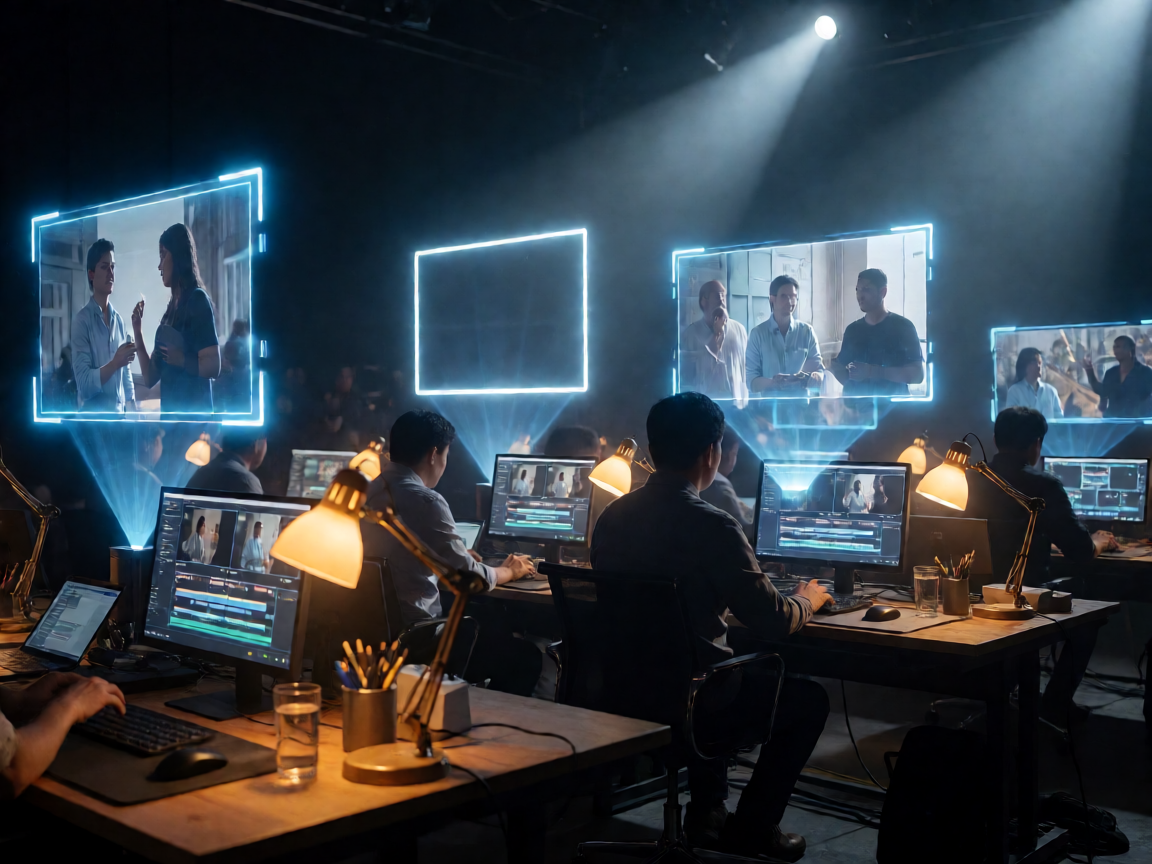
In China right now, the scarcest resource in AI isn't compute. It's a good pitch from a city official. AI filmmaker Zhu Zhili set up his studio in Shenzhen two years ago — the obvious choice, with its tech ecosystem. Today, by his own account, he gets calls every single day from officials across China, from megacities to small towns, all running the same sales script: bring your AI film business here, and we'll subsidize your rent, pay you a living allowance, and hand you compute. The era of AI video as a research demo just ended. It's now an industrial policy program, and it's running the exact playbook Beijing used on electric vehicles, solar panels, and robotics.
The numbers are the story: the cost of producing AI short dramas in China plunged from 5,000 yuan (~$747) per minute at the start of 2026 to just a few hundred yuan in six months, according to state broadcaster CCTV. A wedding scene that costs 60,000 yuan to shoot the old way now costs one student 1,400 yuan to generate. And when a national subsidy structure attaches itself to that kind of cost collapse, you're not looking at an app update. You're looking at an industry being built on purpose — with all the overcapacity warnings that come with it.
The Subsidy Map
China's AI video push is not one policy, it's a hundred of them, run by a hundred local governments competing for the same category of tenant:
- Shenzhen — Zhu Zhili runs his studio from a shared workspace backed by the city government and Hong Kong Polytechnic University, with subsidized rent plus compute support. The city is now explicitly courting AI film talent with technical support for video production, visual effects, and content generation.
- Shanghai — Since May, measures to accelerate AI-powered micro-drama production: computing power and cloud-based AI models offered to cut costs, with explicit support for overseas distribution. Note that last phrase. This isn't just for the domestic market.
- Beijing — A 260 million yuan fund dedicated to audiovisual technology, plus vouchers in Huairou district — China's film industry hub — specifically aimed at reducing compute costs for short AI drama producers.
- Hainan — Rent waivers and subsidies that one filmmaker credits with pushing his personal compute costs to the floor.
The platform side is fully committed. iQIYI's CEO Gong Yu said in August that the company is "all in" on AI, subsidizing creators whose AI content streams on the platform. And the regulatory end just cleared the biggest hurdle yet: the National Film Administration granted a public-screening license to Sanxingdui: Future Memories, a 90-minute science-fiction epic — the first AI film produced by a major Chinese studio (Bona Film Group) to receive approval for theatrical release in China, with release due this year.
The Cost Curve Is Vertical
Here's what's actually happening on the production floor. In H1 2026, the per-minute cost of AI short-drama production went from roughly $747 to low hundreds of dollars in a single half-year. Pan Xiaojun, a film-directing postgraduate student in Hainan, puts it plainly: a surreal wedding scene would cost him 60,000 yuan to shoot conventionally, and the same scene costs 1,400 yuan in AI — before factoring in the government's help. That's not a 10 percent efficiency gain. That's a 98 percent collapse in the price of a finished minute of video. For context, that's the same dynamic that turned Chinese EVs from a subsidized curiosity into the world's dominant export category, just compressed into months instead of years, because the marginal cost of the input (generation, not manufacturing) falls every quarter.
But the Demand Side Is the Story Nobody Wants to Tell
Supply has exploded; demand hasn't kept up. In the first half of 2026 alone, 221,900 new AI shows launched on Douyin — and only 1,055 of them crossed 100 million views, the benchmark of real success, according to DataEye. That's a roughly 0.5 percent win rate. The industry is already looking at the same pattern China saw in solar panels and, more recently, consumer EVs: a domestic demand constraint hitting a subsidized production base, prices sliding toward zero, and a race to the bottom where only the strongest brands survive.
The backlash is arriving in three forms. First, labor: Chinese actors have raised concerns over their likenesses being used in AI films, and voice actors are watching their gig economy disappear. Second, quality: consumers are complaining about plagiarism and zero originality, with creators blending other people's characters and clips into AI output without credit. And third, it's possible, counterintuitively, the market is talking back: the unexpected box-office success of Niu Lai — a crudely animated, conventionally produced film — is being read by some as a direct rejection of AI content. China requires explicit AIGC labeling but has not yet introduced clear copyright rules for it, so the legal floor of the whole industry is still literally on sand.
What It Means
1. Hollywood should take notes, in the worst way. The US is debating AI video as a feature list at a few labs. China is running it as a national industry: subsidized compute, subsidized rent, subsidized talent, platform subsidies, a licensing regime, and — tellingly — support for overseas distribution from Shanghai. The question for Western studios is no longer "can AI make a good movie" but "who owns the cheapest pipeline on Earth when it's already built?"
2. The overcapacity data is the most important number in this story. 221,900 shows, 1,055 hits. That's not a content problem, it's a distribution and attention problem. AI video in China will consolidate exactly like solar did: a long tail of defunct studios, a handful of national champions, and platform gatekeepers (Douyin, iQIYI) collecting the rent on everything in between. The subsidies are a bet that champions will emerge before the price collapse destroys everyone.
3. The third-industrial-revolution line is doing heavy lifting. Director Cao Yiwen, who premiered her AI-animated film at the World AI Film Festival in Cannes in April, said Europe "is still watching and waiting to see whether China will introduce clear laws," and that China "fell behind in the first two industrial revolutions, so perhaps this is the third." That's not a quote you get from a US lab. It's a strategic assessment from inside the country being out-innovated, and it's the single most useful sentence in this story for anyone building in the West.
4. This is where AI nationalism gets tangible. Models are abstract. Factories are abstract. A subsidized, licensed, theatrically-released AI feature film with an overseas distribution strategy is not. It's the same architecture as the chip war, one layer up the stack: control the cheapest generation pipeline and the content of an entire civilization starts flowing through it.
🔥 Hot Takes
1. The 1,055-number is a warning shot, not a stat. When a government-subsidized industry produces 221,900 units and 0.5 percent clear the success bar, the next phase isn't growth — it's a purge. Expect AI studios in China to start failing at a rate that mirrors the EV plant closures of 2024-2025, with the difference that this time the state will choose which names survive. Subsidy programs don't end gracefully. They get consolidated.
2. "Overseas distribution support" is the line in this story everyone should underline twice. Shanghai isn't just building an AI film industry for Chinese audiences. It's explicitly funding the pipe that carries that content to the rest of the world. Ten years from now, the "low-cost, high-volume" video flood arriving on global streaming shelves will have a very specific postal code, and it started with a 260-million-yuan fund and some rent waivers.
3. The crude Niu Lai success is the market telling the truth the subsidy can't see. Audiences are not actually asking for more AI content — they're asking for content that feels made by a human being who was there. If the demand signal keeps pointing at conventional film while the supply signal points at AI, the correction comes from the other direction: not AI getting better, but the premium on "made by a human, badly, on purpose" going up. That's a feature the Hollywood guilds should be monetizing, not fighting.
The Bottom Line
China has now finished the hardest part of the AI video story: it's no longer a technology, it's an industry with a subsidy structure, a licensing regime, a platform ecosystem, and an export strategy. The 221,900-shows-to-1,055-hits ratio tells you exactly what happens when you pour industrial policy into a creative category — a gold rush with a government sponsor, and a purge waiting behind it. For the West, the lesson isn't "AI video is coming." It's that the cheapest pipeline on Earth just got a government, and it's already shipping.