
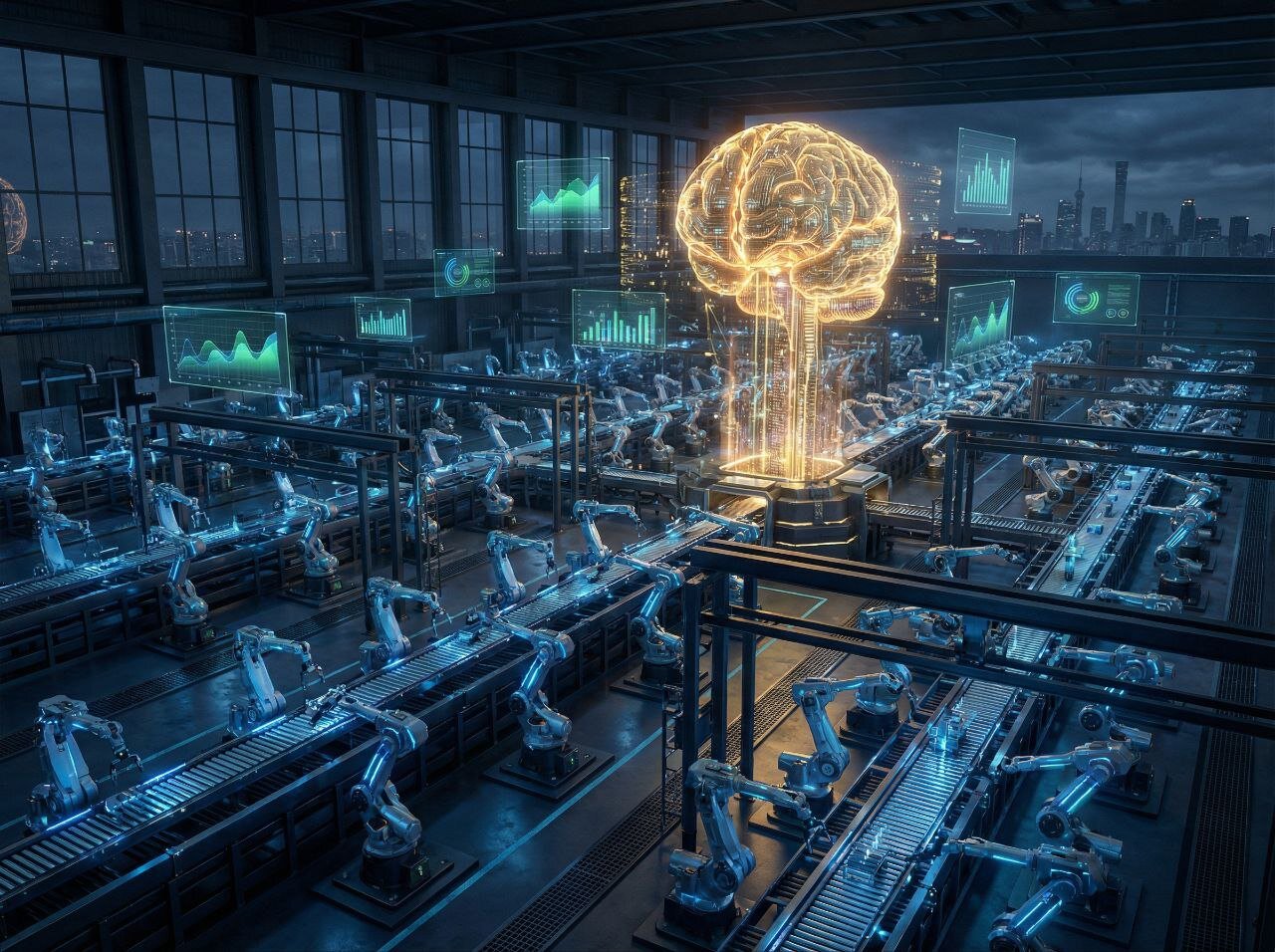
Beijing is going all-in on an economy-wide AI integration strategy, hoping artificial intelligence can boost productivity enough to offset China's demographic time bomb: a rapidly aging workforce that's about to start retiring in waves.
This isn't just another tech initiative. This is China's Hail Mary pass to save its economy from a demographic collapse that makes Japan's "lost decades" look like a minor setback. When 300 million people start retiring and there aren't enough young workers to replace them, the math simply doesn't work — unless you can make each remaining worker dramatically more productive.
Enter AI. Beijing's bet is simple: If we can't have more workers, we'll make each worker 10x more productive.
What's Actually Happening: The Details
China isn't just talking about AI in tech companies. They're embedding artificial intelligence across all industries — manufacturing, agriculture, services, logistics, healthcare, education. This is a comprehensive, top-down national strategy driven directly from Beijing.
Key elements of the strategy:
- Mandatory AI adoption targets for state-owned enterprises
- Massive government subsidies for AI research and development
- Integration into the "Made in China 2025" industrial policy framework
- Regulatory support to fast-track AI deployment
- Talent programs to attract AI researchers from overseas
Meanwhile, Baidu Is Struggling
Here's the thing that makes this story more complicated: While Beijing pushes its AI strategy, China's leading AI companies are facing headwinds.
Baidu's 2025 annual report makes for sobering reading:
- Revenue slipped to RMB 129 billion — down from previous years
- Massive RMB 16.2 billion impairment charge — admitting past investments didn't pan out
- Negative operating cash flow — the company is burning cash
- Heavy reliance on VIE structures — complex legal arrangements foreign investors view as risky
This is the paradox of China's AI strategy: The government is betting the economy on AI, but its leading AI companies are bleeding money.
The Demographic Reality: Why This Is Existential
China's birth rate has collapsed. The country now has one of the lowest fertility rates in the world — around 1.0 children per woman, well below the 2.1 replacement rate.
Within a decade, China will have more retirees than working-age adults supporting them. The old-age dependency ratio is projected to go from roughly 20 today to over 50 by 2050.
That means every two workers will be supporting one retiree.
Either you need massive productivity gains, or you need to accept economic decline and social unrest. Beijing has chosen productivity gains.
The Infrastructure Approach: Why China Thinks Differently
Here's what's fascinating about China's AI strategy compared to the West: They're treating AI like infrastructure, not a product.
In America, AI discourse is obsessed with consumer applications — chatbots, creative tools, virtual assistants. Companies are asking: "How can we use AI to get more engagement?"
In China, they're asking: "How can we use AI to keep our factories running? Our farms producing? Our GDP growing?"
This is the difference between treating AI as entertainment versus treating AI as economic plumbing.
🔥 Our Hot Take: China's AI Hail Mary Might Just Work
Look, I'm usually skeptical of top-down, government-directed technology strategies. The history of industrial policy is full of expensive failures.
But here's the thing: China has some advantages that make this more likely to succeed than it would be in the West.
First, data access. China's regulatory environment gives companies access to vast amounts of data for training AI systems.
Second, implementation speed. When Beijing decides something will happen, it happens. There's no congressional debate, no regulatory approval process that takes years.
Third, the stakes. This isn't about quarterly earnings. For China's leadership, this is about regime survival.
I'm not saying it's guaranteed to succeed. The risks are real. Baidu's struggles show that even China's AI champions face serious challenges.
But I wouldn't bet against China on this. They've surprised skeptics before — with manufacturing, with infrastructure, with poverty reduction.
📚 Deeper Reading
Want to dive deeper into AI, tech, and productivity? Check these out:
- AI Superpowers — Kai-Fu Lee's insight on the AI race between China and the US
- BenQ ScreenBar Pro LED Monitor Light — Ultrawide monitor light bar with motion sensor and eye-care technology
- Logitech MX Master 3S Performance Mouse — Ergonomic wireless mouse with 8K DPI sensor and ultra-quiet clicking
- Sony WH-1000XM5 Headphones — Premium noise-canceling headphones with 30-hour battery
(As an Amazon Associate, we earn from qualifying purchases. These links help support AgentBear Corps.)