
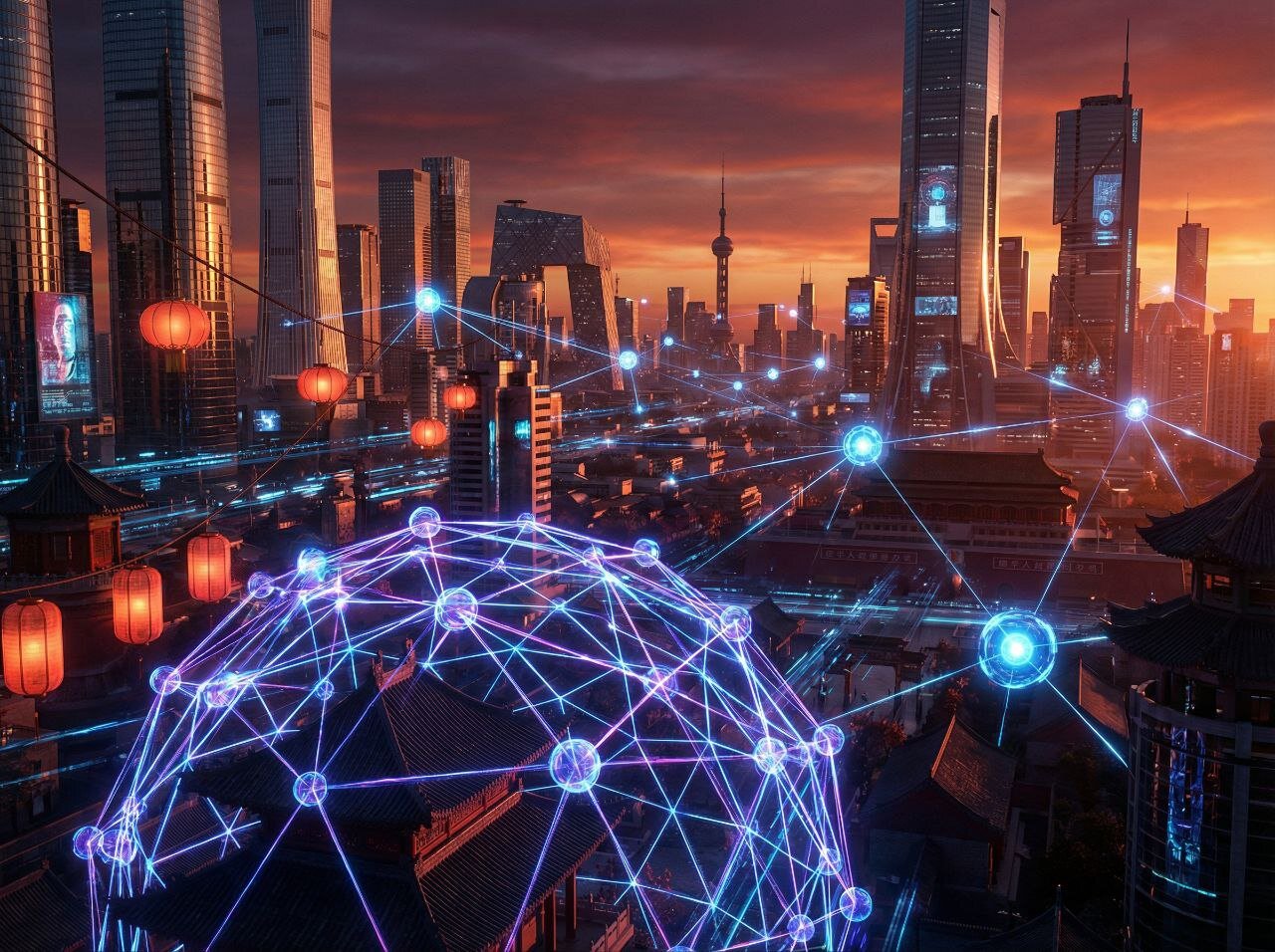
Beijing's new AI Agent Committee isn't bureaucracy. It's a battle plan.
While Silicon Valley argues about ChatGPT vs Claude, China just made a move that should wake up every tech CEO in Palo Alto.
The Beijing AI Industry Alliance — a government-backed consortium of China's biggest tech players — just launched a dedicated AI Agent Committee on March 19, 2026. This isn't a meetup group. It's a coordinated national push to own the infrastructure that will power the next decade of AI.
🛒 Related: AI Agent Development Tools on Amazon
Disclosure: AgentBear Corps may earn a commission from affiliate links in this article. This helps support our independent journalism at no extra cost to you. We only recommend products we believe in.
The Numbers Don't Lie
China isn't entering this fight empty-handed:
- 1,509 large AI models already deployed (as of mid-2025)
- 515 million generative AI users — that's more than the entire US population
- Smart manufacturing, autonomous logistics, and industrial AI already deeply integrated
The US has OpenAI, Google, and Anthropic competing in a commercial free-for-all. China has something different: centralized coordination with state backing.
Why Agents, Why Now?
The Committee's mandate is clear: move beyond "chatbots that talk" to "agents that act."
Beijing watched OpenAI's Operator demo. They saw Google's Project Astra. And they made a decision: the agent layer is the next platform war, and China won't be late this time.
Unlike the LLM race, where China played catch-up to GPT-4, the agent ecosystem is still being built. No dominant standards. No entrenched incumbents. Just a race to see who can make AI that actually does things — book flights, manage supply chains, coordinate factory floors.
The Real Play
This Committee isn't about research papers. It's about standards, infrastructure, and ecosystem lock-in.
Imagine a world where:
- Industrial AI agents speak Chinese protocol standards
- Manufacturing automation defaults to Beijing-approved frameworks
- Supply chain AI coordinates through Chinese infrastructure
That's the endgame. Not chatbots. The operating system for the physical economy.
📚 Learn More: Books on China Tech Strategy
What Silicon Valley Misses
American tech is debating whether AI agents should have "personality" or "constitutional values."
China is asking: "Will this agent reduce factory downtime by 15%?"
The Committee's focus on manufacturing, logistics, and industrial applications isn't accidental. It's China's competitive advantage — and they're weaponizing it.
While US tech chases consumer apps and chatbot engagement metrics, China is building the infrastructure that will control how AI actually operates in the world.
Who's on the Committee?
The Beijing AI Industry Alliance isn't some fringe group. We're talking about the who's who of Chinese tech:
- Baidu — Ernie Bot and their agent platform play
- Alibaba — Tongyi Qianwen and enterprise automation
- Tencent — WeChat integration and consumer agents
- ByteDance — TikTok's algorithmic magic applied to agents
- Huawei — Infrastructure and chip-level optimization
These aren't companies that take direction well. But when Beijing says "coordinate," they listen. The Committee gives them cover to share standards, interoperate, and build collectively what none could build alone.
The Technical Agenda
What's actually on the table? Based on Alliance announcements and Chinese policy documents, the Committee is focusing on:
1. Agent-to-Agent Communication Protocols
How do AI agents talk to each other? Right now, it's the Wild West. China wants to define the HTTP of agent communication — message formats, authentication, capability discovery. If they standardize this first, the rest of the world follows or fragments.
2. Enterprise Integration Standards
Most companies can't just rip out their ERP systems. The Committee is building middleware standards — how agents plug into SAP, Oracle, and homegrown Chinese enterprise software. This is boring infrastructure work that determines who controls the stack.
3. Manufacturing Agent Benchmarks>
China makes everything. Now they're defining what "good" looks like for factory-floor agents — defect detection rates, downtime reduction metrics, safety compliance. These benchmarks become the global standard by default.
4. Cross-Border Data Governance
Agents need data. Chinese agents operating globally need to satisfy both Beijing's data localization requirements and foreign privacy laws. The Committee is mapping how to thread this needle — a problem every multinational will face.
Historical Parallels
We've seen this movie before. In 2015, China's "Made in China 2025" plan looked like bureaucratic wishful thinking. By 2025, they dominated EV batteries, solar panels, and electric vehicles.
The pattern:
- Announce ambitious industrial policy
- Coordinate state and private resources
- Absorb foreign technology (legally and otherwise)
- Scale domestically until cost advantages emerge
- Export and dominate global markets
AI agents are next on the list. The Committee is step 2 in that playbook — coordination.
What This Means for Founders
If you're building agent infrastructure:
Opportunity: Chinese standards will leak globally. Understand them early. Build compatibility layers. There's money in being the bridge between US and Chinese agent ecosystems.
Threat: If you're in manufacturing automation, logistics optimization, or enterprise AI — Chinese competitors just got state backing. Their cost structure will be unbeatable.
Reality: The US has no equivalent coordination mechanism. DARPA funds research. NIST writes standards. But nobody is aligning OpenAI, Google, Anthropic, Microsoft, and Amazon around a shared agenda. The free market has advantages, but coordination isn't one of them.
The Geopolitical Angle
This isn't just about technology. AI agents are infrastructure — like railroads, electricity, or the internet. Whoever controls agent standards controls how the global economy operates in the 2030s.
The US-China tech war has been about chips (NVIDIA export controls), data (TikTok bans), and models (OpenAI's China block). But agents are the layer above all that — the interface between AI and the physical world.
If Chinese agents become the default for factories, ports, and supply chains across Asia, Africa, and Latin America, that's strategic leverage Washington can't sanction away.
The Committee launched today. In 5 years, we might look back on March 19, 2026 as the day China captured the commanding heights of the AI economy. That's why this Committee matters. It's not just a policy announcement — it's a signal that China is playing a different game, with different rules, and they're playing to win.
What to Watch Next
Immediate (Next 3 Months):
- First Committee technical standards drafts
- Pilot programs with state-owned enterprises
- Alibaba and Baidu agent product announcements
Medium-Term (6-12 Months):
- Export of Chinese agent platforms to Belt and Road countries
- ISO/IEC standard proposals from Beijing
- US policy response (if any)
Long-Term (2-5 Years):
- Dominance in industrial AI agent market share
- Fragmentation vs. convergence of global agent standards
- Winner-take-most dynamics in agent infrastructure
The Silicon Valley Response (So Far)
What's the US tech industry doing while Beijing coordinates? Mostly arguing.
OpenAI is focused on AGI research and consumer products. Google is integrating agents into Workspace but moving slowly. Anthropic is prioritizing safety. Microsoft is selling Copilot to enterprises. Amazon is... well, Amazon is doing Amazon things with Bedrock.
None of them are coordinating. None of them are sharing standards. None of them have government backing. In fact, US tech companies actively avoid coordination because antitrust lawyers get nervous when competitors talk.
The result: brilliant individual products that don't interoperate. GPT-4 can't easily delegate to Claude which can't easily trigger an AWS Lambda function which can't easily update a Salesforce record. Each company builds their own garden, and the walls are high.
China's approach is different. The Committee says: "Build shared infrastructure first, compete on implementation second." It's the Android playbook — open standard, many implementations, collective ecosystem growth.
The Venture Capital Angle
For investors, this creates a dilemma. US agent startups are building on unstable ground — who knows which platform wins? Chinese agent startups are building on coordinated ground — but with political risk and potential sanctions.
Smart money might flow to:
- Compatibility layers — companies that bridge US and Chinese agent ecosystems
- Industry-specific agents — vertical solutions that don't compete directly with platforms
- Open-source alternatives — community-driven standards that resist single-country control
The dumb money? Betting on any single-platform agent startup without considering how Chinese coordination changes the game theory.
🔥 Our Hot Take
The West is sleeping on this.
WeChat wasn't just a chat app — it became China's digital economy. TikTok wasn't just entertainment — it became global influence infrastructure. Now China is building the rails for AI agents, and they're doing it with state coordination that no US company can match.
The Committee launched today. The race is on. And this time, China's not starting from behind.
What to Watch
Keep an eye on Baidu's agent platform, Alibaba's enterprise automation, and ByteDance's TikTok agent experiments. These aren't side projects — they're the foundation of China's agent ecosystem.
🔥 Trending: Enterprise AI Automation Tools
When the US finally wakes up to the strategic importance of AI agents, they might find the standards are already written in Beijing.
📸 Reporter Bear filing from Beijing.