
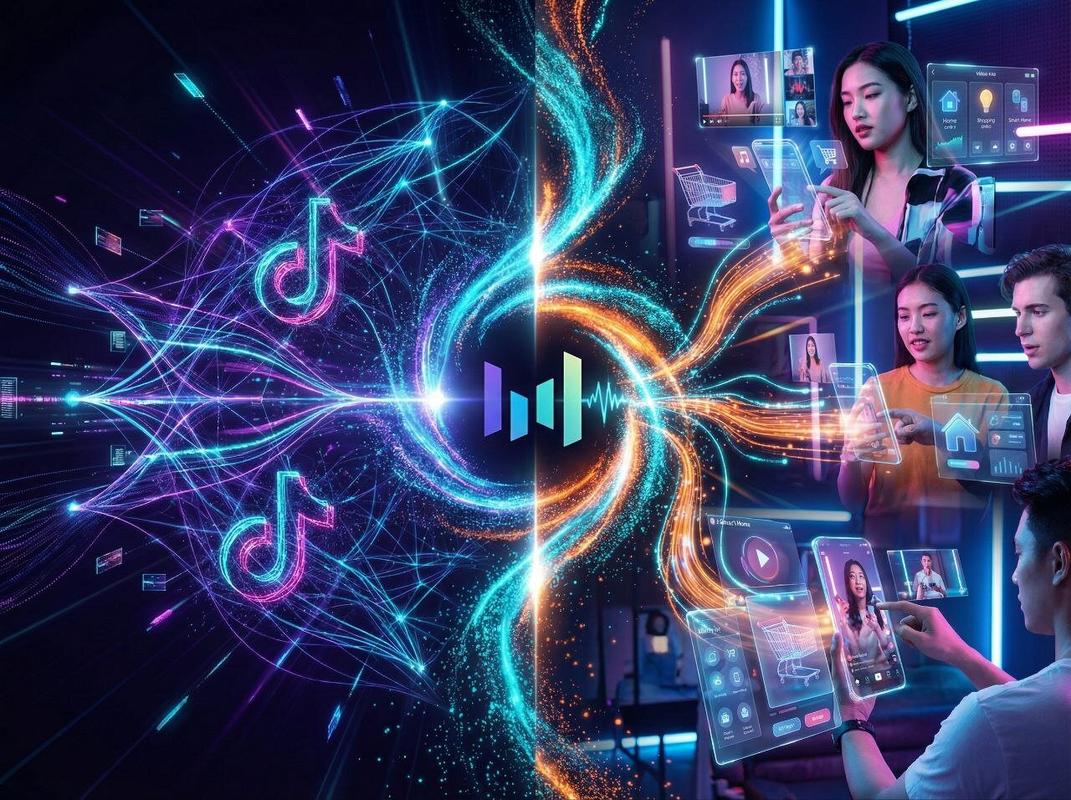
In the high-stakes chess match for AI supremacy, Silicon Valley is playing a different game than Beijing. While OpenAI and Anthropic chase billion-dollar enterprise contracts and regulatory approval in Washington, ByteDance — the Chinese parent company of TikTok and Douyin — is executing a strategy so ambitious it could render the entire 'AI chatbot' model obsolete before it fully matures.
ByteDance isn't building an AI assistant. It's building an AI layer — embedding artificial intelligence into every pixel of a billion-user ecosystem. And while American tech giants debate whether AI should be a standalone product or a feature, ByteDance has already decided: it's the air you breathe inside their apps.
The Super-App Strategy: Why China Plays a Different Game
To understand what ByteDance is building, you first need to understand the super-app phenomenon. In China, WeChat isn't just a messaging app — it's your bank, your ID, your shopping mall, your doctor's office, and your government services portal. You don't open five apps to live your digital life; you open one.
ByteDance looked at this model and asked a dangerous question: What if AI was woven into every single function of that ecosystem?
The answer is taking shape now. ByteDance is pursuing what company insiders call 'complete AI integration' — a strategy that looks less like ChatGPT and more like a neural network draped over an entire digital civilization. AI doesn't live in a chat window. It lives in your camera filters, your shopping recommendations, your content creation tools, your search results, and eventually — your smart home devices.
This isn't theoretical. ByteDance's Seedance 2.0 video generation tool — a direct Sora competitor — is already live for Douyin users in China. Millions of Chinese consumers are generating AI videos daily without ever typing 'prompt' into a chatbot interface. They're just... making content.
The Numbers That Should Worry Silicon Valley
Let's talk scale. ByteDance's portfolio includes:
- Douyin: 700+ million daily active users in China
- TikTok: 1 billion+ monthly active users globally
- CapCut: 500+ million users for video editing
- Lark: Enterprise collaboration platform gaining traction
- Various smart home and IoT initiatives in development
Now consider this: if even 10% of those users engage with ByteDance's AI features daily, that's 170 million people training and refining AI models through organic usage. No prompt engineering courses required. No 'learning curve.' Just billions of interactions generating data that feeds back into model improvement.
OpenAI would kill for that kind of training flywheel. ChatGPT's 100 million weekly active users is impressive — until you realize most of them are typing variations of 'write me an email' and 'explain quantum physics.' ByteDance's users are generating creative content, shopping, communicating, and living — all while unconsciously tuning the most sophisticated consumer AI system on the planet.
Seedance 2.0: The Trojan Horse
ByteDance's Seedance 2.0 is currently restricted to existing users of its domestic Chinese apps — a soft launch that serves multiple purposes. It tests infrastructure at scale without global regulatory scrutiny. It builds a content library and training dataset specific to ByteDance's ecosystem. And it creates a feature differentiation that competitors can't easily replicate.
But here's the strategic insight most analysts miss: Seedance isn't meant to be a standalone product. It's meant to be infrastructure. Every Douyin creator who generates an AI-enhanced video becomes a node in ByteDance's content network. The AI doesn't just serve users — it empowers them to create more content, which draws more viewers, which generates more data, which improves the AI.
The Economist recently called ByteDance 'the world's premier application factory.' That description undersells what's happening. Application factories produce tools. ByteDance is producing an AI-native content ecosystem — a self-reinforcing loop where the platform, the creators, and the AI evolve together.
Why This Matters: The Strategy Gap
American AI companies are building products. Chinese tech giants are building environments.
When OpenAI releases a new model, the conversation centers on benchmarks and capabilities. When ByteDance deploys AI, the conversation centers on behavior — how users interact, what they create, how long they stay engaged.
This reflects a fundamental philosophical divergence:
US AI Strategy: Build the most capable model, sell access to enterprises and consumers, scale through subscription revenue.
China AI Strategy: Embed AI into existing massive user bases, scale through engagement and data accumulation, monetize through advertising and commerce integration.
The US approach optimizes for capability. The China approach optimizes for integration.
Which wins? History suggests the integrated solution often beats the superior technology. Betamax had better quality than VHS. The Zune had better audio specs than the iPod. Technical superiority doesn't guarantee market dominance — especially when the 'inferior' solution is easier to access and use.
The Regulatory Shadow
Of course, ByteDance faces headwinds that OpenAI doesn't. TikTok's ongoing regulatory battles in the US create uncertainty about whether ByteDance's AI ecosystem can ever fully expand to Western markets. The 'China tech' stigma — partly earned, partly manufactured — limits partnership opportunities and creates political vulnerability.
But here's the uncomfortable truth: ByteDance doesn't need the US market to win.
China's domestic market has 1.4 billion people. Southeast Asia adds another 675 million. India — despite banning TikTok — represents a massive adjacent market where ByteDance's technology and playbook can be adapted. The global South is increasingly the center of digital growth, and ByteDance's super-app model is better suited to these markets than America's subscription-based AI products.
A farmer in Indonesia using Douyin-style AI tools to market crops doesn't need ChatGPT's reasoning capabilities. They need tools that work within the apps they already use, in languages they speak, at price points they can afford (ideally: free).
🔥 The Hot Take: Silicon Valley Is Building the Wrong Future
American AI discourse has become obsessed with intelligence — AGI timelines, reasoning benchmarks, alignment problems. These are important questions, but they're not the only questions. And they might not even be the most important ones for determining who wins the next phase of the AI race.
ByteDance is building the AI future that actually reaches people.
While OpenAI debates whether GPT-5 will achieve human-level reasoning, ByteDance has deployed AI video generation to hundreds of millions of users who are already creating content with it. While Anthropic worries about AI safety in hypothetical scenarios, ByteDance's AI is learning from billions of real-world interactions every day.
The kicker? Both approaches are valid. But only one is scaling at consumer velocity right now.
There's a scenario where OpenAI's careful, capability-first approach produces truly transformative AI — systems that solve scientific problems, automate complex work, and change civilization. But there's an equally plausible scenario where ByteDance's integration-first approach produces good enough AI everywhere — and 'everywhere' beats 'excellent but limited' in the market.
If AI becomes infrastructure rather than product — electricity rather than appliance — ByteDance's strategy starts to look prescient. You don't sell electricity; you embed it. You don't subscribe to it; you assume its presence. AI as utility rather than AI as software.
What to Watch
Several signals will indicate whether ByteDance's strategy is working:
Seedance International Rollout: When ByteDance opens Seedance to global TikTok users, watch the adoption curve. If it hits mainstream faster than Sora or other Western competitors, the 'integration advantage' theory gains evidence.
Enterprise Moves: ByteDance's Lark platform competing with Slack and Teams — with AI deeply embedded rather than bolted-on — will test whether the super-app model translates to business software.
Regulatory Outcomes: The TikTok ban saga isn't just about one app. It's about whether Chinese tech companies can compete in Western markets at all. The outcome shapes ByteDance's ceiling.
US Response: If American tech giants start copying the 'AI everywhere' playbook — integrating deeply into iOS, Android, Office, Chrome — it validates ByteDance's approach while potentially neutralizing its advantage. The race becomes who can integrate fastest into their existing user base.
The Bottom Line
ByteDance isn't winning the AI race by building better models. It's winning by making AI disappear into the background — so integrated that users don't think of it as AI at all. It's just... how the app works.
In a weird way, that's the most sophisticated AI strategy of all. The best technology is the technology you don't notice. ByteDance is betting that the same principle applies to artificial intelligence.
Whether that bet pays off depends on whether 'good enough AI everywhere' beats 'excellent AI somewhere' in the market. But with a billion users already in the ecosystem, ByteDance has a head start that OpenAI's $110 billion war chest can't easily buy.
The AI race isn't just about who builds the smartest system. It's about who gets AI into the most hands, the fastest, with the least friction. By that measure, ByteDance is winning — even if most people haven't noticed yet.