
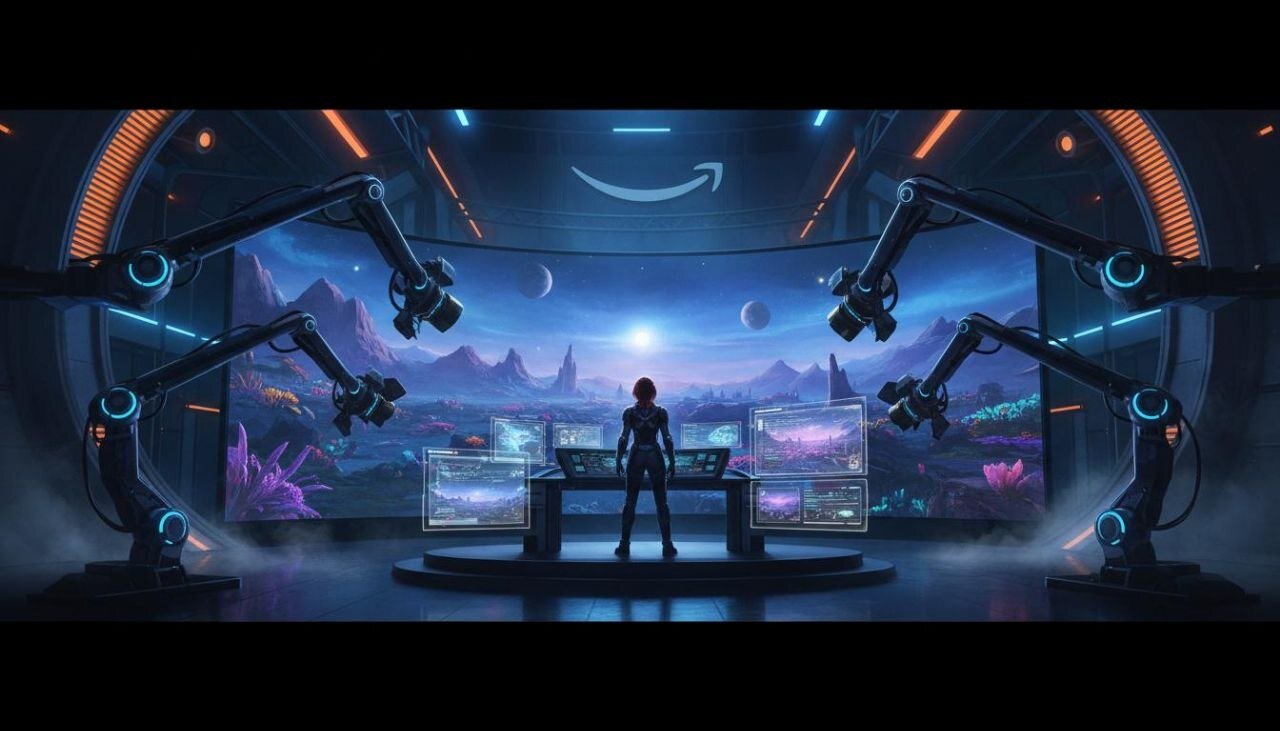
Amazon has quietly built an internal AI-powered production platform capable of generating original television and film content, and has already greenlit three projects for development, according to sources familiar with the initiative. The move represents the most aggressive attempt yet by a major technology company to use generative AI to disrupt traditional Hollywood production pipelines.
The platform, which combines proprietary video generation models with automated post-production tools, allows Amazon to produce broadcast-quality content at a fraction of the cost and time required by conventional studios. Early internal estimates suggest production cost reductions of 60-70% for certain categories of content, particularly animated series, science fiction backgrounds, and crowd scenes that previously required expensive physical sets or CGI rendering.
How the Platform Works
Amazon's system integrates multiple AI technologies into a single production pipeline. At the front end, text-to-video models generate raw footage from scripts and storyboards. Middle layers handle automated editing, color correction, and sound design. The back end uses AI-driven quality control to ensure output meets broadcast standards.
The platform is not fully autonomous. Human directors, writers, and editors remain involved in creative decisions. But the ratio of human labor to output has shifted dramatically. A traditional animated series might require 200-300 artists and technicians per episode. Amazon's AI-assisted pipeline reportedly operates with teams of 30-40 people handling creative direction while AI handles the bulk of frame generation, in-betweening, and rendering.
For live-action content, the platform uses a different approach. Actors perform on sound stages with minimal sets, while AI generates backgrounds, environments, and digital extras in real time. This "virtual production" technique was pioneered by Disney's The Mandalorian using LED volumes, but Amazon's system replaces the physical LED walls with AI-generated imagery that can be modified instantly without requiring stage rebuilds.
The Three Greenlit Projects
Amazon has approved three pilot projects for production using the AI platform. Details are limited, but the projects reportedly include:
An animated science fiction series set in a procedurally generated universe where each episode explores different AI-created worlds. The premise itself is meta — a show about AI-generated realities, produced using AI generation.
A historical drama using AI to recreate period-accurate settings and crowd scenes without the location shooting and extras that typically consume half a historical production's budget.
A hybrid live-action/animated comedy that uses AI to transform actors into stylized characters, allowing the show to shift visual styles between scenes without requiring multiple animation teams.
None of the projects have been publicly announced, and Amazon has not confirmed the initiative. The company is reportedly waiting to see production results before deciding whether to publicize the platform or continue operating it quietly.
Why This Threatens Hollywood
The traditional film and television industry operates on a cost structure that has remained largely unchanged for decades. Major productions require armies of technicians, expensive equipment, location shoots, and post-production houses that charge premium rates. A single episode of a prestige drama can cost $10-20 million. A blockbuster film can exceed $300 million.
AI production threatens to collapse these costs. If Amazon can produce content that audiences accept as equivalent in quality at 30-40% of the traditional cost, the economic foundation of the studio system begins to erode. Netflix, Disney, Warner Bros. Discovery, and Paramount would face pressure to either adopt similar technologies or accept lower margins.
The threat is not just to studios. Below-the-line workers — animators, visual effects artists, set builders, location scouts, extras — represent hundreds of thousands of jobs in the entertainment industry. AI production platforms that reduce crew sizes by 80% would have devastating employment effects, similar to what digital photography did to film processing labs or what streaming did to video rental stores.
The writers' and actors' strikes of 2023 included AI protections in their eventual contracts, but those agreements focused on generative text and digital likenesses. They did not fully address AI-generated video production, which was still considered theoretical at the time. Amazon's platform appears to be moving faster than labor agreements can adapt.
The Quality Question
The critical unknown is whether AI-generated content can match human-created content in viewer satisfaction. Early experiments have been mixed. Some AI-generated short films have won festival awards and impressed critics. Others have been criticized for "uncanny valley" effects, inconsistent character appearances, and narrative incoherence that becomes apparent over longer formats.
Amazon's approach appears to mitigate these issues by keeping humans in the creative loop rather than attempting full automation. Directors make creative decisions. Writers shape narratives. Editors curate AI output. The AI handles execution — generating frames, filling backgrounds, and handling technical production tasks — rather than replacing creative judgment.
This hybrid model may prove more acceptable to audiences than fully AI-generated content. It also provides legal and labor cover, allowing Amazon to argue that it is augmenting human creativity rather than replacing it. But the employment math is still brutal: if 40 people can do what previously required 300, the other 260 are out of work regardless of how the remaining 40 are described.
The Competitive Landscape
Amazon is not the only company pursuing AI-generated content. Netflix has reportedly experimented with AI tools for background generation and dubbing. Disney has filed patents for AI-driven animation techniques. Smaller studios are using off-the-shelf tools like Runway, Pika, and Stable Video Diffusion to produce short-form content.
But Amazon has advantages that competitors lack. The company operates Amazon Web Services, the world's largest cloud infrastructure provider, giving it privileged access to the compute resources required for training and running video generation models. It owns Amazon Studios, which has existing distribution channels and relationships with talent. And it has the capital to absorb the inevitable failures that will occur as the technology matures.
Most importantly, Amazon has a strategic reason to invest in content production that goes beyond entertainment. The company uses original content to drive Prime subscriptions, which in turn drive e-commerce purchases. If Amazon can produce acceptable content at half the cost, the value proposition of Prime improves, and the entire flywheel accelerates. This means Amazon can justify AI production investments that a pure-play studio could not afford.
Regulatory and Legal Risks
AI-generated content faces significant legal uncertainty. Copyright law does not clearly address works created by AI systems, particularly when those systems are trained on copyrighted material. The ongoing lawsuits against OpenAI, Stability AI, and Midjourney could establish precedents that affect AI video generation as well.
If courts rule that AI training on copyrighted works constitutes infringement, Amazon would need to license training data or develop training methods that avoid copyrighted material. Either approach would increase costs and reduce the competitive advantage of AI production.
There are also potential regulatory issues. The European Union's AI Act includes provisions for transparency in AI-generated content that may require labeling or disclosure. China's content regulations require government approval for AI-generated media. The US has no comprehensive AI content regulation yet, but the Federal Trade Commission has signaled interest in deceptive practices related to AI-generated media.
What Happens Next
Amazon is likely to continue operating its AI production platform quietly until it has demonstrated results. If the three greenlit projects deliver content that audiences watch and critics accept, the company may accelerate investment and begin producing content at scale. If the projects underperform, Amazon may retool the platform or pivot to using AI only for specific production tasks rather than end-to-end content creation.
The more significant impact may be on the broader industry. If Amazon proves that AI-assisted production works at scale, every major studio will face pressure to adopt similar technologies. The result could be a rapid transformation of the entertainment industry, with production costs collapsing, employment models shifting, and the boundary between human and AI-created content becoming increasingly difficult to determine.
Hollywood has survived previous technological disruptions — sound, color, television, home video, digital effects, streaming. Each disruption killed some business models and created others. AI production may be the most disruptive of all, because it attacks the fundamental cost structure of content creation itself. And Amazon, with its cloud infrastructure, distribution platform, and e-commerce incentives, may be the company best positioned to exploit it.