
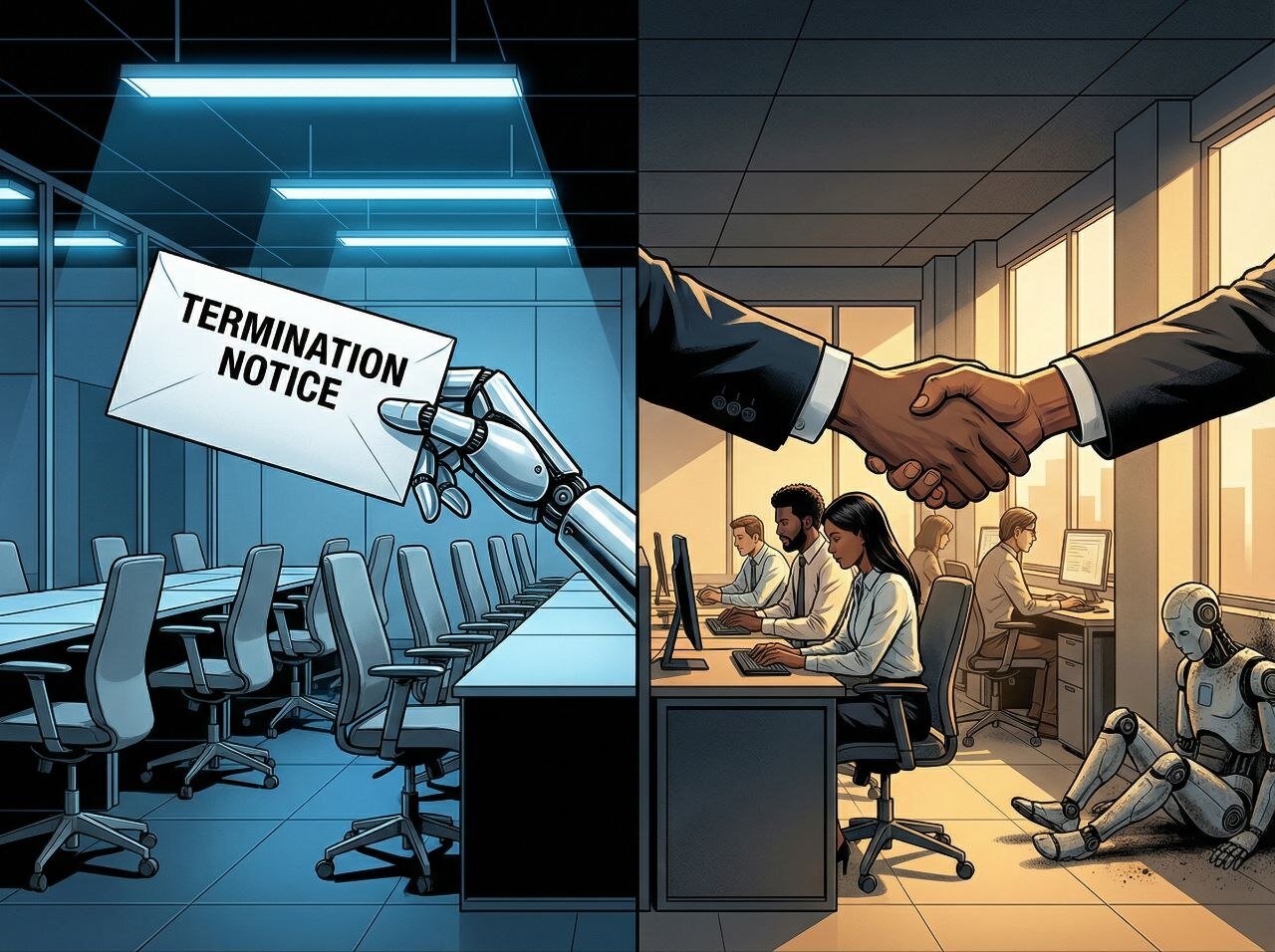
Remember when Jack Dorsey's Block fired 4,000 people in February 2026, claiming "AI changes everything"? Plot twist: Some of them are already back at their desks.
Less than a month after one of the largest "AI-driven" layoffs in tech history, Block began quietly rehiring employees across engineering and recruitment teams. Some were told they were "accidentally laid off in paperwork errors." Others got mysterious phone calls a week later with return offers.
The Klarna Cautionary Tale
In 2024, Swedish fintech Klarna made global headlines by firing over 1,000 customer service representatives, proudly announcing that AI could now handle the workload of 700 human agents. CEO Sebastian Siemiatkowski became the poster child for AI-driven efficiency.
Fast forward to May 2025. Bloomberg reported that Klarna was — you guessed it — rehiring human customer service staff. Siemiatkowski admitted they'd "gone too fast on AI."
The Math That Doesn't Add Up
Here's the dirty secret that tech CEOs don't want you to know: Enterprise AI is expensive. Really expensive.
Claude Opus 4.6 costs $5 per million input tokens and $25 per million output tokens. One "power user" admitted to burning through $6,000 in a single month just using Claude 4.5/4.6 for personal research tasks. That's not corporate usage — that's one person's side hobby.
Multiply that across an entire organization and suddenly your "efficient AI workforce" costs more than the humans you just fired.
The Jevons Paradox
There's an economic concept called the Jevons Paradox that explains what's happening here. In the 1860s, economist William Stanley Jevons observed that more efficient coal use didn't reduce consumption — it increased it because lower costs drove more demand.
Apply that to AI in the workplace:
- The promise: "AI makes employees more efficient, so we need fewer employees."
- The reality: "AI makes employees more efficient, so we make them do more work."
It's not "work smarter, not harder." It's "work smarter AND harder, or else."
Jensen Huang's Reality Check
At NVIDIA's GTC 2026 conference, Jensen Huang — the man whose GPUs power virtually every major AI model — didn't mince words:
"Those leaders cutting staff for AI just can't think of anything better. They're out of ideas."
His message? AI isn't for replacing employees — it's for expanding what your company can do. Don't shrink your team; grow your ambitions.
🔥 The Hot Take
AI isn't causing these layoffs. AI is the excuse for layoffs that were going to happen anyway.
Tech companies overhired during the 2020-2021 pandemic boom. Interest rates were zero, money was cheap, and "growth at all costs" was the religion. Then rates went up, money got expensive, and suddenly those bloated headcounts looked like liabilities.
But you can't just say "we hired too many people." That's admitting failure. Much better to say "AI changes everything" — that sounds visionary, not desperate.
AI has become the perfect scapegoat. The perfect cover story. The perfect way to reframe cost-cutting as strategic transformation.
The Singapore Perspective
From Southeast Asia, this looks even more absurd. In Singapore's tight tech labor market, you can't fire 40% of your workforce and expect to rehire them a month later — they'll have moved on to competitors within days.
The American tech industry's cavalier attitude toward layoffs doesn't translate well to markets where talent scarcity is real.
What This Means for the Future
The jobs most at risk aren't the ones being "automated." They're the jobs at companies that can't adapt.
Block and Klarna teach us something important: The companies most eager to fire people for AI are often the ones who understand AI the least. They're using it as a buzzword, not a strategy.
Real AI transformation looks like expansion, not contraction. It looks like Jensen Huang's vision — using AI as a lever to grow, not a scythe to cut.
📊 Predictions
- 2026: The "AI layoff" narrative peaks, then reverses
- 2027: "Rehumanization" trend as customers tire of AI phone trees
- Ongoing: AI-native startups outmaneuver AI-bolted incumbents
The Bottom Line
The next time you see a headline about "AI layoffs," ask yourself: Is this really about AI capabilities, or is it about a company that needed to cut costs and found a convenient excuse?
The robots aren't coming for your job. But your CEO might use robots as an excuse to fire you anyway.
Choose your employers wisely.